Every community organisation grapples with building meaningful online connections while staying true to its mission and values. For Marketing Directors in Sydney, the challenge goes beyond visibility to finding partners who prioritise ethical strategies and sustainability. With Sydney’s digital agencies praised for their blend of creative and technical expertise, choosing the right agency can determine whether your digital efforts fuel real community impact or just add more noise. This guide unpacks the core differences between agency types and the principles of sustainable, ethical digital growth.
Table of Contents
- Digital Agencies In Sydney: Core Concepts Clarified
- Types Of Digital Agencies And Service Distinctions
- Sustainable Web Design And Ethical Seo Practices
- Digital Strategies For Community-Based Organisations
- Risks, Pitfalls And Compliance In Digital Campaigns
Key Takeaways
| Point | Details |
|---|---|
| Understanding Digital Agencies | Digital agencies in Sydney offer integrated solutions combining strategy, design, and implementation, providing access to diverse expertise without full-time payroll overhead. |
| Focus on Meaningful Outcomes | Agencies should measure success by community impact metrics rather than vanity metrics, ensuring alignment with organisational missions. |
| Sustainable Growth Strategies | Prioritise sustainable digital growth by investing in foundational online elements and balancing short-term gains with long-term strategies. |
| Compliance and Ethical Risks | Understand and mitigate risks related to data privacy, content accuracy, and advertising compliance to maintain trust and avoid legal consequences. |
Digital agencies in Sydney: Core concepts clarified
Digital agencies in Sydney operate at the intersection of creative strategy, technical expertise, and business outcomes. Understanding what these agencies actually do, and how they differ from freelancers or in-house teams, helps community brands make informed decisions about whether outsourcing is right for your organisation. Sydney’s agency sector has developed a distinct character driven by its competitive market and collaborative culture.
At their core, digital agencies combine multiple service areas into integrated solutions. Rather than hiring separate specialists, a digital agency functions as a coordinated team handling everything from strategy and design through to implementation and ongoing optimisation. For community brands, this means having access to varied expertise without the overhead of full-time payroll. Agencies typically offer web design, search engine optimisation, content strategy, paid advertising management, social media campaigns, and analytics reporting. The specific mix varies by agency, with some specialising deeply in one area whilst others provide comprehensive services. What distinguishes agencies from freelancers is scale: agencies have established processes, account management structures, and quality control systems. Sydney web agencies like us will always blend creative and technical expertise to deliver bespoke solutions that keep pace with a competitive digital market.
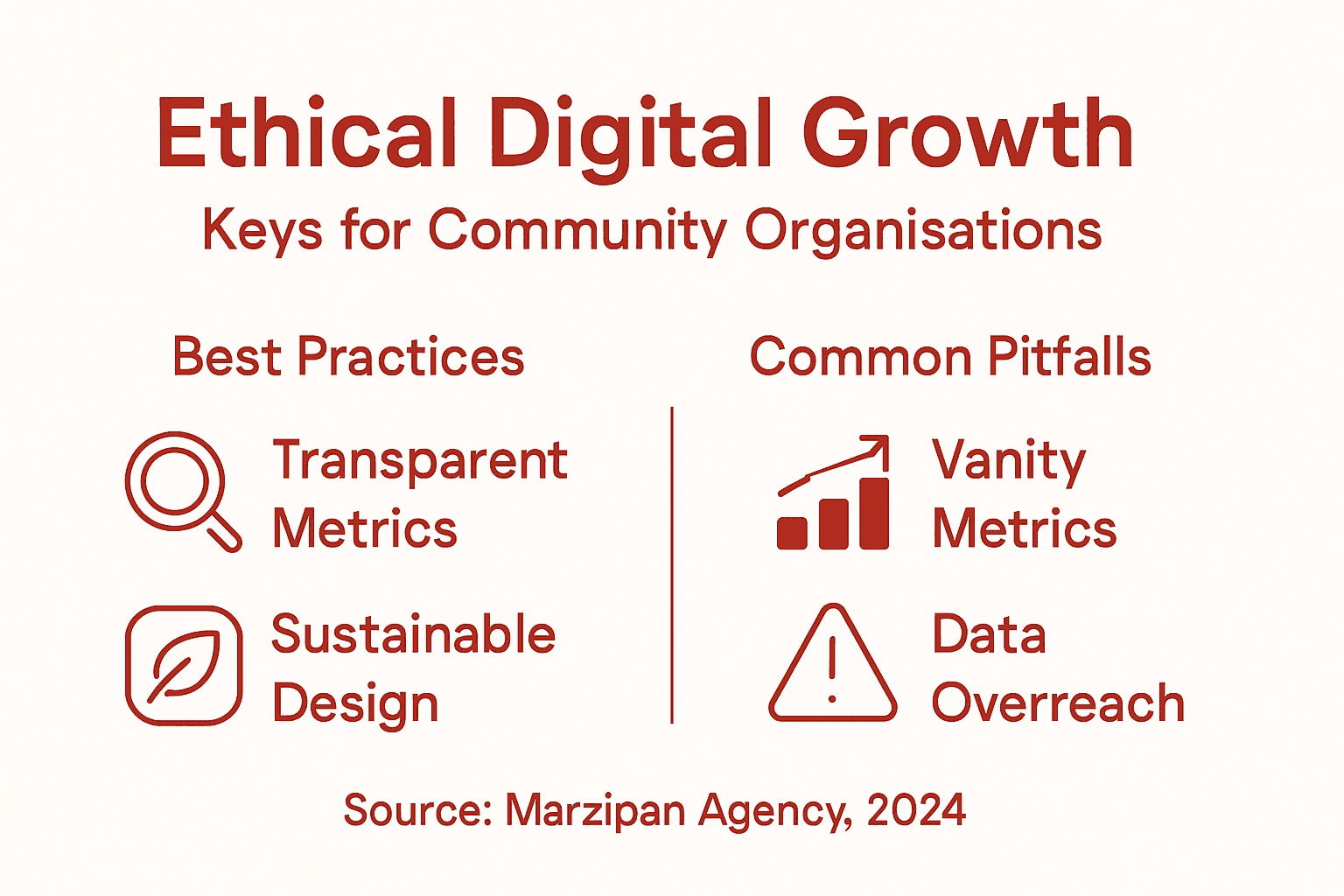
A critical concept for community organisations to understand is the difference between vanity metrics and meaningful outcomes. Many agencies still operate under old models focused on visitor numbers, social media likes, or impressions. Purpose-driven agencies take a different approach, measuring success by how effectively digital channels support your mission. This means tracking volunteer sign-ups, donation completeness rates, event registrations, or engagement metrics that directly reflect community impact. For example, a not-for-profit supporting homeless services needs to know whether their website drives actual calls to their helpline or increases participation in their programmes, not simply how many people scrolled past a post. Ethical digital agencies in Sydney understand this distinction and structure their work accordingly.
The concept of sustainable digital growth is increasingly important, particularly for mission-led brands operating with limited budgets. Sustainable growth means building an online presence that lasts and scales with your organisation’s needs rather than requiring constant spending to maintain results. This typically involves investing in foundational elements like your website architecture, search engine optimisation through organic methods, and audience building through valuable content. Short-term tactics like paid advertising have their place, but they should supplement rather than replace sustainable strategies. When evaluating agencies, ask how they balance quick wins with long-term sustainable approaches. The Digital Transformation Agency emphasises creating secure and connected digital experiences that build genuine trust. Community brands deserve the same philosophy.
Pro tip: When speaking with a potential agency, ask them to walk through one recent project and explain which metrics they tracked throughout and after launch; their answers will reveal whether they prioritise sustainable growth or short-term noise.
Types of digital agencies and service distinctions
Not all digital agencies operate the same way. Understanding the different types available helps community organisations identify which model aligns with your budget, timeline, and complexity of work. The agency landscape includes full-service operations, specialist firms, boutique agencies, and hybrid models. Each brings distinct advantages and limitations depending on what your organisation needs to accomplish.
Full-service agencies provide integrated solutions across the entire digital spectrum. These agencies handle web design, search engine optimisation, paid advertising, content creation, social media management, and analytics reporting all under one roof. For community brands, this approach offers convenience and coordination. When your website launch connects to a digital marketing campaign, a content strategy, and ongoing optimisation, the teams can align these elements efficiently. However, full-service agencies often come with higher costs because you’re paying for their breadth of capability. They may also have less deep specialisation in specific areas compared to boutique firms. Specialist agencies, by contrast, focus intensely on one domain. An agency might concentrate exclusively on search engine optimisation, paid advertising, or eCommerce development. For community organisations with a specific challenge—such as improving website search visibility or rebuilding your online presence from scratch—a specialist agency like ours can deliver deeper expertise and often more cost-effective solutions within that narrow focus.

Beyond structure, agencies differentiate themselves through their approach and values. Purpose-driven agencies explicitly align with clients who prioritise social impact, sustainability, or community benefit. These agencies measure success differently than traditional firms. Rather than optimising purely for revenue or traffic, they track volunteer engagement, donation rates, community reach, or mission alignment. This distinction matters significantly for not-for-profits and community organisations because it means the agency understands your constraints and motivations. Data-driven agencies emphasise analytics and measurement across all work. They operate through constant testing, refinement, and evidence-based decision making. Creative-focused agencies lead with storytelling and brand identity development, believing compelling narratives drive outcomes. Government-focused agencies specialise in navigating public sector procurement, compliance requirements, and stakeholder management. Each of these approaches produces different results. A creative agency might produce stunning brand identity work but struggle with technical SEO. A data-driven agency might optimise your conversion funnel brilliantly but produce generic marketing copy. The key is matching the agency’s strengths to your actual needs.
Service distinctions also reflect how agencies price and partner with clients. Some agencies work on project basis, charging a fixed fee for specific deliverables like a website redesign. Others operate on retainer models, where you pay monthly for ongoing services like content creation or campaign management. Performance-based agencies tie their fees to outcomes, though this model suits some projects better than others. Community brands should understand these models because they directly impact cash flow and long-term commitment. Project-based work suits one-off initiatives with clear endpoints. Retainers make sense for ongoing optimisation where cumulative effort drives results. When evaluating any agency type, ask directly about how they define success, what happens after the initial project concludes, and whether their values genuinely align with yours. Understanding web development approaches helps clarify what capability different agencies bring to implementation.
Here’s a comparison of digital agency types and their distinct benefits for community organisations:
| Agency Type | Core Benefit | Common Limitation | Ideal For |
|---|---|---|---|
| Full-service | Seamless, all-in-one support | Higher cost, less deep focus | Brands needing broad expertise |
| Specialist | Intensive domain expertise | Limited scope, narrow solutions | Organisations with specific needs |
| Boutique | Personalised, tailored work | Small teams, capacity constraints | Smaller campaigns or projects |
| Hybrid | Flexible, mix of approaches | Varies greatly by structure | Groups seeking custom solutions |
Pro tip: Request case studies specifically from organisations similar to yours (nonprofits, community groups, or social enterprises) rather than accepting examples from commercial clients, as success metrics and challenges differ significantly between sectors.
Sustainable web design and ethical SEO practices
Sustainable web design and ethical SEO represent a fundamental shift in how digital agencies approach their work. Rather than optimising purely for conversions or search rankings, these practices consider the broader impact of digital solutions on people, the environment, and communities. For purpose-driven brands in Sydney, this alignment matters deeply because your online presence should reflect your values, not contradict them.
Sustainable web design starts with recognising that websites consume energy. Every page load, every server request, and every data transfer has a carbon footprint. Energy-intensive design patterns like auto-playing videos, unnecessary animations, and bloated code files all contribute to environmental cost. Sustainable design approaches this differently by prioritising lightweight code, optimised images, and efficient server infrastructure. Eco-design principles emphasise regenerative design, lifecycle thinking, and circular economies as core values. This means designing websites that load quickly, use minimal resources, and remain accessible on slower connections or older devices. Community organisations with limited technology budgets particularly benefit from this approach because sustainable websites tend to cost less to run and host. A well-designed sustainable website performs better across all metrics: faster load times, better user experience, lower hosting costs, and improved search engine rankings. These outcomes align naturally with your mission rather than requiring compromises.
Ethical SEO differs sharply from practices that prioritise rankings above all else. Unethical SEO tactics include keyword stuffing, creating low-value content purely for search engines, buying backlinks, or cloaking content to show different versions to search engines and users. These tactics may produce short-term ranking gains but ultimately damage trust and often violate search engine guidelines, resulting in penalties. Ethical SEO focuses on creating genuinely valuable content that serves your audience first and happens to rank well as a side effect. For a community health organisation, this means writing content that actually helps people understand health issues, find services, or make informed decisions. When search engines recognise that your content genuinely serves user intent, rankings follow naturally. Web Sustainability Guidelines from W3C recommend cross-functional collaboration and systems thinking that minimises environmental footprints whilst enhancing accessibility and usability. This means your SEO strategy should improve not just search visibility but also how accessible your content is to people with disabilities, how quickly it loads for users on mobile networks, and how much server energy it consumes.
The connection between sustainable design and ethical SEO runs deeper than these individual practices. Both share a common philosophy: long-term thinking over short-term gains. Sustainable websites built with quality architecture and ethical SEO built on genuine value creation both compound over time. Your website becomes an asset that grows in value rather than requiring constant spending to maintain rankings through tactics that may become outdated or penalised. When you work with a digital agency, ask whether they measure success purely through traffic and rankings or whether they also consider accessibility improvements, environmental impact, user satisfaction, and cost-effectiveness. Ask whether they use techniques that serve your audience or manipulate search algorithms. Ask what happens to your website six months or two years after launch. Agencies genuinely committed to sustainable and ethical practices will show you infrastructure that supports these values, team members trained in accessibility and performance optimisation, and contracts that include ongoing maintenance and improvement rather than abandonment after launch. Community brands deserve agencies that view your digital presence as a long-term investment in your mission rather than a transaction to complete and move on from.
Pro tip: When auditing an agency’s claimed commitment to sustainability, ask them to show you a website they built two years ago and demonstrate its current performance metrics, accessibility score, and load time; if they cannot easily access these details, their commitment to sustainable practices is likely superficial.
Digital strategies for community-based organisations
Community-based organisations face distinct digital challenges that differ significantly from commercial enterprises. Your organisation likely operates with lean budgets, volunteer workforces, limited technical expertise, and mission-driven goals rather than profit maximisation. Digital strategies designed for commercial companies often fail in this context because they assume resources, staff capacity, and priorities that most community organisations simply do not possess. Effective web design for charities and NFPs in Sydney must account for these constraints whilst still delivering measurable impact toward your mission.
The foundation of any community digital strategy is clarity about your actual purpose and who you serve. Before investing in any digital tool or campaign, define what digital channels should accomplish for your organisation. Are you trying to increase volunteer recruitment, raise awareness about a particular issue, facilitate service access, build community engagement, or generate funding? These objectives require fundamentally different digital approaches. A homelessness support organisation needs digital strategies that help vulnerable people find shelter and services quickly, which means prioritising website usability, mobile accessibility, and clear navigation over aesthetic design. A youth mentoring programme might prioritise social media engagement and storytelling to recruit mentors and build community support. Effective digital engagement strategies require building digital skills within organisations and fostering collaborative learning with community groups. Start by asking your volunteers, staff, and community members which digital channels they actually use and trust. This insight often reveals that your target audience may not be active on the social media platforms you assumed they use, or they may prefer email communication to website browsing. Designing digital strategies around actual user behaviour rather than assumptions prevents wasted effort.
Operational sustainability must shape your digital strategy choices. If your organisation cannot dedicate staff time to maintaining social media accounts or updating website content regularly, creating accounts on multiple platforms will backfire. Dormant or outdated digital channels damage credibility more than having no presence at all. Instead, focus intensely on one or two channels where you can genuinely sustain consistent activity. A single well-maintained email list with monthly updates often generates more impact than scattered presence across five platforms updated sporadically. Similarly, select digital tools that integrate with your existing systems and workflows rather than creating isolated new tasks. If your organisation manages volunteers through a particular software platform, digital recruitment strategies should channel interested volunteers into that existing system rather than creating parallel signup processes. The Australian Government’s approach to digital inclusion and accessible services emphasises tailored strategies that work for diverse groups with varying digital literacy levels. Apply this principle to your community: design digital strategies that work for people with limited technology access, older adults, or those with disabilities, because these considerations benefit everyone.
Measurement in community digital strategies should focus on outcomes aligned with your mission rather than vanity metrics. Track concrete results like volunteer applications received through your website, people accessing services via online booking, donations processed online, or event registrations completed digitally. If your goal is raising awareness about mental health support, measure whether people who encounter your digital content actually contact your helpline or attend support groups, not simply whether your post received likes. This outcome focus ensures your digital strategy remains tethered to actual community benefit. Many community organisations find that a modest but well-executed digital presence substantially outperforms a sprawling but poorly maintained one. You do not need to be everywhere; you need to be genuine, consistent, and effective where you choose to operate. Build your strategy incrementally. Start with one strong digital channel supporting your primary organisational goal, establish processes to keep it current, and only expand to additional channels once the foundation is solid and sustainable. This approach prevents digital overwhelm whilst building momentum toward genuine online impact.
Pro tip: Before selecting any new digital tool or platform, spend one week asking your volunteers, staff, and community members which channels they actually use; base your strategy on this data rather than industry trends, because the best platform is the one your specific audience already occupies.
Risks, pitfalls and compliance in digital campaigns
Digital campaigns carry real risks that community organisations must understand before launching. Unlike traditional communication, digital channels operate within complex legal frameworks, platform regulations, and public expectations about data use and transparency. A campaign that succeeds in generating engagement but violates privacy standards or misleads audiences can damage your organisation’s reputation more severely than no campaign at all. For purpose-driven brands, compliance and ethical practice are not bureaucratic inconveniences but essential protections of the trust your community places in you.
Data privacy represents the most significant compliance concern in digital campaigns. When you collect email addresses through signup forms, track website visitor behaviour, or use audience targeting tools, you are handling personal information. Australian privacy law requires explicit consent before collecting personal data, clear statements about how data will be used, and reasonable security measures to protect it. Many community organisations underestimate how strictly these rules apply. A volunteer management email list, a website analytics account, or a social media audience list all constitute personal data that requires proper handling. Missteps lead to genuine consequences. Data breaches expose vulnerable people in your community to identity theft or other harms. Privacy violations can result in regulatory complaints and fines. More immediately, they destroy trust. Community members will stop engaging with your organisation if they believe their information is mishandled. The Australian Government’s approach emphasises that digital regulations address misinformation and user welfare concerns, requiring organisations to implement reasonable safeguards. Before launching any digital campaign, audit what personal information you collect, confirm you have consent to collect it, document how you store and protect it, and establish clear policies about data retention and deletion.
Content accuracy and truthfulness create another critical risk area. Digital platforms amplify misinformation rapidly, and your organisation bears responsibility for what you publish. This does not mean achieving perfect accuracy in every post. It means being transparent about uncertainty, correcting errors promptly when discovered, and avoiding deliberately misleading claims. A mental health organisation citing unverified statistics about depression prevalence damages credibility if those figures prove incorrect. A fundraising campaign overstating impact or misrepresenting how donations will be used violates donor trust and potentially legal fundraising regulations. Community organisations often lack in-house legal expertise, but this gap is addressable through diligence. Verify facts before publishing. Use reputable sources. Distinguish between opinion and fact. Disclose conflicts of interest. If an agency suggests content that feels misleading, push back. Advertising and information campaigns must comply with principles ensuring transparency, accountability, and adherence to regulations that safeguard public trust. Platforms also impose their own content policies that can change without notice. Facebook, Google, and other services regularly update rules about what content they will or will not amplify. Understanding these platform policies prevents costly surprises. An agency should monitor platform policy changes and advise you about implications for your campaigns.
Another frequent pitfall involves targeting and advertising transparency. Paid advertising campaigns targeting specific demographics or interests can quickly become discriminatory if not carefully managed. Advertising for housing, employment, or services to audiences defined by race, religion, or other protected characteristics violates anti-discrimination law. Even unintentional discrimination through proxy targeting carries legal risk. If you advertise volunteer opportunities only to people matching certain geographic or interest profiles, you may inadvertently exclude eligible candidates. Transparency about campaign funding also matters. If your organisation receives grants restricted to certain uses, you cannot use that funding for unrelated campaigns without violating grant conditions. Digital campaigns create detailed audit trails, so misuse becomes discoverable. Choose an agency that understands compliance requirements in your sector and demonstrates this understanding through documented processes. Ask them about how they ensure campaigns comply with anti-discrimination law, what happens if platform policies change during your campaign, and how they document compliance decisions for your records. The relationship between you and your agency should include shared accountability for legal and ethical outcomes, not just creative success.
For clarity, here is a summary of core ethical digital risks faced in community campaigns:
| Risk Type | Description | Impact on Organisation |
|---|---|---|
| Data Privacy | Mishandling personal information | Loss of trust, legal consequences |
| Content Accuracy | Publishing errors or misleading claims | Damaged credibility and donor confidence |
| Targeting Bias | Discriminatory advertising or outreach | Legal risk, exclusion of communities |
| Compliance Gaps | Failure to meet regulatory requirements | Financial penalties, campaign shut-down |
Pro tip: Before launching any campaign, document what personal data you collect, who in your organisation can access it, how long you retain it, and how you delete it; review this policy with your board or governance group, because data mishandling becomes an organisational liability, not just an agency problem.
Achieve Ethical Digital Growth with Marzipan
Community organisations often struggle to build a sustainable online presence that truly reflects their values without succumbing to short-term noise or compromising their principles. The article highlights challenges such as balancing sustainable web design, ethical SEO practices, and meaningful outcome measurement instead of merely chasing vanity metrics. You want digital solutions that respect your mission, carefully handle data privacy, and foster genuine engagement with your community.
At Marzipan, we specialise in crafting websites and digital campaigns that go beyond appearances to create lasting impact. Through our tailored approach combining ethical AI, sustainable design, and performance-driven SEO, we help purpose-driven brands in Sydney grow online without costing the earth. Discover how thoughtful strategy and transparent measurement can transform your digital presence into a true asset.
Ready to move from overwhelm to clarity with your digital strategy? Explore how our web design for community-based organisations offers exceptional results aligned with your mission.

Take the next step today by visiting Marzipan to start building an online presence that scales your impact ethically. Learn more about how our ethical SEO practices and sustainable approach can support your community goals. Don’t settle for short-term noise—partner with us for digital growth that lasts.
Frequently Asked Questions
What services do digital agencies in Sydney typically offer?
Digital agencies in Sydney generally provide a range of services including web design, search engine optimisation (SEO), content strategy, paid advertising management, social media campaigns, and analytics reporting, often customising their offerings based on client needs.
How can community brands ensure they choose an ethical digital agency?
Community brands can ensure they choose an ethical digital agency by asking about the metrics used to measure success, how these align with their mission, and whether the agency prioritises sustainable growth and community-focused outcomes over vanity metrics.
What is the difference between full-service agencies and specialist agencies?
Full-service agencies provide a comprehensive solution across various digital services, suitable for brands needing broader expertise, while specialist agencies focus intensively on a specific area like SEO or paid advertising, offering deeper expertise but a narrower scope of services.
How do sustainable web design practices benefit community organisations?
Sustainable web design practices benefit community organisations by prioritising lightweight code and efficient server infrastructure, leading to faster load times, lower hosting costs, and improved user experience, all of which align with the long-term goals of mission-driven brands.
Contact us today and see how we can elp you shine online.