Balancing purpose with discoverability can feel challenging for community leaders determined to uphold their organisation’s values online. Creating an ethical, SEO-friendly website is about more than digital presence; it is a powerful tool for amplifying your mission and reaching those who need your message most. With a focus on clear values, responsible technology choices, and audience-centred communication, you can build a foundation that attracts support while staying true to your principles.
Table of Contents
- Step 1: Define Core Values And Audience Focus
- Step 2: Select An Ethical Platform And Eco Hosting
- Step 3: Structure Site For Accessibility And Clarity
- Step 4: Optimise Content For Search And Impact
- Step 5: Verify SEO Performance And Refine Approach
Quick Summary
| Key Insight | Explanation |
|---|---|
| 1. Define core values and audience | Understanding organisational values and target demographics creates a strong foundation for your online presence. |
| 2. Choose ethical hosting solutions | Select hosting providers that prioritise sustainability, reflecting your brand’s commitment to responsible digital citizenship. |
| 3. Prioritise web accessibility | Ensure your website is navigable for all users, fostering inclusivity and expanding your audience reach. |
| 4. Optimise content for SEO | Develop genuine, keyword-rich content that aligns with your mission, enhancing visibility to potential supporters. |
| 5. Monitor and refine SEO performance | Continuously analyse website metrics to improve relevance and effectiveness, adapting your strategy as needed. |
Step 1: Define core values and audience focus
Creating an SEO-friendly website for mission-driven brands begins with understanding your organisation’s foundational principles and the specific audience you aim to serve. This crucial first step involves deeply examining what drives your work and who most needs your message.
To define your core values, gather your team and conduct a collaborative exploration of your organisation’s fundamental beliefs. The Queensland business values framework recommends a systematic approach to this process. Your core values should reflect:
- Authentic principles that genuinely represent your organisation’s purpose
- Beliefs that guide decision-making and organisational culture
- Consistent standards that distinguish your brand’s unique approach
Simultaneously, understanding your target audience requires comprehensive research into their demographics, behaviours, and online engagement patterns. Screen Australia’s audience pathway guide highlights the importance of mapping your audience’s:
- Demographic characteristics
- Online community preferences
- Content consumption trends
- Motivational drivers
By aligning your organisation’s core values with a nuanced understanding of your target audience, you create a powerful foundation for an authentic and impactful online presence.

Expert Suggestion: Conduct periodic reviews of your values and audience insights to ensure continued relevance and alignment with evolving organisational goals and community needs.
Step 2: Select an ethical platform and eco hosting
Selecting an ethical digital platform and environmentally responsible hosting solution is crucial for mission-driven brands committed to sustainable online practices. Your website’s technological foundation should reflect your organisation’s values and commitment to minimising digital environmental impact.
Begin by evaluating potential hosting providers using comprehensive ethical assessment criteria. Look for platforms that demonstrate genuine commitment to sustainability through:
- Transparent carbon offset programmes
- Renewable energy powered data centres
- Energy-efficient server infrastructure
- Commitment to reducing electronic waste
The Australian Government’s Hosting Certification Framework provides an excellent resource for identifying service providers that meet rigorous standards of environmental responsibility and data sovereignty. Consider these key factors when making your selection:
- Verify the provider’s environmental certifications
- Assess their energy consumption metrics
- Review their data privacy and security protocols
- Evaluate their commitment to local sustainability initiatives
Choosing an ethical hosting platform is more than a technical decision – it’s a statement of your brand’s values and commitment to responsible digital citizenship.
Expert Suggestion: Request detailed sustainability reports from potential hosting providers and compare their environmental performance metrics before making a final decision.
Compare traditional hosting and ethical hosting for mission-driven websites:
| Aspect | Traditional Hosting | Ethical Hosting |
|---|---|---|
| Environmental footprint | Often high | Actively minimised |
| Energy sources | Mixed or non-renewable | Prefer renewable energy |
| Transparency | Limited reporting | Detailed sustainability reports |
| Community impact | Indirect or overlooked | Supports local initiatives |
Step 3: Structure site for accessibility and clarity
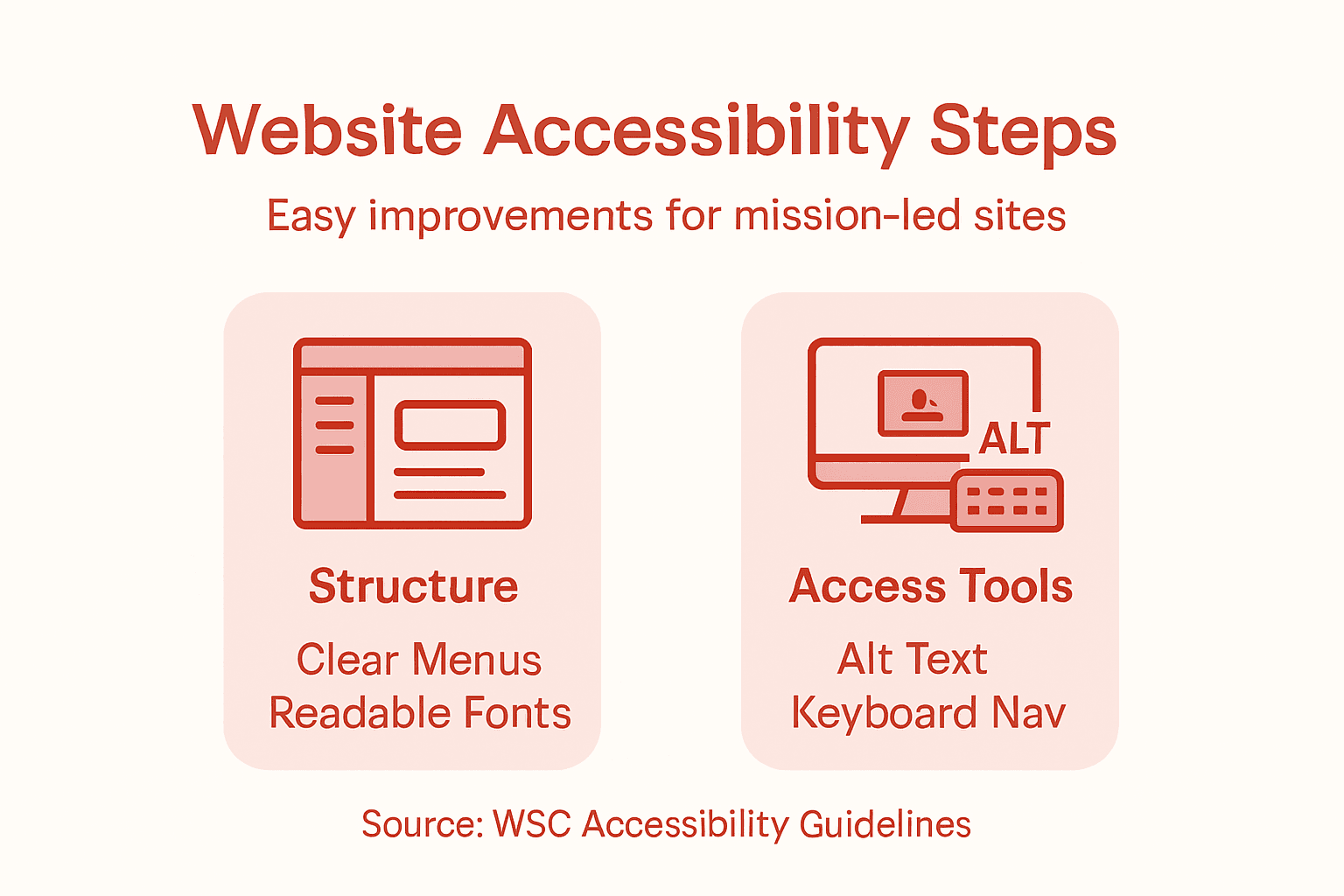
Building a website that welcomes and supports all users requires thoughtful design and a commitment to inclusivity. Your mission-driven brand’s online presence should be easily navigable and comprehensible for every visitor, regardless of their abilities or technological background.
Start by implementing comprehensive web accessibility guidelines, which provide a robust framework for creating an inclusive digital experience. Focus on developing a site structure that prioritises user experience through:
- Clear and logical navigation menus
- Consistent page layouts
- Descriptive headings and link texts
- High colour contrast for readability
- Alternative text for images
The Centre for Accessibility Australia’s standards recommend several critical considerations for ensuring your website remains accessible and user-friendly:
- Ensure keyboard navigability for all site functions
- Use semantic HTML to support assistive technologies
- Provide captions and transcripts for multimedia content
- Design responsive layouts that work across different devices
Accessibility is not an afterthought – it’s a fundamental requirement for creating an inclusive digital experience that respects and empowers all users.
Expert Suggestion: Regularly test your website using automated accessibility checking tools and conduct user testing with individuals who use assistive technologies.
Step 4: Optimise content for search and impact
Creating content that resonates with both search engines and your mission-driven audience requires a strategic approach balancing authenticity and discoverability. Your website’s content should communicate your organisation’s purpose while ensuring potential supporters can easily find you online.
Start by understanding strategic search engine optimization techniques that align with your brand’s ethical standards. Focus on developing content that naturally incorporates relevant keywords while maintaining genuine, meaningful communication:
- Research audience search behaviours
- Use keywords contextually and naturally
- Create compelling, purpose-driven content
- Address specific audience questions and needs
- Update content regularly to maintain relevance
The APS Professions’ on-page SEO guidelines recommend several critical strategies for mission-driven organisations:
- Conduct thorough keyword research specific to your sector
- Craft descriptive, meaningful page titles
- Develop clear, semantic heading structures
- Write user-focused metadata descriptions
Effective SEO is not about gaming the system, but about creating genuine, valuable content that serves your audience’s needs.
Expert Suggestion: Periodically analyse your website’s performance using analytics tools to understand how your content resonates with both search engines and your target audience.
Step 5: Verify SEO performance and refine approach
Monitoring and improving your website’s search performance is an ongoing process that requires consistent attention and strategic analysis. Your mission-driven brand needs a systematic approach to understanding how your digital content connects with your target audience.
Begin by implementing comprehensive SEO performance tracking that provides meaningful insights into your website’s discoverability and user engagement. Key metrics to focus on include:
- Organic search traffic volumes
- Keyword ranking positions
- User engagement rates
- Click-through percentages
- Conversion performance
The NSW Government’s OneCX SEO monitoring guidelines recommend a collaborative approach to refining your digital strategy:
- Review analytics data monthly
- Identify underperforming content segments
- Update metadata and keyword targeting
- Conduct technical website audits
- Adjust content strategy based on insights
Effective SEO is a continuous journey of learning, adapting, and improving your digital presence to serve your mission more effectively.
Expert Suggestion: Develop a quarterly review process that systematically evaluates your website’s SEO performance and aligns your digital strategy with your organisation’s evolving goals.
Here’s a summary of how each website step supports mission-driven brands:
| Step | Purpose | Impact on Brand | Key Consideration |
|---|---|---|---|
| Define values & audience | Aligns mission with users | Builds trust and clarity | Conduct regular reviews |
| Ethical platform & eco hosting | Shows commitment to sustainability | Strengthens responsible reputation | Assess provider credentials |
| Structure for accessibility | Enhances user inclusion | Expands audience reach | Maintain accessible design |
| Content SEO & impact | Improves search visibility | Attracts engaged supporters | Use ethical optimisation |
| SEO performance & refinement | Guides ongoing growth | Ensures relevance and effectiveness | Monitor and adapt strategy |
Boost Your Mission-Driven Brand With Ethical SEO and Sustainable Web Design
Building an SEO friendly website for mission-driven brands can feel overwhelming when you want to balance authentic values with digital performance. You understand the importance of defining core values and audience focus, choosing ethical platforms, and creating accessible content that truly connects. Yet achieving sustainable SEO that lasts and reflects your organisation’s purpose remains a challenge.
At Marzipan we specialise in helping community-based organisations grow online without compromising their ethics. By combining sustainable web design with performance-driven SEO strategies and ethical AI, we help you create websites that perform well now and into the future. Whether you want clear navigation, impactful content or eco hosting solutions our expertise aligns perfectly with the steps outlined in How to Make SEO Friendly Website for Mission-Driven Brands.
Take the next step towards a website that captures your values and drives real impact. Explore how our web design for community-based organisations and ethical SEO solutions can elevate your brand sustainably. Visit Marzipan today and start growing online with purpose.
Frequently Asked Questions
How can I define the core values for my mission-driven brand?
Defining your core values involves gathering your team to collaboratively explore your organisation’s foundational beliefs. Start by identifying the principles that genuinely represent your purpose and will guide your decision-making.
What steps should I take to ensure my website is ethically hosted?
To ensure ethical hosting, evaluate potential providers based on their commitment to sustainability, such as using renewable energy and having transparent carbon offset programmes. Look for hosting options that actively minimise their environmental footprint.
How can I make my website more accessible for all users?
To enhance accessibility, implement comprehensive web accessibility guidelines that focus on clear navigation, descriptive headings, and alternative text for images. Regularly test your website using accessibility checking tools to ensure it meets diverse user needs.
What key strategies should I use to optimise my content for search engines?
Optimising content for search engines requires researching relevant keywords and naturally incorporating them into your writing. Focus on creating meaningful content that answers specific questions from your audience, updating it regularly to maintain relevance.
How do I monitor and refine my SEO performance effectively?
Monitoring and refining your SEO performance involves tracking key metrics, such as organic search traffic and user engagement rates. Review your analytics data monthly and adjust your content strategy based on insights to improve your search visibility.