

Building trust online can feel overwhelming for Sydney social entrepreneurs who want more than a standard website. When your organisation’s values shape every aspect of your business, clarity becomes the foundation for decisions, client relationships, and sustainable growth. This guide highlights how to define a values-driven business model, lay solid legal groundwork, and create ethical offerings that help your website stand out to partners and clients who share your mission.
Table of Contents
- Step 1: Define Your Values-Driven Business Model
- Step 2: Register Your Business And Set Legal Foundations
- Step 3: Build Ethical Service Packages For Clients
- Step 4: Establish Sustainable Workflows And SEO Practices
- Step 5: Validate Client Websites For Performance And Impact
Quick Summary
| Key Point | Explanation |
|---|---|
| 1. Define Core Values Clearly | Articulate what drives your business to attract aligned clients and guide your operational decisions. |
| 2. Register Business Legally | Establish your business in Australia legally to build credibility and avoid compliance issues. |
| 3. Create Ethical Service Packages | Design service offerings that transparently address clients’ genuine needs without upselling. |
| 4. Develop Sustainable Workflows | Implement standardised processes to enhance productivity and maintain high service quality. |
| 5. Validate Websites Post-Launch | Measure website performance and impact to ensure alignment with clients’ goals and mission. |
Step 1: Define your values-driven business model
Your business model flows directly from your values. Before you design websites for others, you need to articulate what drives your own organisation—what problems you solve, who you serve, and why it matters to you.
Start by reflecting on the core principles that guide your decisions. These aren’t slogans; they’re the beliefs that shape how you work, who you partner with, and what you refuse to compromise on. Business values guide decisions by creating consistency across your organisation, helping you attract the right clients and build a team aligned with your mission.
Consider these questions as you develop clarity:
- What problem does your website building business solve that matters to you personally?
- Who are you genuinely equipped to serve—and who will you deliberately not serve?
- What practices would you never adopt, even if they were profitable?
- How does your approach differ from generic web agencies?
- What do clients need to know about your philosophy upfront?
Your answers become your positioning. A values-driven website building business might refuse to over-engineer solutions, prioritise accessibility over visual trends, or commit to sustainable hosting practices. These aren’t marketing angles—they’re operating principles.
Your values aren’t what you claim to believe; they’re what guides your actual decisions under pressure.
Document your core values in plain language. Avoid corporate jargon. Write as though you’re explaining to a potential client why they should trust you. This clarity becomes your filter for every decision ahead—pricing, partnerships, project selection, and how you market your services.
When you’re clear on your values, clients who share them find you. Clients who don’t align naturally self-select elsewhere. This reduces friction and creates sustainable growth, not just busy work.
Pro tip: Write your values as commitments, not aspirations. Instead of “we value innovation,” try “we commit to testing new accessibility standards with every project” or “we refuse to recommend technology our clients cannot maintain themselves.”
Step 2: Register your business and set legal foundations
Legal registration isn’t glamorous, but it’s the skeleton holding everything together. You need to establish your business as a legitimate entity in Australia before you can operate, invoice clients, or build credibility.
Start by choosing your business structure. You can operate as a sole trader, partnership, or company. Most website building businesses start as sole traders for simplicity, but as you grow, a company structure offers liability protection and tax advantages. Register a company with ASIC if you want formal incorporation, or operate as a sole trader if you prefer fewer compliance requirements initially.

Next, obtain an Australian Business Number (ABN). This is essential for invoicing clients and paying tax. You’ll also need to register your business name with the relevant state authority and apply for any necessary licences or permits depending on your location and services.
Here’s what you need to handle:
- Register your chosen business structure (sole trader, partnership, or company)
- Apply for an ABN through the Australian Taxation Office
- Register your business name with your state registrar
- Set up tax file number (TFN) arrangements
- Understand your GST registration requirements (mandatory if revenue exceeds AUD 75,000)
- Obtain professional indemnity insurance for website work
Getting the legal framework right upfront prevents costly problems when clients start paying you.
Once registered, keep records of everything. Maintain separate business and personal finances, track expenses, and understand your tax obligations. Different structures have different requirements, so clarify these early.
Consider engaging an accountant or business adviser to ensure you’ve met all obligations. The cost is minimal compared to fixing compliance issues later.
Pro tip: Set up your business accounting system before your first client payment arrives. Using tools like MYOB or Xero from day one makes tax time easier and gives you clear visibility into your profitability from the start.
Step 3: Build ethical service packages for clients
Your service packages are where values meet business reality. They define what you deliver, to whom, and at what price. Ethical packages are transparent about scope, honest about outcomes, and designed to serve your clients’ actual needs rather than maximise your revenue.
Start by identifying the real problems community organisations face. Do they need a basic online presence, or sophisticated SEO and content strategy? Do they have the capacity to manage their site, or do they need ongoing support? Your packages should address these genuine needs, not push clients toward unnecessary features.
Truthful marketing and fair client treatment form the foundation of ethical service design. This means being upfront about what’s included, what’s excluded, and what results are realistic within each package tier. Avoid vague promises or hidden costs that surface later.
Structure your packages intentionally:
- Foundation package: Core website setup, basic accessibility standards, essential content pages
- Growth package: SEO foundations, performance optimisation, content guidance, quarterly support
- Partnership package: Ongoing management, strategic content planning, advanced analytics, monthly strategy sessions
Each tier should feel complete for the client’s current stage, not like a forced upsell to the next level.
Here’s how the main website service package tiers compare:
| Package Level | Target Client Stage | Core Focus | Typical Inclusions |
|---|---|---|---|
| Foundation | Early-stage organisations | Essential site setup, basics | Basic site build, accessibility |
| Growth | Growing organisations | Enhancing visibility, improvements | SEO, content, quarterly support |
| Partnership | Established organisations | Strategic growth, ongoing success | Advanced analytics, monthly strategy |
Ethical packages solve specific problems at fair prices. If a client doesn’t need your highest tier, they shouldn’t feel pressured into it.
Be explicit about what happens after launch. Will you provide training? How long is support included? What costs recur? Clients deserve to know the full financial picture upfront so they can plan their budget accurately.
Consider including accessibility and sustainability commitments in every package, not just premium tiers. These should be standard practice, not luxury add-ons.
Pro tip: Document each package in a one-page overview clients can reference. Include scope, timeline, price, what’s included post-launch, and contact details for questions. This clarity prevents scope creep and client frustration.
Step 4: Establish sustainable workflows and SEO practices
Sustainable workflows keep you productive without burning out. Sustainable SEO keeps your clients ranking well for years, not just months. Both require systems, discipline, and a refusal to chase quick fixes.
Start with your internal processes. Document how you approach every project stage, from discovery through launch to ongoing support. What questions do you ask clients? How do you conduct audits? What checklists ensure quality before handover? Standardised workflows save time and prevent mistakes.
For SEO, focus on foundations that last. User experience, high-quality content, ethical link building, and technical optimisation form the basis of sustainable organic growth. Avoid tactics that prioritise short-term ranking jumps over genuine audience value. Search algorithms increasingly reward sites that serve users well.
Build these into your standard practice:
- Conduct thorough SEO audits before proposing recommendations
- Focus on technical health and mobile optimisation for every client
- Create content strategies aligned with genuine audience questions, not keyword shortcuts
- Build ethical backlinks through genuine relationships, not schemes
- Monitor performance quarterly and adjust based on actual user behaviour
Template your approach so you’re not reinventing strategy for each client. This consistency improves quality and frees your time for higher-value work.
Sustainable SEO serves the audience first and search engines second. Clients notice the difference immediately.
Set realistic expectations with clients upfront. Rankings take months to build and require ongoing maintenance. Quick fixes exist, but they create long-term problems. Honesty about timelines builds trust and prevents disappointment.
Track what works. Keep records of which strategies delivered results for similar clients, what content types performed well, and which technical improvements mattered most. This data becomes your competitive advantage and informs better decisions over time.
Pro tip: Create a standardised pre-launch checklist covering SEO, accessibility, performance, and security. Running the same audit on every site catches issues early and ensures no client slips through without proper optimisation.
Step 5: Validate client websites for performance and impact
Launching a website is not the end; it’s the beginning. Validation means measuring whether the site actually performs as intended and delivers real impact for your client’s mission. This requires systematic data collection, clear benchmarks, and honest assessment.
Start by establishing what success looks like before launch. What does your client actually want to achieve? More donations? Better volunteer recruitment? Clearer communication about their services? Success metrics differ for every organisation, so avoid one-size-fits-all dashboards.
Measure these core areas. Website load time, responsiveness, and user experience metrics form the foundation of technical performance. These directly affect how visitors experience your site. Slow sites lose users, especially on mobile. Unresponsive layouts frustrate accessibility users. Test both before launch and regularly afterwards.
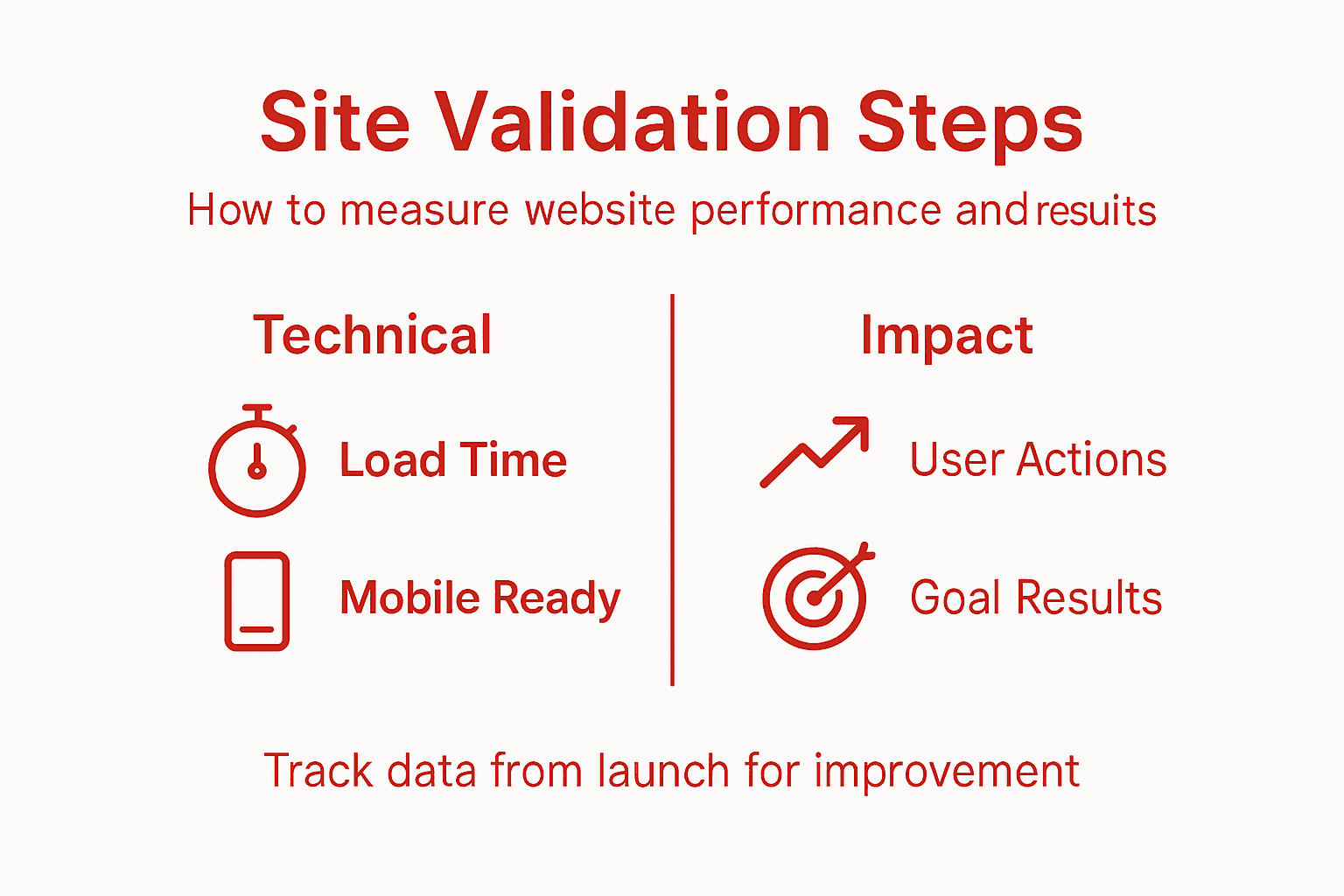
Track business outcomes too. User satisfaction, goal completion rates, and content discoverability reveal whether the site serves its actual purpose. Is your client’s donation form easy to find? Do visitors understand what the organisation does? Are people taking the action your client hopes for?
Essential validation checks include:
- Performance: Load time under 3 seconds, Core Web Vitals passing on mobile and desktop
- Accessibility: WCAG 2.1 AA compliance, keyboard navigation working, alt text complete
- User behaviour: Track which pages get visited, where visitors drop off, what content resonates
- Goal completion: Monitor conversions, contact form submissions, donation transactions
- SEO foundations: Proper metadata, structured data, mobile responsiveness, crawlability
Set up tracking before launch so you capture baseline data immediately. Without baseline, you cannot measure improvement.
Below is a summary of key validation metrics and their client impact:
| Metric Category | What It Measures | Why It Matters to Clients |
|---|---|---|
| Performance | Site speed, responsiveness | Faster access increases engagement |
| Accessibility | Usability for all audiences | Inclusive sites reach more people |
| User Behaviour | Navigation and content interaction | Reveals what users value or ignore |
| Goal Completion | Actions like donations or sign-ups | Proves the site delivers real outcomes |
| SEO Foundations | Search engine readiness, structure | Long-term visibility boosts reach |
A beautiful website that doesn’t achieve its mission is expensive decoration. Measure what matters to your client.
Review results quarterly with your client. Share both wins and gaps honestly. Use data to guide improvements, not to defend decisions. This transparency builds trust and shows measurable return on their investment.
Pro tip: Create a simple one-page performance dashboard your client can check monthly. Include load time, user visits, goal completions, and one key quality metric. Make data accessible so clients understand why ongoing maintenance matters.
Build Your Website Business with Purpose and Performance
Starting a website building business focused on impact means facing challenges like defining clear values, creating ethical service packages, and ensuring sustainable SEO and performance. The article highlights the importance of aligning your business with genuine client needs, transparency, and measurable outcomes—concepts that are often tough to achieve alone.
At Marzipan, we understand these pain points deeply. We specialise in web design for community-based organisations who want websites that not only reflect their mission but also perform reliably and rank well over time. Our approach combines ethical AI, sustainable design, and performance-driven SEO strategies that echo the article’s emphasis on values-driven business models and long-term validation. Let us help you build websites that truly deliver impact.
- Align your offerings with your core values and client goals
- Design transparent and fair service packages without hidden costs
- Adopt sustainable workflows and SEO that serve your clients for the long term
Ready to grow your purpose-driven website business with support tailored to your mission? Visit Marzipan to discover how we help brands like yours create websites built to perform and SEO built to last.
Take the next step in building a values-driven website business that delivers real results. Explore our services and start your journey at Marzipan. Learn more about ethical digital practices and discover how your business can thrive without compromise.
Frequently Asked Questions
How do I define a values-driven business model for my website building business?
To define a values-driven business model, reflect on the core principles that guide your decisions. Identify the problems you want to solve, the clientele you genuinely wish to serve, and what practices you refuse to adopt. Document these principles clearly to guide your future decisions and attract like-minded clients.
What legal steps should I take to register my website building business?
Begin by choosing a business structure, such as a sole trader or company, and register it accordingly. Obtain an Australian Business Number (ABN) and register your business name to ensure compliance. Set up your tax file number and understand your GST registration requirements to operate legally and effectively from day one.
How can I create ethical service packages for my clients?
To create ethical service packages, assess the genuine needs of your target clients and develop transparent offerings that solve specific problems. Clearly outline what each package includes and avoid vague promises. Structure your services into tiers that feel complete for clients at their current stage, ensuring they don’t feel compelled to purchase unnecessary features.
What sustainable workflows should I establish for my website building business?
Establish standardised workflows that detail every project stage, from discovery through to support. Document the processes you use for client communications, audits, and quality checks. This consistency will save time and prevent mistakes, allowing you to focus on higher-value tasks.
How do I validate the performance of my clients’ websites after launch?
Validate the performance of websites by measuring success based on pre-set client goals, such as user engagement or conversion rates. Track key metrics like website speed, user behaviour, and goal completion rates. Schedule quarterly reviews with clients to analyse performance data and identify areas for improvement.
What are essential SEO practices to include when starting my website building business?
Focus on sustainable SEO practices that prioritize user experience, high-quality content, and ethical link building. Conduct thorough SEO audits for each project and create content strategies that address audience needs. Avoid quick fixes and instead aim for practices that deliver long-term visibility and value to your clients.
Recommended
- How to Design a Website for a Small Business Ethically – Marzipan
- How to Make SEO Friendly Website for Mission-Driven Brands – Marzipan
- 7 Examples of Website Layouts for Community Impact – Marzipan
- Web Design Agency Sydney: Digital Impact for Good – Marzipan
- Klik-om-te-bellen plugin voor WordPress – gratis startpunt om samen verder te bouwen – AlexandervanDijl.nl – Bel 020 262 1789