Many community organisations believe ranking higher on Google requires aggressive tactics like keyword stuffing or purchasing links. These outdated myths not only damage credibility but also risk penalties from search engines. The truth is simpler: ethical SEO practices aligned with your mission deliver sustainable ranking improvements without compromising values. This guide reveals how sustainable web design, responsible AI integration, and transparent optimisation strategies help Australian community groups achieve lasting online visibility.
Table of Contents
- Understanding Google Ranking: Fundamentals And Key Factors
- The Principles Of Ethical Seo For Mission-Driven Organisations
- The Role Of Sustainable Web Design In Enhancing Google Rankings
- Integrating Ethical Ai Into Seo Practices
- Common Misconceptions About Seo And Google Ranking
- Comparison Of Ethical Seo Vs Aggressive Seo Tactics
- Practical Steps To Improve Google Ranking Ethically And Sustainably
- Case Studies Of Australian Community Organisations Succeeding With Ethical Seo
- Improve Your Ethical Seo With Marzipan Media
- Frequently Asked Questions
Key takeaways
| Point | Details |
|---|---|
| Ethical SEO prioritises user intent | Quality content addressing real community needs builds trust and improves rankings naturally. |
| Sustainable design boosts performance | Optimised code and images reduce energy use while improving Core Web Vitals scores. |
| Responsible AI supports content creation | AI tools assist research and drafting when combined with human oversight and fact-checking. |
| Avoid aggressive tactics | Keyword stuffing and manipulative links trigger penalties and harm long-term visibility. |
| Focus on mobile optimisation | Mobile-first indexing and local backlinks drive sustainable ranking growth for community brands. |
Understanding Google ranking: fundamentals and key factors
Google ranking determines where your website appears when someone searches for topics related to your organisation. Your position depends on how well Google’s algorithm judges your site’s relevance, quality, and user experience. Higher rankings mean more visibility, more visitors, and greater impact for your mission.
The algorithm prioritises genuine user experience over manipulation. Google evaluates hundreds of signals, but three stand out for community organisations. First, mobile-first indexing means Google predominantly uses your mobile site version for ranking decisions. Since over 60% of searches happen on mobile, ignoring mobile optimisation severely limits your potential.
Second, Core Web Vitals measure loading speed, interactivity, and visual stability. These metrics directly impact how visitors experience your site. Slow pages frustrate users and increase bounce rates, signalling to Google that your content isn’t meeting needs.
Third, accessibility and usability matter enormously. Community organisations serve diverse audiences. Sites that work well for people using screen readers, keyboard navigation, or slower internet connections perform better in rankings. Accessibility isn’t just ethical; it’s strategically smart.
Key ranking factors include:
- Quality content that answers real questions your community asks
- Technical performance measured through Core Web Vitals
- Mobile responsiveness and fast loading times
- Secure HTTPS connections protecting user privacy
- Clear site structure helping both users and search engines navigate
- Local relevance through accurate business information and community connections
Understanding these fundamentals helps you focus efforts where they matter most.
The principles of ethical SEO for mission-driven organisations
Ethical SEO means optimising your online presence without deception or manipulation. For community organisations, this approach aligns perfectly with your values whilst building lasting visibility. The contrast with aggressive tactics couldn’t be clearer.
Keyword stuffing damages both rankings and user experience. Cramming keywords unnaturally into content makes it unreadable and triggers Google penalties. Instead, write naturally for humans whilst including relevant terms where they fit organically. Address the real questions your community asks.
Backlink schemes promise quick results but deliver lasting problems. Purchasing links or participating in link exchanges violates Google’s guidelines. When discovered, these tactics result in severe ranking drops. Ethical backlinks come from genuine relationships with relevant Australian organisations, local news coverage of your work, and partnerships with trusted community resources.
Focus on content quality above all else. Your expertise matters to people seeking help, information, or ways to contribute. Create resources that genuinely serve your audience’s needs. This builds authority naturally whilst supporting your mission. Local SEO optimisation for community brands relies heavily on demonstrating local relevance through helpful content.

Transparency strengthens both rankings and relationships. Be honest about who you are, what you do, and how people can verify your legitimacy. Clear contact information, accurate location details, and authentic testimonials build trust with both visitors and search engines.
Pro Tip: Document your SEO strategy in writing, ensuring all tactics align with your organisation’s published values. This creates accountability and helps volunteers or new staff maintain ethical practices.
Ethical approaches deliver stable, sustainable ranking improvements. Whilst aggressive tactics might show quick gains, they inevitably collapse. Your mission deserves better than short-term tricks.
The role of sustainable web design in enhancing Google rankings
Sustainable web design reduces environmental impact whilst improving the factors Google rewards. Every webpage consumes energy through data transfer, processing, and storage. Optimising these elements benefits both the planet and your rankings.
Lightweight design loads faster. Compressed images, streamlined code, and efficient file formats reduce data transfer. This speeds up your site whilst lowering energy consumption. Faster load times directly improve Core Web Vitals scores, a key ranking factor. Users appreciate quick-loading pages, leading to lower bounce rates and longer engagement.
Minimising HTTP requests simplifies page structure. Each element on a page requires a separate request to the server. Combining files, using CSS instead of images where possible, and removing unnecessary scripts reduces these requests. Fewer requests mean faster loading and less energy use.
Green hosting choices matter more than many realise. Servers running on renewable energy reduce your digital carbon footprint. Whilst this doesn’t directly affect rankings, it aligns with user values and positions your organisation as environmentally responsible. This builds brand strength, which indirectly supports SEO through increased direct traffic and branded searches.
Key sustainable practices include:
- Optimising and compressing all images before upload
- Using modern, efficient file formats like WebP
- Implementing lazy loading for images below the fold
- Choosing minimal, clean design over resource-heavy elements
- Selecting hosting providers powered by renewable energy
- Regularly auditing and removing unused plugins or scripts
Core Web Vitals improve naturally when you prioritise efficiency. Sustainable design isn’t separate from SEO; it’s a pathway to better performance. Your environmental values become a competitive advantage.
Integrating ethical AI into SEO practices
AI tools offer genuine benefits for community organisations when used responsibly. The key lies in maintaining human oversight and ethical guidelines whilst leveraging AI’s efficiency gains.
Use AI for research and initial drafts, not final content. AI excels at analysing search trends, identifying content gaps, and generating outline structures. These capabilities save hours whilst helping you focus on topics your community actually searches for. However, AI cannot replace human expertise, empathy, or mission understanding.
Maintain strict fact-checking protocols. AI sometimes generates plausible-sounding but incorrect information. Every statistic, claim, or recommendation requires human verification against authoritative sources. This protects your credibility and ensures accuracy.
Transparency builds trust. Many Australian organisations now disclose when AI assists content creation, explaining their oversight processes. This honesty resonates with audiences who value authenticity. Privacy regulations require careful handling of any data used in AI tools.
Risk mitigation strategies include:
- Always reviewing and editing AI-generated content thoroughly
- Verifying facts against primary sources before publishing
- Maintaining your organisation’s voice and values in all content
- Avoiding automated keyword insertion or content spinning
- Documenting AI usage policies for transparency
Many Australian SEO practitioners report productivity increases of 30-40% when using AI ethically. These gains come from faster research, improved content planning, and efficient optimisation suggestions. The AI-informed SEO services approach combines technology with human expertise for best results.
Pro Tip: Create an AI usage policy for your organisation detailing acceptable uses, required human oversight, and prohibited practices. This ensures consistency across team members.
AI amplifies human capabilities when used ethically. It cannot replace the authentic voice and mission understanding that make community content valuable.
Common misconceptions about SEO and Google ranking
Several persistent myths mislead community organisations, wasting resources and sometimes causing harm. Understanding what doesn’t work helps you focus on effective strategies.
Keyword stuffing never works. Some believe cramming keywords into content improves rankings. The opposite is true. Google’s algorithm easily identifies unnatural keyword density and penalises it. Users find stuffed content unreadable and leave quickly, increasing bounce rates. Write naturally for humans, including keywords only where they fit organically.
SEO isn’t a one-time project. Many organisations treat SEO as a launch task, then ignore it. Rankings require ongoing content updates, technical maintenance, and adaptation to algorithm changes. Successful organisations build SEO into regular workflows, not one-off campaigns.
More links don’t automatically mean better rankings. Quality and relevance matter far more than quantity. Ten links from respected Australian community organisations outperform hundreds from irrelevant or low-quality sources. Focus on earning links through genuine relationships and valuable content.
Paid advertising doesn’t influence organic rankings. Some believe running Google Ads improves organic search positions. These are completely separate systems. Ads provide visibility whilst you build organic rankings, but they don’t directly affect where you appear in unpaid results.
Key misconceptions to avoid:
- Believing meta keyword tags still matter (Google ignores them)
- Thinking exact keyword matching is essential (semantic understanding is more important)
- Assuming domain age alone guarantees rankings (quality matters more)
- Expecting instant results (sustainable SEO takes months to show full effect)
- Believing social media shares directly improve rankings (they help indirectly through visibility)
Understanding these realities helps you invest time and resources wisely.
Comparison of ethical SEO vs aggressive SEO tactics
The differences between ethical and aggressive approaches extend far beyond immediate results. Long-term sustainability, brand reputation, and mission alignment diverge sharply.
| Factor | Ethical SEO | Aggressive SEO |
|---|---|---|
| Ranking stability | Builds gradually, maintains consistently | Quick gains followed by penalties and drops |
| Penalty risk | Minimal when following guidelines | High risk of manual actions and algorithmic penalties |
| Brand reputation | Strengthens trust and credibility | Damages reputation when tactics are discovered |
| Resource investment | Steady, sustainable effort over time | High initial cost, ongoing recovery from penalties |
| Mission alignment | Reflects organisational values authentically | Often conflicts with transparency and community trust |
| User experience | Prioritises genuine value and usability | Sacrifices user needs for ranking manipulation |
| Long-term ROI | Compounds positively over years | Diminishes as penalties accumulate |
| Community perception | Builds authentic relationships | Erodes trust when manipulation becomes apparent |
Aggressive tactics include purchasing links from link farms, hiding text on pages, creating doorway pages, and using automated content generation without oversight. These methods violate Google’s Webmaster Guidelines and inevitably trigger penalties.
Community organisations face unique reputational risks. Your credibility depends on trust. When stakeholders discover manipulative SEO tactics, the damage extends beyond rankings to donor relationships, volunteer recruitment, and community standing. Local SEO optimisation succeeds when it reflects genuine community connections, not manufactured signals.
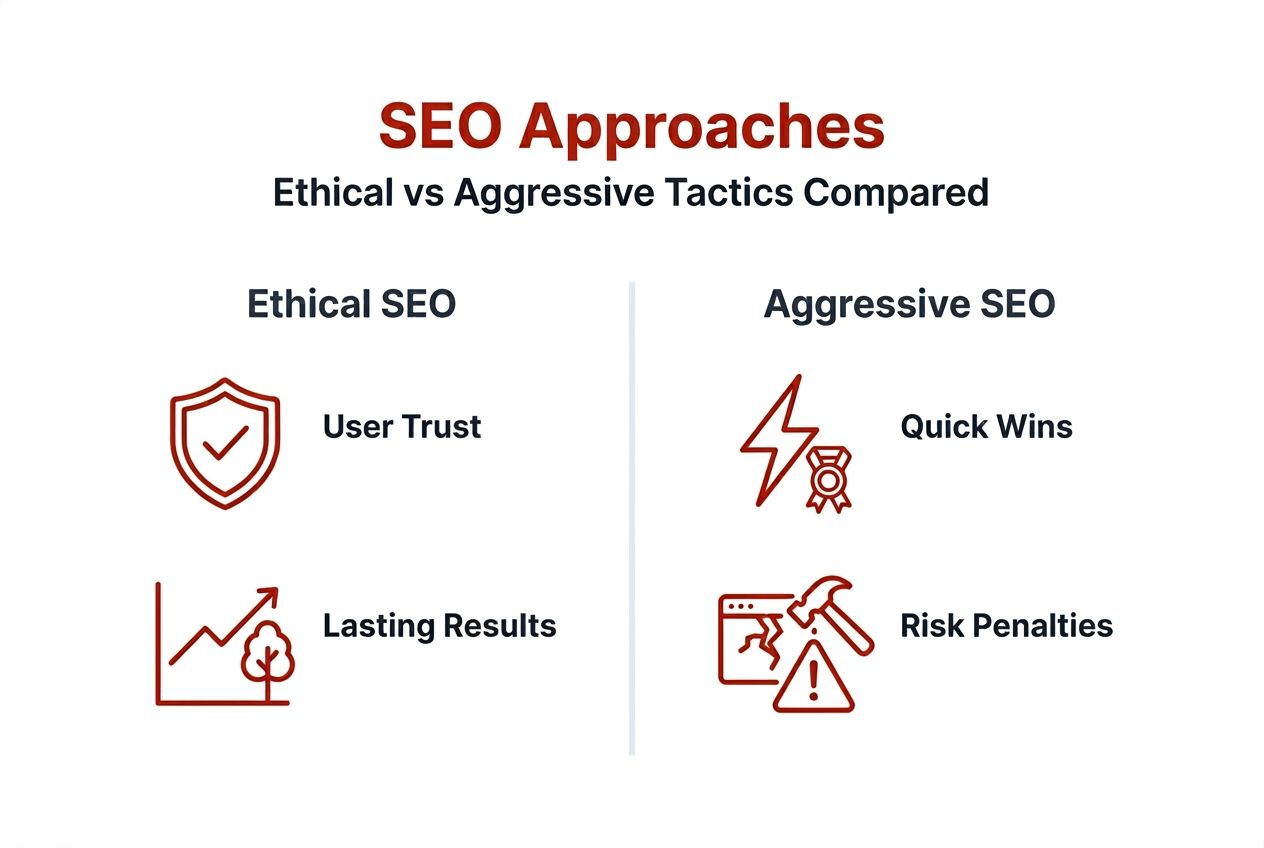
Ethical approaches align perfectly with mission-driven values. Transparency, quality, and user focus characterise both effective SEO and successful community work. This alignment makes ethical SEO not just smarter but more authentic.
Practical steps to improve Google ranking ethically and sustainably
Implementing ethical SEO requires systematic action. These steps provide a roadmap tailored for Australian community organisations.
-
Conduct a comprehensive SEO audit focusing on ethical practices and sustainability. Review your current content, technical performance, backlink profile, and mobile experience. Identify quick wins like image compression alongside longer-term improvements like content expansion.
-
Optimise for mobile-first indexing and Core Web Vitals. Test your site on actual mobile devices, not just desktop browsers. Use Google’s PageSpeed Insights to identify specific performance issues. Prioritise fixing largest contentful paint, first input delay, and cumulative layout shift metrics.
-
Create high-quality content addressing real user questions. Research what your community actually searches for using tools like Google’s autocomplete and “People also ask” sections. Answer these questions thoroughly, drawing on your expertise and mission.
-
Build ethical backlinks from trusted Australian sources. Develop relationships with local news outlets, partner organisations, and community directories. Earn links through valuable resources, original research, or community events worth covering.
-
Integrate AI tools with strict human oversight. Use AI for research, keyword analysis, and content planning. Maintain human control over final content, fact-checking, and strategic decisions. Document your AI usage policies for transparency.
-
Monitor performance regularly and adapt based on data. Track organic traffic, keyword rankings, and user behaviour through Google Analytics and Search Console. Update content quarterly based on performance insights and evolving community needs.
The ethical local SEO agency guidance approach emphasises patience and consistency. Sustainable improvements emerge over months, not days. Focus on cumulative progress rather than overnight transformations.
Regular content updates signal ongoing relevance to Google. Review your top-performing pages quarterly, adding fresh information and updating statistics. This maintains rankings whilst serving your audience better.
Case studies of Australian community organisations succeeding with ethical SEO
Real examples demonstrate how ethical approaches deliver measurable results for mission-driven organisations across Australia.
A Sydney-based environmental charity implemented mobile optimisation and sustainable web design, achieving 47% organic traffic growth over eight months. Their focus on Core Web Vitals improvements and locally relevant content attracted both search engines and community members. Volunteer enquiries increased by 32% directly attributable to improved search visibility.
A Melbourne community health service rebuilt their website using ethical SEO principles and green hosting. Within six months, they ranked first page for twelve priority health topics. Their transparent approach to content creation, citing medical sources clearly and avoiding sensationalism, built trust that converted visitors to patients.
A regional arts organisation applied ethical SEO growth case study strategies, focusing on authentic community stories rather than keyword manipulation. Their organic traffic doubled whilst maintaining perfect alignment with their cultural values. Event attendance grew 28% as local searches brought new audiences.
Common success factors include:
- Patience and consistency over 6-12 months
- Mobile optimisation as a priority, not afterthought
- Quality content reflecting genuine community expertise
- Ethical backlinks from relevant local sources
- Regular performance monitoring and content updates
- Mission alignment in every optimisation decision
The ethical SEO agency success approach proves that values and visibility aren’t competing priorities. Organisations succeeding with ethical SEO report stronger community relationships alongside improved rankings. Their online presence authentically reflects their mission, creating sustainable growth.
These examples inspire confidence that ethical approaches work. Your commitment to transparency and quality becomes your competitive advantage, not a limitation.
Improve your ethical SEO with Marzipan Media
You’ve seen how ethical SEO, sustainable web design, and responsible AI create lasting visibility whilst honouring your values. Implementing these strategies requires expertise and ongoing commitment.
Marzipan Media specialises in AI-informed SEO services tailored for Australian community organisations. We combine technical excellence with mission alignment, ensuring your online presence reflects your values whilst achieving measurable results. Our sustainable web design services reduce environmental impact and improve performance simultaneously. We help you choose green hosting that aligns with your sustainability commitments.
Partner with experts who understand both SEO and community values. Contact Marzipan to start your ethical SEO journey with proven strategies that scale impact, not noise.
Frequently asked questions
What is Google ranking and why does it matter for community organisations?
Google ranking determines your website’s position in search results when people look for services or information you provide. Higher rankings mean more community members discover your organisation, leading to increased donations, volunteer applications, and program participation. For resource-limited organisations, organic visibility provides cost-effective reach.
How does ethical SEO differ from traditional SEO approaches?
Ethical SEO prioritises transparency, user value, and guideline compliance over manipulation. Traditional approaches sometimes employ aggressive tactics like purchased links or keyword stuffing that risk penalties. Ethical methods build sustainable rankings through quality content, genuine relationships, and technical excellence that align with your mission values.
Can sustainable web design actually improve search rankings?
Yes, sustainable design directly improves Core Web Vitals by reducing page weight and optimising performance. Faster loading times, efficient code, and compressed images enhance user experience whilst lowering energy consumption. Google rewards these technical improvements with better rankings, making sustainability both environmentally and strategically beneficial.
What role should AI play in community organisation SEO?
AI excels at research, keyword analysis, and content planning when combined with human oversight. Use AI to identify topics your community searches for and generate content outlines. Always fact-check AI output, maintain your authentic voice, and ensure final content reflects your expertise. Transparency about AI usage builds trust with your audience.
How long does ethical SEO take to show results?
Expect meaningful improvements within 3-6 months, with substantial results emerging over 6-12 months. Ethical approaches build gradually but sustainably, unlike aggressive tactics that risk sudden penalties. Consistency matters more than speed. Regular content updates, technical maintenance, and relationship building compound over time for lasting visibility.