Many Sydney community organisation founders feel overlooked when local families search online for neighbourhood services or events. This can leave your mission-driven group buried beneath larger, less relevant results. By understanding the basics of local SEO, you can connect your organisation with the people who need you most, ensuring your genuine community presence shows up where it matters—in your own backyard.
Table of Contents
- Defining Local SEO For Community Organisations
- Types Of Local SEO And Key Differences
- Core Strategies For Effective Local SEO
- Ethical SEO Principles For Community Values
- Common Local SEO Pitfalls To Avoid
Key Takeaways
| Point | Details |
|---|---|
| Importance of Local SEO | Local SEO enhances visibility for community organisations by targeting specific geographic audiences, ensuring that local residents can find them easily. |
| Core Elements to Focus On | Successful local SEO relies on optimised Google Business Profiles, location-specific content, and genuine community engagement through reviews and partnerships. |
| Ongoing Maintenance is Key | Regular updates to Google Business Profiles and consistent information across platforms are essential for achieving and maintaining local search visibility. |
| Content Relevance | Creating content that addresses local community needs is crucial for effective engagement and improving local search rankings. |
Defining Local SEO for Community Organisations
Local SEO is the practice of optimising your organisation’s online presence to attract people searching for services or information within your specific geographic area. Unlike broad search engine optimisation, local SEO focuses on connecting your community brand with people nearby who are actively looking for what you offer.
For community organisations in Sydney and beyond, this distinction matters deeply. Local search is where residents discover local services, community events, and mission-driven organisations that serve their neighbourhood. When someone searches for “community support services near me” or “volunteering opportunities in Newtown”, local SEO determines whether your organisation appears in those results.
What Sets Local SEO Apart
Local SEO operates differently from general SEO in several important ways:
- Geographic specificity: Your content, keywords, and online profiles target people in your area rather than nationwide audiences
- Local signals: Search engines prioritise factors like your physical location, local reviews, and community engagement
- Map and directory visibility: Appearing on Google Maps and community directories becomes as important as your website ranking
- Community connection: Success depends on authentic local relationships and genuine community presence, not just keyword optimisation
Community organisations benefit because foundational SEO concepts like keyword research and content optimisation apply directly to improving your local visibility. The core techniques remain consistent; the focus simply narrows to your neighbourhood.
Why Community Organisations Need Local SEO
Your community brand exists to serve people nearby. Local SEO ensures those people can actually find you when they need you most. Research on effective community engagement shows that maximising meaningful community involvement requires strong two-way information flow. Your online presence is part of that conversation.
When local families search for support services, community organisations, or volunteer opportunities, they’re ready to act. Without proper local SEO, they find your competitors instead. This isn’t about vanity rankings; it’s about fulfilling your mission.
Community organisations competing with larger institutional brands need every advantage. Local SEO levels this playing field by allowing you to dominate searches where it matters most: your own backyard.
Core Local SEO Elements for Community Brands
Three foundations underpin effective local SEO for community organisations:
- Local business profile optimisation – Accurate, complete information on Google Business Profile and community directories
- Location-specific content – Web pages and resources tailored to your neighbourhood’s needs and language
- Community signals – Reviews, local partnerships, and genuine community engagement that builds trust
Each element reinforces the others. A well-optimised business profile drives visibility in maps searches. Location-specific content answers questions your community actually asks. Community reviews and partnerships signal to search engines that you’re genuinely embedded in your area.
Local SEO for community organisations succeeds when your online presence reflects your actual community presence and mission alignment.
The goal isn’t to trick search algorithms. It’s to make sure authentic community work gets discovered by the people it serves.
Pro tip: Start by listing every platform where your organisation appears online—Google Business Profile, community directories, social media, local listings—and audit whether your name, address, and phone number match exactly across all of them. Inconsistencies confuse search engines and cost you visibility.
Types of Local SEO and Key Differences
Local SEO divides into distinct approaches, each serving different purposes within your overall strategy. Understanding these types helps community organisations choose the right mix for their specific situation and resources.
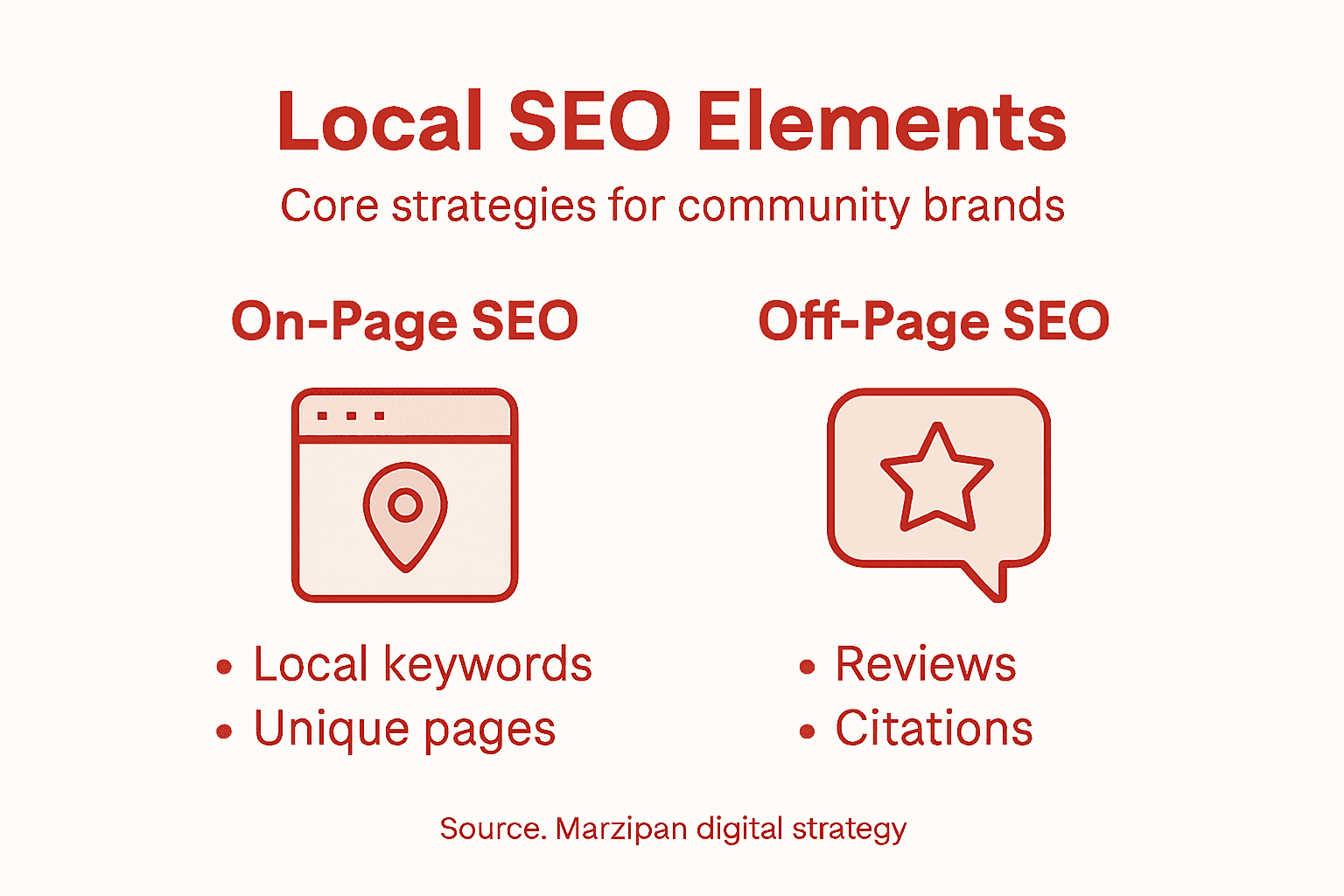
The main distinction lies between what happens on your website and what happens beyond it. On-page local SEO optimises your actual website for local searches. Off-page local SEO builds your reputation and authority through external platforms and community connections. Both matter equally for community brands seeking genuine local visibility.
On-Page Local SEO
On-page local SEO focuses on the content and structure of your website itself. This includes optimising page titles, meta descriptions, and body content with local keywords relevant to your community.
Key elements include:
- Location pages: Dedicated web pages for each area you serve, with area-specific information and local language
- Local keywords: Integrating neighbourhood names, local service terms, and community-specific phrases naturally into content
- Schema markup: Structured data that tells search engines your organisation’s location, hours, contact details, and services
- Mobile optimisation: Ensuring your website works perfectly on phones, where most local searches happen
For a community organisation in Glebe serving families across multiple suburbs, on-page local SEO means creating distinct content pages for each neighbourhood you reach. Each page should speak directly to that area’s needs and concerns.
Off-Page Local SEO
Off-page local SEO happens outside your website but heavily influences your local rankings. This includes your presence on Google Business Profile, local directories, review platforms, and community partnerships.
The main components are:
- Google Business Profile: Your business listing on Google Maps and local search results
- Local citations: Consistent mentions of your organisation across community directories and local websites
- Reviews and ratings: Customer feedback on platforms like Google, Trustpilot, and local community sites
- Local backlinks: Links from reputable local websites, community organisations, and local media
Off-page local SEO succeeds when your organisation becomes a recognisable, trusted part of the local community ecosystem.
When residents leave positive reviews or local news outlets link to your work, search engines take notice. These signals tell Google that you’re genuinely embedded in your area.

Technical Local SEO
Technical local SEO ensures search engines can actually understand and index your local information correctly. This happens behind the scenes but directly impacts visibility.
Technical elements include proper location data formatting, fast page loading speeds, secure website protocols (HTTPS), and correct site structure. Without solid technical foundations, even excellent on-page and off-page work won’t perform optimally.
Community organisations should consider how ethical local SEO strategies align with sustainable digital practices to ensure your growth supports your mission rather than creating unsustainable demands.
Here is a quick comparison of the three main types of local SEO and their practical focus for community organisations:
| SEO Type | Main Focus | Typical Activities |
|---|---|---|
| On-Page Local | Website content tailored to locality | Local pages, keywords, schema |
| Off-Page Local | External reputation and authority | Reviews, citations, partnerships |
| Technical Local | Site structure and operational health | Fast loads, secure site, accuracy |
How These Types Work Together
Effective local SEO combines all three types. Your website content attracts and serves visitors (on-page). Your Google Business Profile and reviews build trust and visibility (off-page). Your technical setup ensures everything works smoothly (technical).
Neglecting any one type creates gaps. A perfectly optimised website with poor reviews struggles. Strong reviews without a functional website waste opportunity. Technical problems undermine everything.
For community organisations with limited resources, prioritise in this order: solid on-page foundations with local keywords, then claim and complete your Google Business Profile, then build review momentum through genuine community engagement.
Pro tip: Start by auditing which type of local SEO your organisation already handles well, then identify the biggest gap. Most community brands excel at community engagement (off-page) but neglect on-page keyword optimisation and technical setup, so focusing there typically yields the fastest improvement.
Core Strategies for Effective Local SEO
Effective local SEO requires a structured approach that combines technical foundations with genuine community engagement. The strategies that work best align with your organisation’s actual capacity and values, not industry trends that feel disconnected from your mission.
Start with the fundamentals. Most community organisations skip the basics in pursuit of flashy tactics, then wonder why nothing moves. Getting the basics right costs less time and delivers more consistent results than chasing advanced strategies.
Claim and Optimise Your Google Business Profile
Your Google Business Profile is your single most important local asset. This is where most local searches lead people directly to your contact information, location, opening hours, and photos.
The essential steps are:
- Claim your listing if you haven’t already
- Complete every field accurately: name, address, phone number, website, business category
- Add high-quality photos of your facilities, team, and community work
- Write a compelling description that explains what you do and who you serve
- Keep hours, contact details, and services updated regularly
Inconsistencies between your Google Business Profile and your website confuse search engines and lose you visibility. A five-minute audit prevents months of lost traffic.
Build Consistent Local Citations
Local citations are mentions of your organisation’s name, address, and phone number across community directories, local websites, and industry-specific platforms. Search engines use consistency across these citations to verify your legitimacy.
Prioritise high-authority local directories first:
- Community service directories for your area
- Local business listings and chambers of commerce
- Industry-specific directories (if you operate in aged care, youth services, mental health, etc.)
- Local government and council websites
Accuracy matters more than quantity. Three perfectly consistent citations outperform ten with mismatched information. Before submitting anywhere, audit and standardise how your organisation name appears everywhere.
Optimise for Local Search Intent
Local search intent differs from general search. When someone searches “food bank near me” or “counselling services in Camperdown”, they want immediate, location-specific results. Your content should answer that need directly.
Create location-specific content pages for:
- Each suburb or neighbourhood you serve
- Specific services with local context
- Community resources tailored to local needs
- Answers to questions your actual community asks
When writing these pages, use natural language that matches how people actually speak in your area. A community health centre in Western Sydney should write differently than one in the Eastern suburbs.
Earn Reviews and Build Trust Signals
Reviews are proof that real people trust your organisation. They influence both search rankings and whether people actually contact you. Community organisations with genuine community support accumulate reviews naturally; your job is making it easy.
Simple strategies include:
- Asking satisfied community members to leave honest reviews after positive experiences
- Providing direct links to your review profiles (Google, Trustpilot, local platforms)
- Responding to all reviews professionally, including critical ones
- Never buying or fabricating reviews—authenticity matters more than volume
Consider how affordable local SEO built for sustainable growth works better for community organisations than expensive tactics requiring ongoing investment you cannot sustain.
Create Content That Answers Real Community Questions
Your website should answer questions your community actually asks. If you run a family support service, create content about parenting challenges in your area. If you provide legal aid, answer questions about rights and processes your clients face.
This content serves two purposes. It genuinely helps people while also capturing the specific language and questions that bring local searches to you.
Effective local SEO for community brands succeeds when your online strategy reflects your actual community presence and demonstrates genuine understanding of local needs.
Content that feels authentic and helpful builds trust far better than optimised content that misses the mark.
Pro tip: Ask your frontline staff and community members what questions people ask repeatedly. Build your content strategy around those actual questions rather than guessing what people might search. You’ll rank better and serve your community more effectively.
Ethical SEO Principles for Community Values
Ethical SEO means building your online visibility in ways that strengthen your mission rather than compromise it. For community organisations, this distinction matters profoundly. You can grow your reach without manipulation, deception, or unsustainable practices that contradict your values.
The core principle is simple: your online strategy should reflect how you actually operate. If your organisation values transparency, your website should be transparent. If you serve the most vulnerable, your digital presence should remain accessible. If you operate sustainably, your SEO approach should not demand endless resource investment.
Transparency Over Manipulation
Ethical SEO prioritises honest communication over tactics designed to fool search engines or users. This means describing your services accurately, being clear about what you can and cannot do, and avoiding sensational language that misrepresents your impact.
Many SEO agencies recommend tactics that undermine trust:
- Keyword stuffing that makes content unreadable
- Misleading headlines that don’t match page content
- Hidden text or cloaking designed to deceive search engines
- Buying links from irrelevant sources
- Fabricating testimonials or reviews
Community organisations that use these tactics gain nothing. Your strength lies in authentic community relationships. Deceptive tactics damage that trust permanently.
Accessibility as a Core Value
Building SEO-friendly websites should never mean sacrificing accessibility. Your site must serve people using screen readers, keyboard navigation, or other assistive technologies. This isn’t a technical detail; it’s a reflection of your commitment to inclusion.
Accessibility and SEO align naturally when built correctly. Fast loading times help both search engines and users on slow connections. Clear structure helps both algorithms and people navigating your content. Descriptive headings serve screen readers and help everyone understand your information hierarchy.
Consider how building SEO-friendly websites for mission-driven brands should prioritise accessibility alongside search visibility, ensuring your growth includes rather than excludes.
Sustainability Over Growth at Any Cost
Ethical SEO recognises that not all growth is sustainable. A strategy that demands constant content creation, monthly paid advertising, or expensive tools may grow your visibility short-term but creates long-term pressure you cannot maintain.
Choose approaches that fit your actual capacity:
- Focus on foundational work that compounds over time rather than constant activity
- Build sustainable content routines your team can maintain indefinitely
- Prioritise owned channels (your website, your email list) over rented platforms
- Invest in tools and systems that save time rather than consume it
- Plan for the long term, not the next quarterly report
A modest, consistent local SEO effort delivered over two years outperforms an intense, unsustainable campaign that collapses after six months.
Community Benefit, Not Just Organisational Gain
Ethical SEO asks: Who benefits from your improved visibility? The answer should extend beyond your organisation. When you rank for “parenting support in Marrickville”, you should genuinely help families find resources. When you appear for “mental health services in your area”, people should find honest information about what you offer.
This means creating content that serves the community, not just your organisation. Answer real questions. Acknowledge limitations. Point people toward other resources when appropriate. Build trust through genuine helpfulness.
Ethical SEO for community organisations succeeds when growth advances your mission rather than diverting energy from it.
Your online presence should extend your values, not contradict them.
Pro tip: Before implementing any SEO tactic, ask yourself: Would I be comfortable if this were public? Does this serve my community or just my rankings? Can I sustain this long-term without burning out my team? If the answer to any question is no, the tactic doesn’t align with your values regardless of how effective it might be.
Common Local SEO Pitfalls to Avoid
Community organisations make predictable mistakes with local SEO that undermine months of effort. Understanding these pitfalls helps you avoid wasting time and resources on approaches that backfire or create more problems than they solve.
Most mistakes stem from the same source: treating local SEO like a one-time project rather than ongoing maintenance. You optimise your Google Business Profile once, create some content, then move on. Search engines and community needs evolve constantly, so static approaches fail.
Neglecting Your Google Business Profile
Your Google Business Profile is not a setup-and-forget asset. Thousands of community organisations claim their listing, fill it out once, then abandon it. This single mistake costs more visibility than almost any other pitfall.
Frequent local SEO mistakes in Australia include neglecting Google Business Profile listings, which directly impacts your local search visibility. Your profile requires regular attention:
- Update opening hours when they change (especially during holidays or special circumstances)
- Add new photos regularly showing your team, facilities, and community work
- Respond to customer reviews consistently
- Post updates about upcoming events or services
- Keep your business category and description current
Even small inconsistencies signal to Google that your information might be outdated. A profile updated quarterly outperforms one updated annually.
Inconsistent Business Information Across Platforms
Name, Address, Phone (NAP) consistency matters far more than most community organisations realise. When your organisation appears as “Community Support Services” on your website, “Community Support” on Google, and “Community Support Servs” on a local directory, search engines become confused about whether you are the same organisation.
Common problems include:
- Abbreviating your name differently across platforms
- Using different address formats (“St” vs “Street”, “NSW” vs “New South Wales”)
- Listing phone numbers with different area codes or formatting
- Creating variations in how you describe your organisation
Before submitting anywhere, standardise exactly how your organisation name, address, and phone number appear. Use that exact format consistently across every platform.
Ignoring Reviews and Community Feedback
Reviews directly influence both your search rankings and whether people contact you. Community organisations that never respond to reviews miss a critical opportunity to build trust and improve visibility.
Common oversights include:
- Never asking satisfied community members to leave reviews
- Ignoring negative reviews rather than responding professionally
- Failing to encourage staff to gather feedback naturally
- Treating reviews as a distraction rather than valuable insight
Respond to all reviews within 48 hours when possible. Thank people for positive reviews. Address concerns in negative reviews constructively. This signals to search engines that you’re actively engaged with your community.
Creating Generic, Non-Local Content
Content that could describe any organisation in any location wastes your effort. “We provide excellent service to our community” appears on thousands of websites and helps nobody rank locally.
Instead, create content addressing real, location-specific needs. If you run family support services in Parramatta, write about parenting challenges specific to that area. If you provide aged care advice, address questions your actual clients ask.
Avoiding local SEO pitfalls requires ongoing attention to data accuracy, community engagement, and content relevance rather than one-time optimisation.
Generic content ranks poorly and serves your community poorly. Location-specific content does both better.
Overlooking Mobile Optimisation
Most local searches happen on mobile phones. Yet many community organisation websites remain poorly optimised for mobile devices, with slow loading times, difficult navigation, or unreadable text.
Test your website on a phone. Load times should be under three seconds. Navigation should work smoothly with touch. Text should be readable without zooming. These aren’t technical niceties; they’re fundamental to local SEO success.
Pro tip: Set calendar reminders to audit your Google Business Profile quarterly and your NAP consistency across all platforms annually. These two simple habits prevent most local SEO problems before they develop.
Below is a summary of common local SEO pitfalls and the ongoing actions required to avoid them:
| Pitfall | Ongoing Action Needed |
|---|---|
| Neglected Google Profile | Quarterly updates and review responses |
| Inconsistent business information | Annual audit of all listed details |
| Ignored reviews | Timely, professional responses to feedback |
| Generic, non-local content | Regularly produce location-based resources |
| Poor mobile optimisation | Test mobile usability and speed routinely |
Elevate Your Community Brand with Ethical Local SEO Solutions
Navigating the challenges of local SEO for community organisations requires more than basic optimisation. The article highlights critical pain points such as inconsistent business information, neglected Google Business Profiles, and the urgent need for authentic community engagement through local content and reviews. If you want to stand out in your neighbourhood and build genuine trust without compromising your values, understanding and implementing ethical, sustainable SEO strategies is essential.
At Marzipan, we specialise in creating websites built to perform that align perfectly with your mission. Combining sustainable web design, ethical AI, and performance-driven SEO, we help purpose-driven brands grow online by crafting local SEO strategies that reflect your actual community presence. From optimising your Google Business Profile to building location-specific content, our approach ensures your organisation not only attracts attention but truly connects with your audience. Discover how our ethical SEO solutions can transform your digital presence and support your mission without exhausting your resources.
Ready to strengthen your community impact through lasting, values-driven local SEO?

Explore how Marzipan can help your organisation grow ethically and sustainably online by visiting our homepage today and take the first step towards SEO that serves your community and mission.
Frequently Asked Questions
What is local SEO and why is it important for community organisations?
Local SEO is the practice of optimizing your organisation’s online presence to attract people searching for services within a specific geographic area. It’s vital for community organisations as it connects them with local residents seeking their services, ensuring they are easily found when needed most.
How can community organisations optimise their Google Business Profile?
Community organisations should claim and complete their Google Business Profile, ensuring all information is accurate and up-to-date, including address, contact details, and operating hours. Adding high-quality images and regularly posting updates about services or events can also enhance visibility.
What type of content should community organisations create for effective local SEO?
Community organisations should create location-specific content that addresses the needs and questions of their community. This can include dedicated web pages for each area served, information on local resources, and answers to frequently asked queries relevant to their services.
How do reviews affect local SEO for community brands?
Reviews play a crucial role in local SEO as they influence search rankings and the likelihood of potential clients contacting the organisation. Encouraging satisfied clients to leave positive reviews, as well as responding to all feedback, can enhance trust and visibility in local search results.
Recommended
- Local SEO Sydney: Ethical Impact for Social Brands – Marzipan
- Affordable Local SEO: Sustainable Impact for Sydney Brands – Marzipan
- Sydney Digital Agency: Ethical Impact For Community Brands – Marzipan
- 7 Top Examples of Digital Branding for Community Groups – Marzipan
- Wat is branding: Waarom het essentieel is voor jouw bedrijf – Betaalbare Websites die Scoren | WebBuildingFirm.com