TL;DR:
- Authentic green marketing relies on verifiable, specific environmental claims to build consumer trust.
- Many Australian consumers are skeptical of green claims, demanding transparency and third-party validation.
- Avoid greenwashing by ensuring claims are evidence-based, comprehensive, and aligned with organizational practices.
Australians care deeply about the environment. 84% are concerned about climate change, and 76% actively weigh sustainability when making purchasing decisions. Yet 82% of those same consumers say they distrust green marketing claims. That gap between concern and trust is where most businesses stumble. Green marketing is frequently misunderstood, misapplied, or reduced to surface-level messaging that rings hollow. This article clarifies what green marketing actually is, how it works in practice, what Australian consumers genuinely expect, and how organisations can build credible, lasting sustainability credentials without falling into the greenwashing trap.
Table of Contents
- What is green marketing?
- How green marketing works: The 4Ps reimagined
- The Australian consumer: Opportunity and scepticism
- Greenwashing: How to avoid common pitfalls
- Practical steps: Building authentic green marketing in your organisation
- Why authenticity beats perfection in green marketing
- How Marzipan can help your organisation market sustainably
- Frequently asked questions
Key Takeaways
| Point | Details |
|---|---|
| Green marketing meaning | It means genuinely promoting environmental and sustainability benefits, not just using eco buzzwords. |
| Australian scepticism | Most consumers care about sustainability, but a large trust gap exists due to greenwashing. |
| How to avoid greenwashing | Substantiate claims with evidence, detail supply chains, and communicate progress transparently. |
| Practical framework | Focus on adapting the 4Ps for sustainability and take a lifecycle approach for true impact. |
| Authenticity wins | Being honest about your sustainability journey builds lasting trust more than pretending to be perfect. |
What is green marketing?
Green marketing is the practice of promoting products or services based on their environmental and sustainability attributes. It is not simply adding the word “eco” to a product label or using green colours in advertising. As defined by Investopedia, green marketing is the promotion of products or services based on their environmental benefits and sustainability, whether real or perceived, as part of broader ESG (Environmental, Social, Governance) practices.
That last phrase, “real or perceived,” is where things get complicated. Perception without substance is the foundation of greenwashing, which this article addresses in detail. Authentic green marketing requires that environmental claims are verifiable, specific, and honest.
“Green marketing is not a trend. It is a strategic response to a shifting consumer landscape where sustainability credentials increasingly determine purchasing decisions.”
ESG integration is now standard practice for large organisations, but its principles apply equally to small and medium enterprises. A business does not need to be a listed company to adopt responsible environmental communication. For green marketing for nonprofits and mission-led organisations, the same rules apply: claims must be grounded in evidence, not aspiration.
In Australia, green marketing is a strategic imperative. Consumers are paying attention, regulators are watching, and competitors are already making sustainability part of their value proposition. Understanding what green marketing is, and what it is not, is the essential starting point.
How green marketing works: The 4Ps reimagined
With a clear definition in mind, let’s see how green marketing operates in practice. The traditional marketing framework of the 4Ps (Product, Price, Place, Promotion) remains a useful structure, but each element takes on a different character when sustainability is the lens.
The mechanics of green marketing involve adapting all four of these elements: sustainable products designed with eco-materials and lifecycle considerations, pricing that reflects the true ethical cost of production, low-impact distribution channels such as electric vehicle fleets, and promotion built on evidence-based claims rather than vague environmental language.
Here is how the 4Ps translate in practice:
| Traditional marketing | Green marketing equivalent |
|---|---|
| Product features and benefits | Eco-materials, lifecycle design, minimal waste |
| Competitive pricing | True-cost pricing that accounts for environmental impact |
| Convenience-driven distribution | Ethical supply chains, low-carbon logistics |
| Broad promotional messaging | Evidence-based claims, third-party verification |
A useful way to think through each P:
- Product. Consider the full lifecycle of what you are selling, from raw material sourcing through to end-of-life disposal. Brands such as Patagonia have made repairability and recycled content central to their product design, not as marketing afterthoughts, but as core engineering decisions.
- Price. Sustainable products often cost more to produce. Transparent pricing that explains why a product costs more, referencing certified supply chains or carbon-offset investments, builds credibility rather than alienating price-sensitive buyers.
- Place. Distribution choices matter. Switching to consolidated shipments, partnering with local suppliers to reduce freight, or choosing fulfilment centres powered by renewable energy are all measurable steps that support green claims.
- Promotion. This is where most organisations go wrong. Promotion should communicate specific, substantiated environmental benefits. Vague terms like “natural” or “planet-friendly” without supporting evidence are both misleading and, in Australia, potentially in breach of consumer law.
Applying these principles to digital channels is equally important. A brand’s sustainable website design choices, such as energy-efficient hosting, optimised code, and reduced page weight, reflect the same values that green marketing communicates. The digital stewardship approach to web presence is a natural extension of authentic green marketing.
Pro Tip: Before making any environmental claim in a promotional channel, document the specific evidence that supports it. This protects the organisation legally and strengthens consumer trust.
The Australian consumer: Opportunity and scepticism
Let’s look at how green marketing matches up to what Australian consumers need and expect. The data tells a nuanced story. Australians are among the most environmentally aware consumers in the Asia-Pacific region, yet they are also deeply sceptical of corporate sustainability messaging.
According to TGM Research’s 2024 findings, 84% of Australians are concerned about climate change, 76% factor sustainability into their purchasing decisions, and yet 82% express distrust of green marketing claims. This is not a small trust deficit. It represents a majority of the very consumers that green marketing is designed to reach.
82% of Australian consumers distrust green marketing claims. This figure should sit at the centre of every sustainability communication strategy.
What do Australian consumers actually want from green marketing? Research and consumer sentiment surveys point to several consistent themes:
- Specific, verifiable claims. Statements like “made with 30% recycled ocean plastic, certified by [specific body]” outperform vague language like “eco-friendly packaging.”
- Honest acknowledgement of limitations. Consumers respond positively to brands that admit they are not yet fully sustainable and outline a clear roadmap.
- Consistent behaviour across the organisation. Marketing claims that contradict business practices (such as promoting sustainability while lobbying against environmental policy) destroy credibility rapidly.
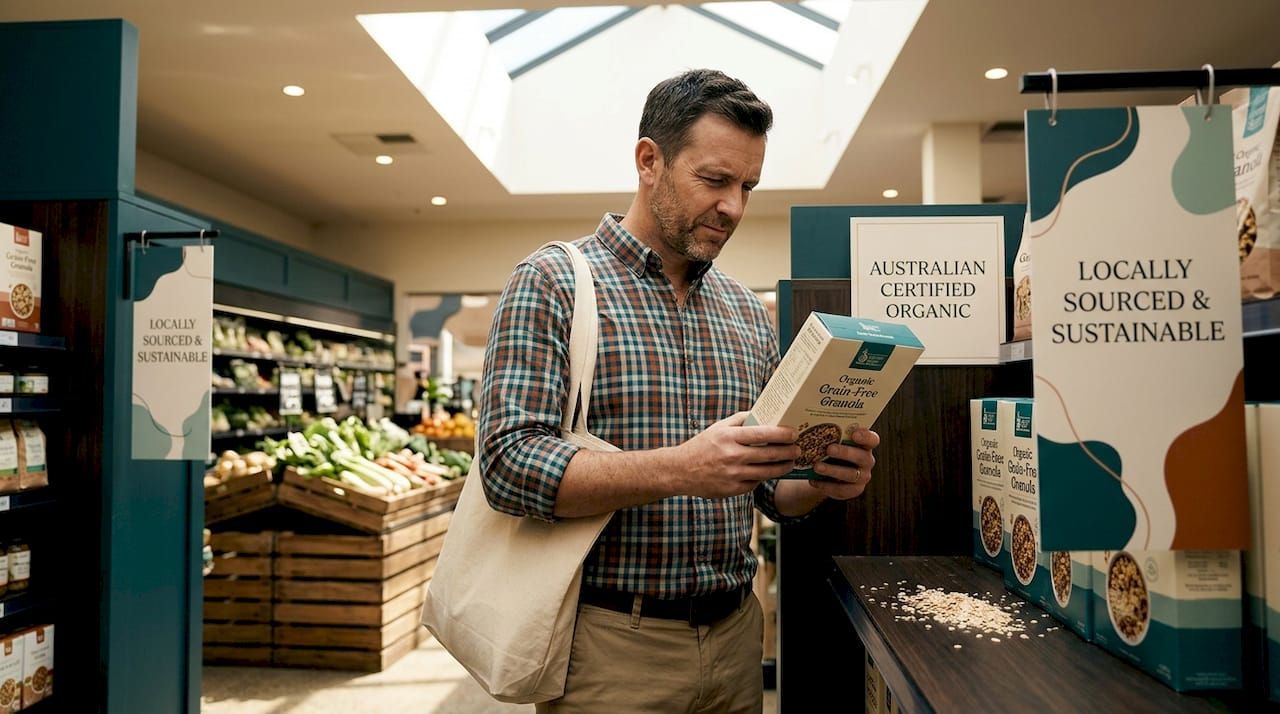
- Third-party validation. Certifications from recognised bodies, whether B Corp, Australian Certified Organic, or similar, provide independent assurance that claims are not self-serving.
- Accessible information. Transparency reports, supply chain disclosures, and environmental impact data should be easy to find on the company website or in marketing materials.
Building trust in marketing for Australian audiences requires a long-term commitment. One well-crafted campaign is not enough. Trust is built through repeated, consistent, honest communication over time.
Greenwashing: How to avoid common pitfalls
Given the scepticism, it is vital to understand how sincere green marketing differs from risky greenwashing. Greenwashing refers to the practice of making misleading or unsubstantiated environmental claims to influence consumer purchasing decisions or improve brand perception.
The forms greenwashing takes are varied. Common examples include using vague terms such as “eco-friendly” or “green” without supporting evidence, making future sustainability commitments without a credible plan to achieve them, focusing on a single environmental attribute while ignoring significant negative impacts elsewhere in the product lifecycle, and using misleading imagery (such as lush forests) to imply environmental credentials that do not exist.
Regulatory risks are real. In 2022, the US Federal Trade Commission fined Kohl’s and Walmart $5.5 million for misleading environmental claims. In Australia, the Australian Competition and Consumer Commission (ACCC) and the Australian Association of National Advertisers (AANA) both have the authority to investigate and penalise misleading green claims. The ACCC has explicitly stated that vague and unsubstantiated environmental claims may breach the Australian Consumer Law.
| Authentic green marketing | Greenwashing |
|---|---|
| Specific, measurable claims with evidence | Vague language: “natural,” “green,” “eco” |
| Third-party certification referenced | Self-declared sustainability without verification |
| Full lifecycle considered and disclosed | Single-attribute focus ignoring broader impact |
| Future goals backed by a concrete plan | Aspirational claims with no roadmap |
| Limitations acknowledged openly | Only positive outcomes communicated |
Steps to substantiate your environmental claims and avoid greenwashing:
- Audit the full product or service lifecycle. Identify every point at which environmental impact occurs, from supply chain inputs through to disposal.
- Use specific, quantified language. Replace “reduced emissions” with “reduced Scope 1 emissions by 18% since 2022, verified by [certifier].”
- Seek independent certification. Third-party verification removes the perception of self-interest from claims.
- Review claims against ACCC and AANA guidelines. Both bodies publish clear guidance on what constitutes acceptable environmental marketing language.
- Document the evidence trail. Maintain records that support every claim made in advertising and marketing materials.
Avoiding greenwashing in digital spaces is particularly important because online claims reach wide audiences quickly and are archived permanently. Ethical marketing guidance for purpose-driven organisations reinforces that honesty and specificity are non-negotiable. Learning from sustainable business best practices can also help frame the broader organisational context in which green marketing sits.
Pro Tip: Third-party certifications such as B Corp, Carbon Neutral certification, or Australian Certified Organic significantly increase consumer trust and reduce the risk of regulatory scrutiny.
Practical steps: Building authentic green marketing in your organisation
With the risks of greenwashing in mind, here is how to create a credible green marketing strategy your audience can trust. The following steps provide a practical foundation for organisations of any size.
The supply chain challenge is significant. Only 29% of Fortune 500 companies trace their carbon footprints beyond Tier 1 suppliers, and 68% of BlackRock’s investment engagement reviews scrutinise environmental marketing claims. For Australian businesses, this signals both the standard being set globally and the scrutiny that is coming locally.
- Assess the true environmental impact. This means going beyond direct operations. It includes the environmental footprint of suppliers, logistics partners, packaging manufacturers, and end-of-life product pathways. A credible green marketing claim cannot ignore significant upstream or downstream impacts.
- Communicate with transparency. Detail certifications, methodologies, and measurable results in marketing materials. Avoid hiding caveats in fine print. If a product is partially sustainable, say so. Consumers respond better to partial honesty than to overclaiming.
- Educate staff and suppliers. Green marketing is not solely a communications function. Staff need to understand the organisation’s environmental values and policies so that their behaviour is consistent with what is being marketed. Suppliers should be required to meet defined environmental standards as a condition of the commercial relationship.
Common pitfalls that Australian SMEs encounter in green marketing include:
- Treating sustainability as a marketing department responsibility rather than an organisational-wide commitment
- Making claims based on intention rather than current practice
- Failing to update marketing materials when products or practices change
- Underestimating the reputational damage caused by a single unsupported claim being exposed publicly
- Assuming consumers will not check the evidence behind a claim
The digital expression of your sustainability values is part of this picture. A sustainable digital design approach to your website, including green hosting, efficient code, and accessibility, demonstrates values in action rather than in words alone.
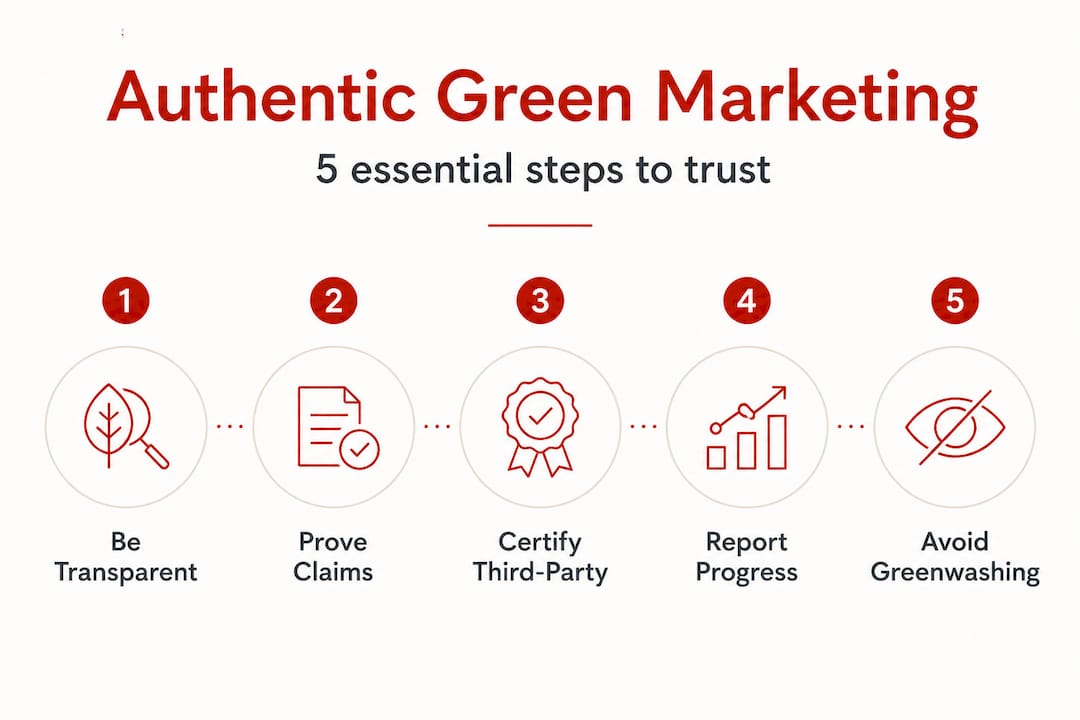
Pro Tip: Communicate progress honestly. Sharing that you have achieved 60% of a sustainability target, along with a credible plan for the remainder, builds more trust than claiming complete success prematurely.
Why authenticity beats perfection in green marketing
A common assumption in green marketing is that organisations need to present a perfect environmental record before they can speak credibly about sustainability. This is not supported by what Australian consumers actually say they want.
Research consistently shows that green marketing builds a genuine competitive edge for Australian businesses targeting eco-conscious consumers, particularly given the 84% climate concern rate. But the same data on 82% distrust levels makes clear that the way claims are made matters as much as the claims themselves.
Brands that gain loyalty in the sustainability space tend to share their journey openly. They acknowledge where they started, what they have achieved, what remains unresolved, and what the next steps are. This approach is fundamentally different from brands that present an idealised sustainability narrative and then fail to support it under scrutiny.
Overclaiming erodes trust far faster than admitting work-in-progress status. When a brand is exposed for overstating its environmental credentials, the reputational damage extends beyond the specific claim. Consumers begin to question everything the brand has ever communicated about sustainability. That loss of credibility is very difficult to recover.
By contrast, brands that are open about their limitations tend to build stronger relationships with environmentally conscious consumers. This is because sustainability-minded audiences are often well-informed. They understand that genuine progress is incremental. They do not expect perfection. What they will not tolerate is dishonesty.
The practical lesson from digital stewardship lessons at Marzipan is that this same principle applies to the digital environment. Sustainable web practices are not binary. An organisation can commit to reducing its digital carbon footprint progressively, communicate that commitment clearly, and earn credibility through demonstrated action over time.
How Marzipan can help your organisation market sustainably
If you are ready to make your green marketing strategy credible and effective, here is how Marzipan can help.
Marzipan works with purpose-driven organisations across Australia to build digital presences that reflect their values. From sustainable website rebuilds that reduce environmental impact through efficient design and ethical hosting choices, to SEO and digital marketing strategies grounded in transparency and long-term trust, Marzipan’s approach is practical and values-aligned. For marketing professionals and business owners looking to connect with eco-conscious Australian consumers without overpromising, Marzipan offers the strategic and technical support to do that credibly. Get in touch to discuss how your organisation can market sustainably without compromise.
Frequently asked questions
What is green marketing in simple terms?
Green marketing is promoting products or services by emphasising their environmental and sustainability benefits, provided those claims are accurate and substantiated.
How can businesses avoid greenwashing in Australia?
Businesses should use specific, evidence-backed claims, obtain third-party certification where possible, and ensure all marketing content complies with ACCC and AANA guidelines on environmental advertising.
What do Australian consumers want from green marketing?
Australians expect honesty, transparency, and credible proof of sustainability commitments. 76% consider sustainability in purchase decisions, but 82% currently distrust green claims, making evidence and specificity essential.
Is green marketing only for big brands?
No. Businesses of any size can practise authentic green marketing. The key is that claims are proportionate to actual practice, clearly communicated, and supported by evidence appropriate to the organisation’s scale.
Does green marketing actually help sales?
Yes, when executed with credibility. Authentic green marketing builds competitive advantage among eco-conscious consumers, increasing trust, engagement, and long-term loyalty in a market where sustainability increasingly drives purchasing decisions.
Recommended
- Eco-friendly business tips: drive sustainability and cut costs – Marzipan
- Best digital marketing agency websites in Australia: 62% prioritise sustainability – Marzipan
- Green Web Hosting Australia | Compare Eco-Friendly Hosting Providers | Marzipan Media
- Eco-friendly design explained: Build sustainable impact online – Marzipan
- Certificate IV Environmental Sustainability Australia | Green Career Online | CTDI — Canterbury Training and Development Institute