TL;DR:
- Authenticity and operational consistency are essential for successful mission-driven marketing.
- Transparent storytelling and community involvement build deeper trust and supporter loyalty.
- Poor alignment between mission and actions can damage reputation and trust.
Many community organisations in Sydney believe that having a compelling mission is enough to attract and retain supporters. It is not. Purpose-led brands outperform only when authenticity and operational excellence align with that mission. Without both, even the most inspiring purpose statement risks being dismissed as hollow. This article explains what genuine mission-driven marketing looks like, where it succeeds, where it fails, and how community-focused organisations can build digital strategies that hold up under scrutiny. Practical frameworks, real-world examples, and actionable steps are covered throughout.
Table of Contents
- What is mission-driven marketing?
- Evidence: Why mission-driven brands achieve deeper trust
- Mission without substance: Common pitfalls
- Making mission-driven marketing work: Practical steps
- Building long-term engagement: Measuring and evolving impact
- Our perspective: Why true mission alignment trumps surface-level purpose
- How Marzipan helps mission-driven brands in Sydney grow ethically
- Frequently asked questions
Key Takeaways
| Point | Details |
|---|---|
| Authentic mission wins | Mission-driven marketing only works if actions and communications align with real values. |
| Evidence shows impact | Brands like Tony’s Chocolonely and Patagonia prove that mission can grow trust and revenue when backed by substance. |
| Avoid purpose-washing | Superficial mission messaging can erode credibility if not supported by operations and transparency. |
| Measure and adapt | Continually track, report, and learn from impact metrics to build enduring community support. |
What is mission-driven marketing?
Mission-driven marketing places an organisation’s ethical or community goal at the centre of every communication and strategy. It is not a campaign style or a seasonal initiative. It is an ongoing commitment to transparency, consistent action, and honest storytelling that reflects the organisation’s actual values.
This approach differs from traditional marketing, which focuses on direct promotion of products or services. It also differs from generic purpose marketing, where brands attach themselves to a cause without meaningful operational change. Mission-driven marketing requires that the cause shapes decisions across the entire organisation, not just the communications team.
The core ingredients of mission-driven marketing include:
- Transparency: Openly sharing how decisions are made and how resources are used
- Consistent action: Ensuring that what the brand does matches what it says
- Ethical storytelling: Using real stories and honest data rather than manufactured narratives
- Community involvement: Actively including supporters and beneficiaries in the brand’s direction
Tony’s Chocolonely’s marketing success demonstrates the power of building transparency and values into every layer of a brand, from product design to packaging to public reporting. Their approach is instructive for any organisation seeking to build credibility online.
For organisations building their digital presence, building SEO-friendly mission websites is a practical starting point for ensuring that mission-aligned content is also discoverable.
Pro Tip: Write down your organisation’s mission in one sentence. Then audit your last five pieces of content. If the mission is not visible in each one, there is a gap to address.
Evidence: Why mission-driven brands achieve deeper trust
Real-world examples provide strong evidence that mission-first marketing delivers measurable results. Tony’s Chocolonely grew into a $230 million brand while spending comparatively little on traditional advertising. Their unequal chocolate bar, designed to represent inequality in the cocoa supply chain, became a physical symbol of their mission. Customers became advocates because the brand’s actions matched its words.

Patagonia’s ‘Don’t Buy This Jacket’ campaign took a different but equally striking approach. By actively discouraging unnecessary consumption, Patagonia strengthened loyalty among customers who shared their environmental values. The campaign increased advocacy precisely because it prioritised mission over short-term sales.
For nonprofits, the results are similarly compelling. Mission-centric SEO campaigns for organisations like MEDLIFE have produced significant gains in online visibility and supporter engagement.
“When a brand’s mission is visible in its operations, its content, and its community relationships, trust follows naturally. Campaigns become conversations.”
Here is a comparison of mission-driven versus traditional marketing approaches:
| Factor | Mission-driven marketing | Traditional marketing |
|---|---|---|
| Primary focus | Community or ethical goal | Product or service promotion |
| Trust mechanism | Transparency and action | Brand awareness and reach |
| Audience relationship | Collaborative and ongoing | Transactional |
| Content tone | Honest and values-led | Persuasive and promotional |
Practical steps for building trust through mission alignment include:
- Publish open impact reports on a regular schedule
- Conduct honest assessments of where the organisation falls short
- Create channels for community feedback and act on what is shared
- Use digital branding case studies to benchmark your own approach against others
Mission without substance: Common pitfalls
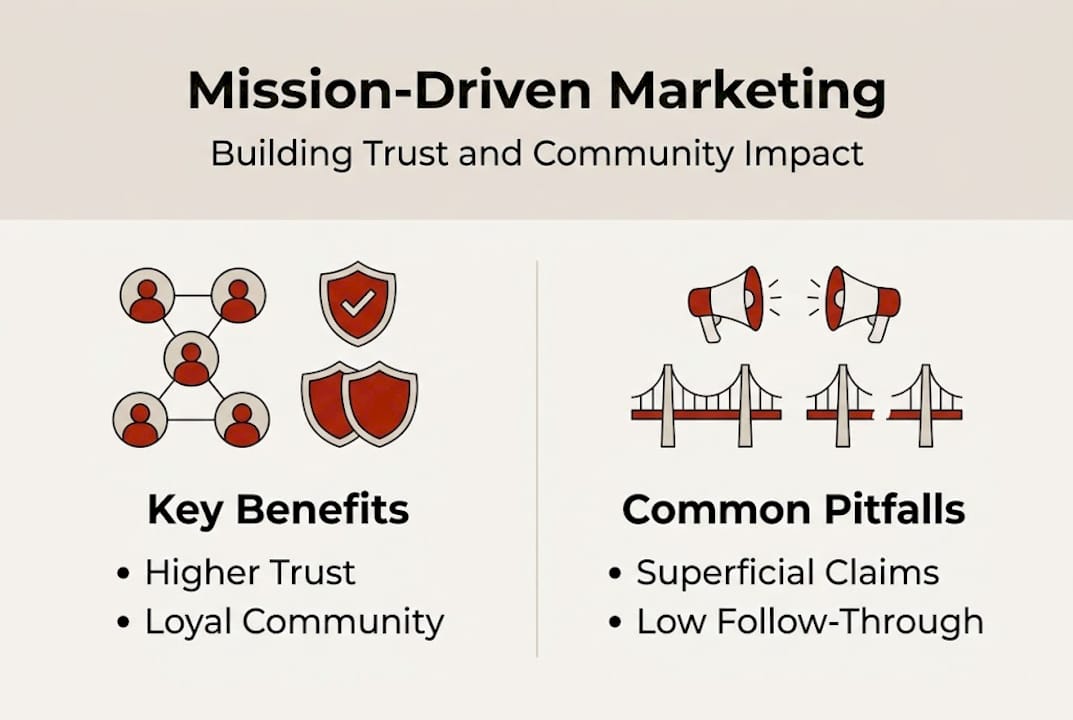
A strong mission does not guarantee marketing success. Several well-documented patterns show where mission messaging can misfire, sometimes damaging the very trust it was meant to build.
The most common mistakes include:
- Superficial cause marketing: Attaching a cause to a campaign without changing operations or policies
- Lack of transparency: Making claims about impact without sharing verifiable data
- Ignoring community feedback: Treating supporters as an audience rather than participants
- Inconsistent behaviour: Acting in ways that contradict the stated mission
Mission-driven messaging can backfire when it is not matched by operational excellence and genuine product or service quality. The Stengel 50, a widely cited list of purpose-led brands, has faced scrutiny because some brands on the list underperformed peers in commercial terms. Purpose alone does not drive results.
The following table illustrates the difference between mission presence and actual long-term performance:
| Scenario | Mission presence | Operational backing | Long-term outcome |
|---|---|---|---|
| Authentic alignment | High | Strong | Sustained trust and growth |
| Surface-level purpose | High | Weak | Reputational risk |
| No mission focus | Low | Strong | Moderate commercial success |
| No mission, no backing | Low | Weak | Decline |
For organisations seeking to avoid these traps, SEO for nonprofit outcomes provides guidance on building discoverability without compromising values. Understanding ethical digital stewardship is equally important for ensuring that digital choices reflect organisational principles.
Pro Tip: Before publishing any impact claim, ask whether you can back it with publicly available data. If you cannot, the claim is not ready to publish.
Making mission-driven marketing work: Practical steps
With common pitfalls identified, organisations can take deliberate steps to align their digital marketing with their mission in a way that is both authentic and effective.
- Define and communicate your mission story: Write a clear, specific account of why the organisation exists, who it serves, and what it has achieved. Avoid vague language.
- Integrate purpose into all content: Every blog post, social update, and email should connect back to the mission. This is not about repeating a slogan but about showing how daily work reflects the organisation’s values.
- Audit for authenticity: Review existing content and digital channels to identify gaps between what the organisation says and what it does.
- Optimise for discoverability: Use local SEO impact strategies to ensure that mission-aligned content reaches the right audiences in Sydney and beyond.
- Conduct regular SEO audits: SEO audits for purpose-led sites help identify technical and content issues that may be limiting visibility.
- Build community collaboration online: Create spaces where supporters can contribute, share feedback, and see how their input shapes the organisation’s direction.
Mission-centric content has produced measurable results. MEDLIFE’s online engagement grew by 80% through SEO strategies that centred on their mission rather than generic promotional content.
Key actions for ongoing alignment include:
- Schedule quarterly content audits against mission criteria
- Track which content generates the most supporter action
- Update impact data regularly to keep content accurate and credible
Pro Tip: Use regular impact measurement to generate content. When you track what changes, you create a steady stream of honest, credible stories that demonstrate results rather than just ideals.
Building long-term engagement: Measuring and evolving impact
Mission-driven marketing does not end with a campaign. Sustained impact requires ongoing measurement, honest reporting, and a willingness to adapt based on what the data shows.
Meaningful metrics for community organisations include:
- Online reach: How many people are finding and engaging with mission-aligned content
- Supporter actions: Sign-ups, donations, volunteer registrations, and shares
- Loyalty growth: Repeat engagement from existing supporters over time
- Direct impact: Measurable outcomes linked to the organisation’s stated goals
Connecting community stories with digital tracking creates a feedback loop. When supporters see their contributions reflected in transparent reporting, they are more likely to remain engaged and advocate for the organisation.
“Honest reporting and ongoing measurement are critical to sustained support and trust. Organisations that share both successes and setbacks build deeper credibility than those that only highlight wins.”
Regular website audits are a practical tool for maintaining this alignment. Learning how to conduct website audits ensures that the digital presence continues to reflect the organisation’s current mission and performance.
Social media also plays a role. Platforms like Instagram can be used for ethical engagement when content is grounded in real stories and transparent reporting rather than curated highlights.
Organisations that treat measurement as a communication tool, not just an internal management exercise, tend to build stronger long-term relationships with their communities.
Our perspective: Why true mission alignment trumps surface-level purpose
There is a pattern worth noting. Organisations that treat their mission as a marketing message tend to struggle. Those that treat it as an operational standard tend to grow. The difference is not in the quality of the copywriting. It is in whether the mission runs through the people, the product, the processes, and the communications simultaneously.
Surface-level purpose carries real risk. When a community notices a gap between what an organisation claims and what it does, the reputational damage is often disproportionate to the original offence. Trust, once lost in a values-led context, is difficult to recover.
The hardest work in mission-driven marketing is internal. It is about ensuring that the people delivering services, managing finances, and making strategic decisions are all accountable to the same values that appear in public communications. External marketing is the last step, not the first.
Organisations that build this way tend to spend less on advertising and more on substance. Their digital marketing philosophy becomes an extension of how they operate, not a separate function trying to manage perceptions.
How Marzipan helps mission-driven brands in Sydney grow ethically
Putting these principles into practice requires the right digital foundation. Marzipan works with purpose-led organisations in Sydney to build websites, SEO strategies, and digital campaigns that reflect genuine values rather than surface-level positioning.
From digital marketing for high-trust organisations to sustainable web design, Marzipan’s services are designed to strengthen online visibility while keeping organisations consistent with their sustainable values. Whether you need a full website audit, a content strategy aligned with your mission, or support with local SEO in Sydney, the team at Marzipan can help. Get in touch to discuss how ethical digital growth can work for your organisation.
Frequently asked questions
What is the main benefit of mission-driven marketing?
Mission-driven marketing builds trust and community engagement, leading to longer-term loyalty and advocacy. Patagonia and Tony’s Chocolonely both saw boosted loyalty and engagement through mission-led campaigns.
Can mission-driven marketing ever fail?
Yes, if the mission is not authentic or backed by strong products and operations, communities can lose trust or ignore the brand. Purpose alone can backfire without operational excellence to support it.
How can small community organisations apply mission-driven tactics online?
Start by clearly communicating your purpose, using authentic stories, and regularly auditing your digital presence for alignment. SEO and digital audits help align mission with discoverability from the ground up.
What metrics should be used to measure mission-driven marketing?
Online engagement, supporter actions, loyalty growth, and transparent impact reporting are key metrics. Honest reporting and ongoing measurement sustain trust and long-term impact for community organisations.
Recommended
- How to Make SEO Friendly Website for Mission-Driven Brands – Marzipan
- Why audit your website: boost impact and trust ethically – Marzipan
- Sydney Digital Agency: Ethical Impact For Community Brands – Marzipan
- 7 Video Marketing Ideas for Community Engagement – Marzipan
- Posts tagged with ‘community’ | Astro Starter Pro