

TL;DR:
- Outdated websites in Sydney mission-driven organisations harm credibility, accessibility, and the environment.
- Upgrading with sustainable practices like green hosting, image compression, and ethical SEO significantly reduces carbon emissions.
- Regular audits and a structured approach ensure ongoing accessibility, SEO, and community engagement.
Mission-driven organisations in Sydney face a specific challenge: outdated websites that undermine credibility, fail accessibility standards, and generate unnecessary carbon emissions. Research suggests that up to 90% emissions reduction is achievable when sustainable web practices are applied consistently. At the same time, many community organisations continue to operate sites built years ago, with uncompressed images, inaccessible code, and no coherent SEO strategy. This guide outlines a structured, practical approach for Sydney organisations ready to update their web presence in a way that reflects their values, improves performance, and strengthens community engagement.
Table of Contents
- Assessing your current website and setting sustainable goals
- Implementing sustainable web design solutions
- Embedding ethical SEO for lasting online authority
- Ensuring accessibility and ongoing website improvement
- A fresh perspective on web updates for social impact
- Next steps: expert help with sustainable web updates
- Frequently asked questions
Key Takeaways
| Point | Details |
|---|---|
| Evaluate your site | Begin with a content and sustainability audit to set clear, purpose-driven upgrade goals. |
| Implement sustainable design | Switch to green hosting, optimise media, and streamline code for major carbon and speed gains. |
| Adopt ethical SEO | Focus on authentic, locally tailored content and avoid shortcuts for trust and discoverability. |
| Maintain accessibility | Regularly check WCAG 2.1 AA compliance and train staff to embed accessibility at every update. |
| Consider a rebuild | For outdated or fragmented sites, a tailored Sydney rebuild can strengthen mission impact online. |
Assessing your current website and setting sustainable goals
Now that you understand the importance of updating your mission-driven site, let us begin by evaluating where you stand and what upgrades will yield the biggest gains.
A website review is the necessary starting point for any meaningful update. Without a clear picture of what currently exists, it is difficult to prioritise improvements or measure progress. For mission-driven organisations, the review process should cover five core areas: hosting infrastructure, image and media assets, code quality and structure, accessibility, and existing SEO practices.
Each of these areas carries direct consequences for both environmental performance and community reach. Poor hosting choices, for instance, contribute to higher energy consumption per page load. Unoptimised media files inflate page weight unnecessarily. Inaccessible code excludes users with disabilities. Weak SEO means fewer people find your work at all.
The following table compares common outdated practices with updated alternatives aligned to sustainable and mission-driven goals:
| Area | Outdated practice | Updated practice |
|---|---|---|
| Hosting | Shared conventional server | Accredited green hosting provider |
| Images | Large JPEGs with no compression | WebP format with responsive sizing |
| Code | Legacy plugins, bloated themes | Lean, semantic HTML and CSS |
| Accessibility | No alt text, poor colour contrast | WCAG 2.1 AA compliant structure |
| SEO | Keyword stuffing, generic copy | Ethical, localised, long-tail keywords |
Once you have reviewed each area, the next step is setting achievable goals. Not every issue needs to be resolved at once. Prioritising by impact is more practical.
Key high-impact improvements to consider first:
- Switch to green hosting to reduce server-side emissions immediately
- Compress and convert all images to WebP format to reduce page weight
- Add meaningful alt text to every image to improve both accessibility and SEO
- Review heading structure to ensure logical, screen-reader-friendly hierarchy
- Remove or update redundant pages identified during the content audit
Pro Tip: Use a Keep/Update/Delete content audit spreadsheet to systematically categorise every page and media asset. This approach saves time by focusing effort on content that directly supports your mission.
Understanding ethical design terminology is also useful at this stage, particularly when briefing developers or agencies unfamiliar with sustainable standards.
Unoptimised images are consistently the single largest contributor to digital emissions on most websites. Addressing them first delivers the most immediate reduction in carbon output and improves load speeds for all users.
The audit phase may feel time-consuming, but it provides a clear foundation for all subsequent decisions. Organisations that skip this step often end up making disconnected improvements that do not add up to a coherent, sustainable web presence. A structured review, completed once, informs every stage that follows. For further context on Sydney web impact and what local organisations are achieving, reviewing published case studies can provide realistic benchmarks.
Implementing sustainable web design solutions
Once you have set clear goals, the next step is to implement the most impactful upgrades for sustainability, without overwhelming your team.
Sustainable web design is not a single feature. It is a set of decisions made across hosting, code, media, and user experience that collectively reduce the energy a website consumes per visit. For community organisations with limited technical resources, focusing on the highest-impact changes first is the most practical strategy.
Core sustainable upgrades to implement:
- Green hosting: Switch to a provider powered by renewable energy. Australian options include Krystal Hosting and WHC, both of which offer documented sustainability credentials.
- Image optimisation: Convert all images to WebP format and use responsive image sizing so mobile users do not download desktop-sized files unnecessarily.
- Lazy-loading: Apply lazy-loading to all non-critical images and embedded media so they only load when a user scrolls to them.
- Clean, semantic code: Remove unused CSS, consolidate JavaScript files, and use semantic HTML elements to reduce page weight and improve accessibility.
- Dark mode and reduced-motion options: These small UX additions reduce screen energy use and improve experience for users with visual or motion sensitivities.
The following table compares green hosting providers available in Australia against conventional shared hosting:
| Provider | Energy source | Carbon neutral claim | Price range (AUD/month) |
|---|---|---|---|
| Krystal Hosting | 100% renewable | Yes | $10 to $30 |
| WHC | Green data centres | Partial | $8 to $25 |
| SiteGround | Renewable energy matching | Yes | $12 to $35 |
| Conventional shared host | Mixed/coal-heavy | No | $5 to $20 |
Pro Tip: Prioritise lazy-loading for all non-critical images before any other code changes. It requires minimal development effort and immediately reduces both page load time and per-visit emissions.
The data on sustainable UX improvements is notable. Research shows that per-page carbon can drop from 3.36g to 0.21g through systematic UX design changes, representing a 93% reduction. For an organisation with thousands of monthly visitors, that figure translates to a measurable reduction in digital carbon output each year.

Reviewing sustainable site terminology will help your team communicate these changes clearly with developers and stakeholders. Terms like lazy-loading, render-blocking resources, and core web vitals have specific meanings that inform technical decisions.
Organisations often underestimate how much conventional web design practices contribute to emissions. A website receiving 10,000 monthly visitors at an average of 3.36g of CO2 per page generates over 33kg of CO2 monthly. Bringing that figure down to 0.21g per page through green hosting and image optimisation reduces monthly emissions to approximately 2kg. The technical steps are achievable. The impact is real and quantifiable.
Embedding ethical SEO for lasting online authority
Sustainability lays a strong foundation, and ethical SEO ensures your renewed site is both discoverable and trusted by Sydney audiences.
Ethical SEO refers to search engine optimisation practices that build genuine authority over time, without manipulative shortcuts. For mission-driven organisations, this approach aligns naturally with values around honesty, community service, and long-term impact. It also tends to perform better in the long run, as search engines increasingly penalise low-quality or manipulative tactics.
Key steps to embed ethical SEO into your updated site:
- Identity-driven keyword mapping: Identify the terms your community actually searches for, not just high-volume generic keywords. Focus on phrases that reflect your specific programmes, location, and impact areas.
- Localised content: Reference Sydney neighbourhoods, local events, and community partners where relevant. This improves local search visibility and builds genuine connection with your audience.
- Privacy-focused analytics: Replace tools that track users aggressively with privacy-respecting alternatives that still provide actionable data.
- Accessible, story-driven copy: Write content that real people can read and understand. Plain language, proper heading structure, and authentic stories all contribute to both accessibility and SEO performance.
A clear workflow for embedding ethical SEO across your site:
- Audit existing SEO: Use a tool such as Google Search Console or Screaming Frog to identify missing meta descriptions, broken links, duplicate content, and pages with no organic traffic.
- Integrate authentic case studies: Publish real examples of your organisation’s work, using natural language that reflects how community members describe your services.
- Avoid black-hat tactics: Do not purchase backlinks, use keyword stuffing, or create duplicate pages for minor location variations. These tactics create short-term gains and long-term penalties.
- Focus on long-tail mission keywords: Phrases such as “youth employment support western Sydney” or “community garden programme Parramatta” attract smaller but highly relevant audiences more likely to engage with your work.
Pro Tip: Plausible Analytics is a privacy-first tool that provides traffic data without tracking individual users across sites. It is GDPR compliant and suitable for organisations committed to ethical data practices.
70% of Australian users prefer to click on organic search results rather than paid advertisements, reinforcing the value of building genuine authority through ethical SEO over time.
Resources on ethical SEO for nonprofits provide further guidance on avoiding common pitfalls while building credible online authority. For organisations preparing a full review, following a structured Sydney SEO audit process ensures no key areas are missed. Understanding semantic SEO for mission-driven orgs is also valuable, particularly when developing content that addresses multiple related topics in depth.
Natural keyword integration with local references and privacy-first analytics are the foundation of ethical SEO that fosters genuine community connections rather than simply gaming ranking algorithms.
Ensuring accessibility and ongoing website improvement
With sustainability and ethical SEO in place, maintaining accessibility and a culture of website improvement is the final step to ensuring lasting online impact.
Accessibility is not a one-time task. Websites evolve. Content is added, pages are restructured, and new media formats are introduced. Each change creates the potential for new accessibility gaps. Organisations committed to serving their communities need a structured routine for verifying that their site remains accessible and effective.
The Web Content Accessibility Guidelines (WCAG) 2.1 AA standard provides the benchmark. WCAG 2.1 AA compliance is considered the minimum standard for public-facing websites in Australia, and it aligns directly with the values of mission-driven organisations seeking to include rather than exclude.
The following table outlines core compliance checks, recommended tools, and suggested frequency:
| Criteria | Tool | Frequency |
|---|---|---|
| Alt text on images | WAVE, axe DevTools | Quarterly and after each content update |
| Heading hierarchy | Screaming Frog, manual review | Quarterly |
| Colour contrast ratio | Colour Contrast Analyser | At design stage and quarterly |
| ARIA labels and roles | axe DevTools, browser dev tools | Quarterly |
| Keyboard navigation | Manual keyboard testing | Biannually |
| Form labels and error messages | WAVE, manual testing | Quarterly |
Establishing a routine is as important as the initial audit. Organisations that conduct regular checks catch problems early and maintain a consistent standard for all users.
Key routines to adopt:
- Quarterly accessibility audits: Schedule these in advance and assign responsibility to a specific team member or external reviewer.
- Continuous content updates: Every new page, blog post, or media file should be reviewed for accessibility before publishing, not after.
- Stakeholder training: Ensure that anyone who updates the website understands basic accessibility requirements, including how to write useful alt text, use heading levels correctly, and check colour contrast.
- User feedback channels: Provide a visible way for users to report accessibility issues. This surfaces problems that automated tools miss.
Pro Tip: Set up a recurring calendar reminder to revisit both accessibility and SEO performance every quarter, or whenever your organisation’s impact goals shift significantly. Consistency over time produces better outcomes than periodic large-scale fixes.
Staying connected with Sydney web agency insights can help organisations understand current best practices and identify when professional support would accelerate progress. The web standards landscape changes regularly, and local expertise ensures your site remains compliant and competitive.
A fresh perspective on web updates for social impact
Technical upgrades alone may not be sufficient for organisations whose websites have grown through years of patched-together additions. In many cases, the cumulative weight of outdated content, legacy code, and inconsistent design makes incremental improvements less effective than a structured rebuild.
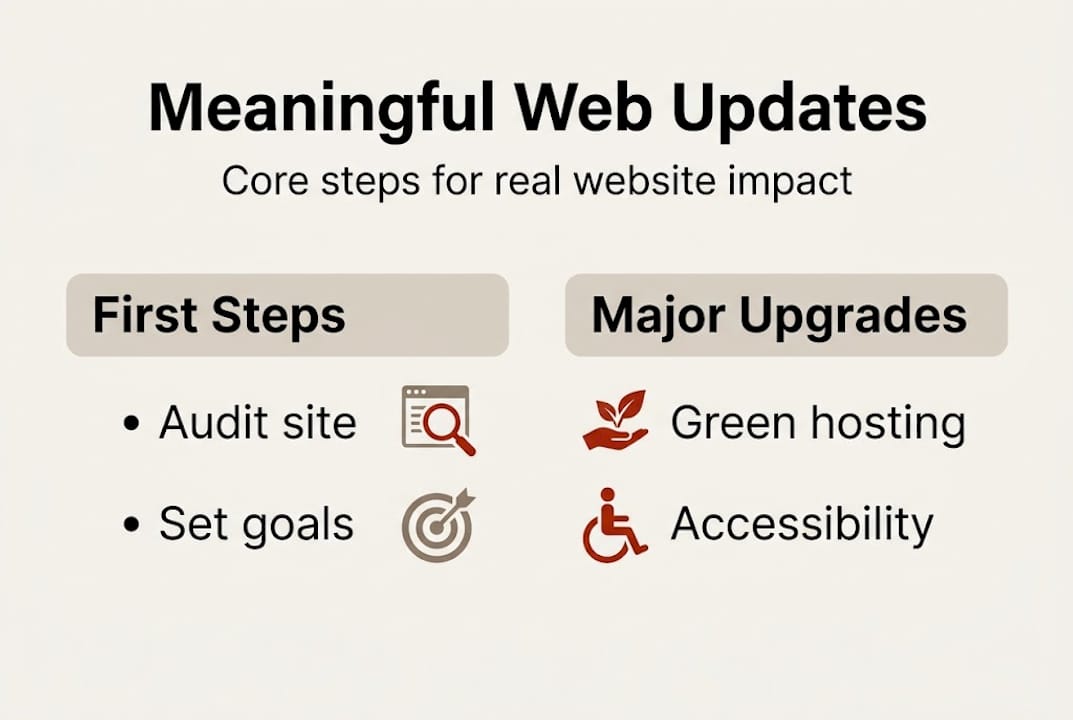
A full redesign, developed with a clear brief and local expertise, allows an organisation to build a site architecture that genuinely supports its mission from the ground up. Content hierarchies, navigation structures, and calls to action can all be designed with community users in mind, rather than retrofitted onto a framework that was never intended for that purpose.
Bespoke web design from local agencies consistently delivers stronger mission alignment and sustainable outcomes than generic templates or off-the-shelf solutions. A Sydney-based agency brings cultural familiarity with local communities, understanding of Australian accessibility expectations, and direct knowledge of relevant SEO patterns.
Working with Sydney agency expertise also means accountability and ongoing support, rather than a completed handover with no continued relationship. For organisations planning a meaningful web update in 2026, the question worth asking is not only “what can we fix?” but “what would we build if we started fresh with everything we now know?”
Next steps: expert help with sustainable web updates
Ready to amplify your organisation’s mission with a refreshed, sustainable, and effective web presence? Here is how to get specialised support.
Working with an agency experienced in sustainable and ethical web solutions removes the guesswork from the process. Marzipan helps mission-driven Sydney organisations build sites that perform well, reduce digital emissions, and attract the right audiences through ethical SEO.
Whether your organisation needs a full rebuild, a targeted SEO review, or support with Sydney digital marketing, the right starting point is a structured audit with expert guidance. Marzipan offers tailored support through sustainable web design solutions and ethical SEO services designed specifically for purpose-driven organisations. Each engagement is shaped around your mission, your community, and the outcomes that matter most to your work.
Frequently asked questions
What is the first step to update a website sustainably?
Begin with a content audit using a Keep/Update/Delete strategy and review your hosting, code, media assets, and accessibility for environmental and ethical gaps before making any changes.
How can mission-driven Sydney organisations make their site more discoverable?
Use ethical SEO with local targeting that incorporates local Sydney references, accessible and story-driven content, and privacy-focused analytics tools aligned with your mission values.
What sustainable features reduce a website’s carbon footprint the most?
Green hosting, converting images to WebP with compression, implementing lazy-loading, and writing lean semantic code are consistently the most effective steps for reducing per-page emissions.
How often should accessibility and SEO compliance be checked?
Review both accessibility and SEO performance at minimum once per quarter, and also whenever significant content changes, new sections, or updated impact goals are introduced to the site.
Does a full website rebuild offer more value than small fixes?
A full rebuild with local agency expertise can better align site structure, content, and performance to your mission and long-term sustainability goals than a series of disconnected incremental fixes.