Small businesses often overlook SEO, assuming it requires massive budgets or technical expertise. Yet SEO delivers an average ROI of 748% for small businesses, making it one of the most cost-efficient marketing channels available. This guide explores ethical SEO strategies tailored for Sydney’s small businesses and community organisations, showing you how to leverage organic search for sustainable growth without compromising your values. You’ll discover practical tactics, measurement frameworks, and local optimisation techniques that deliver real results.
Table of Contents
- How SEO Boosts Small Business Success: High ROI And Organic Growth
- Ethical SEO Practises For Small Businesses And Community Groups
- Local And Sustainable SEO Strategies Tailored For Sydney Small Businesses
- Measuring And Maximising SEO ROI For Small Businesses In 2026
- Unlock Your Small Business Potential With Expert SEO Services
- Frequently Asked Questions
Key takeaways
| Point | Details |
|---|---|
| High ROI potential | SEO delivers measurable growth with returns averaging 748% across small businesses |
| Ethical practices matter | Transparent, quality-focused strategies build lasting trust and authority online |
| Local targeting works | Sydney businesses can optimise visibility to reach community audiences effectively |
| Revenue over traffic | Track conversions and revenue attribution rather than vanity metrics |
| Long-term investment | Results compound after 6 months with consistent, strategic effort |
How SEO boosts small business success: high ROI and organic growth
The numbers tell a compelling story. SEO generates returns of 748% on average, with e-commerce businesses seeing 875% and real estate firms reaching 1,389%. These aren’t theoretical projections but documented outcomes from businesses that invested strategically in organic search. For Sydney’s small businesses and community organisations operating on tight budgets, this level of return transforms SEO from optional marketing tactic to essential growth driver.
Research confirms these patterns at scale. Meta-analysis demonstrates significant increases in organic rankings and traffic with a high effect size of d=1.049, meaning the impact is both statistically significant and practically meaningful. When you optimise your site properly, search engines reward you with visibility that compounds over time.
Beyond raw traffic numbers, SEO delivers several strategic advantages:
- Cost efficiency compared to paid advertising channels
- Targeted reach to audiences actively searching for your solutions
- Sustainable growth that doesn’t stop when ad budgets run out
- Authority building that strengthens brand trust
- 24/7 visibility without ongoing media spend
“SEO isn’t just about rankings. It’s about positioning your business where your customers are already looking, at the exact moment they need what you offer.”
The landscape continues evolving. AI-driven search in 2026 prioritises topic authority over keyword stuffing, rewarding businesses that demonstrate genuine expertise. Mission-led brands and community organisations particularly benefit from this shift, as authentic, value-driven content naturally aligns with what search engines now prioritise. Learning ethical SEO strategies for 2026 positions your organisation for success in this changing environment.
Understanding how to improve rankings ethically matters more than chasing quick wins. The businesses seeing 700%+ returns invest in sustainable practises that build momentum rather than shortcuts that risk penalties.
Ethical SEO practises for small businesses and community groups
Ethical SEO means optimising your online presence through transparent, honest methods that prioritise user value over manipulation. For mission-driven brands in Sydney, this approach aligns perfectly with organisational values whilst building sustainable search visibility. You’re not gaming the system but rather making it easier for search engines to understand and recommend your genuinely valuable content.
Key ethical principles include:
- Transparency in content creation and link building
- Honest representation of products, services, and organisational missions
- Quality-focused content that genuinely serves user intent
- Natural link acquisition through valuable resources
- Accessible website design that serves all users
- Privacy-respecting data collection practises
The shift towards AI-driven search in 2026 makes ethical practises even more critical. Search algorithms now prioritise topic authority over keyword density, meaning comprehensive, expert content outperforms thin pages stuffed with search terms. This rewards organisations that invest in substantive resources rather than shortcuts.

For small businesses starting their SEO journey, benchmarks suggest beginning with Google Business Profile optimisation plus 5 to 10 well-optimised pages and 1 to 2 blog posts monthly. This manageable approach builds momentum without overwhelming limited resources. Results typically compound after 6 months of consistent effort.
Pro tip: Avoid common unethical shortcuts like buying links, spinning content, hiding text, or creating doorway pages. These tactics might offer temporary gains but risk penalties that can devastate your online visibility. Search engines have become remarkably sophisticated at detecting manipulation, and recovery from penalties often takes longer than building authority properly from the start.
Community organisations particularly benefit from ethical approaches. When you demonstrate genuine expertise and commitment to your mission through quality content, you attract engaged supporters rather than casual browsers. This alignment between values and tactics makes SEO feel natural rather than compromising. Exploring ethical guidance for nonprofits helps mission-driven organisations navigate this landscape confidently.
Working with ethical local SEO specialists ensures your growth strategy respects both search engine guidelines and your organisational principles. The best results come from partnerships that understand your values aren’t constraints but competitive advantages in building authentic online presence.
Local and sustainable SEO strategies tailored for Sydney small businesses
Local SEO transforms how Sydney businesses and community organisations connect with their immediate audiences. Whilst general SEO targets broad search visibility, local optimisation focuses on geographically-relevant queries like “community centre Newtown” or “ethical web design Sydney.” This specificity matters enormously for organisations serving defined geographic areas.
Google Business Profile optimisation and local content form the foundation of effective local SEO. Your GBP listing acts as your primary local search asset, appearing in map results and local packs when Sydney residents search for relevant services. Complete, accurate profiles with regular updates signal active engagement to search algorithms.
Key local SEO strategies include:
- Optimising Google Business Profile with complete information, categories, and regular posts
- Incorporating Sydney-specific keywords naturally into content
- Building citations across local directories and community platforms
- Encouraging and responding to customer reviews
- Creating location-specific content addressing local needs and events
- Earning links from Sydney-based organisations and publications
| Aspect | General SEO | Local SEO |
| — | — |
| Target audience | Broad, potentially global | Geographically specific |
| Key ranking factors | Domain authority, content quality, backlinks | Proximity, GBP optimisation, local citations |
| Primary platforms | Organic search results | Map pack, local results, GBP |
| Content focus | Topic expertise and authority | Local relevance and community connection |
| Competition scope | Industry-wide competitors | Local market competitors |
Implementing local SEO systematically:
- Claim and fully optimise your Google Business Profile with accurate NAP (name, address, phone) details
- Ensure NAP consistency across all online directories and citations
- Create location-specific landing pages for each service area you serve
- Generate and respond to customer reviews on Google and relevant platforms
- Develop content addressing local search intent and community topics
- Build relationships with local organisations for natural link opportunities
- Monitor local search performance through Google Business Insights and Search Console
Pro tip: Consistency matters more than perfection in local SEO. Regular GBP updates, monthly review responses, and quarterly citation audits maintain momentum better than sporadic intensive efforts. Set calendar reminders for these maintenance tasks.
Sydney’s diverse neighbourhoods create opportunities for hyper-local targeting. A Newtown cafe optimising for “sustainable coffee Newtown” faces different competition than one targeting “sustainable coffee Sydney.” This granularity lets small businesses compete effectively against larger competitors by dominating specific geographic niches.
Exploring local SEO optimisation in Sydney reveals tactics specific to our market. Understanding how to leverage local SEO services nearby helps you evaluate potential partners based on their understanding of Sydney’s unique landscape.
Measuring and maximising SEO ROI for small businesses in 2026
Traditional SEO metrics like traffic and rankings tell incomplete stories. A site receiving 10,000 monthly visitors but generating no revenue performs worse than one with 1,000 visitors converting at 5%. The challenge lies in connecting SEO activities to actual business outcomes, particularly for small businesses without sophisticated analytics infrastructure.
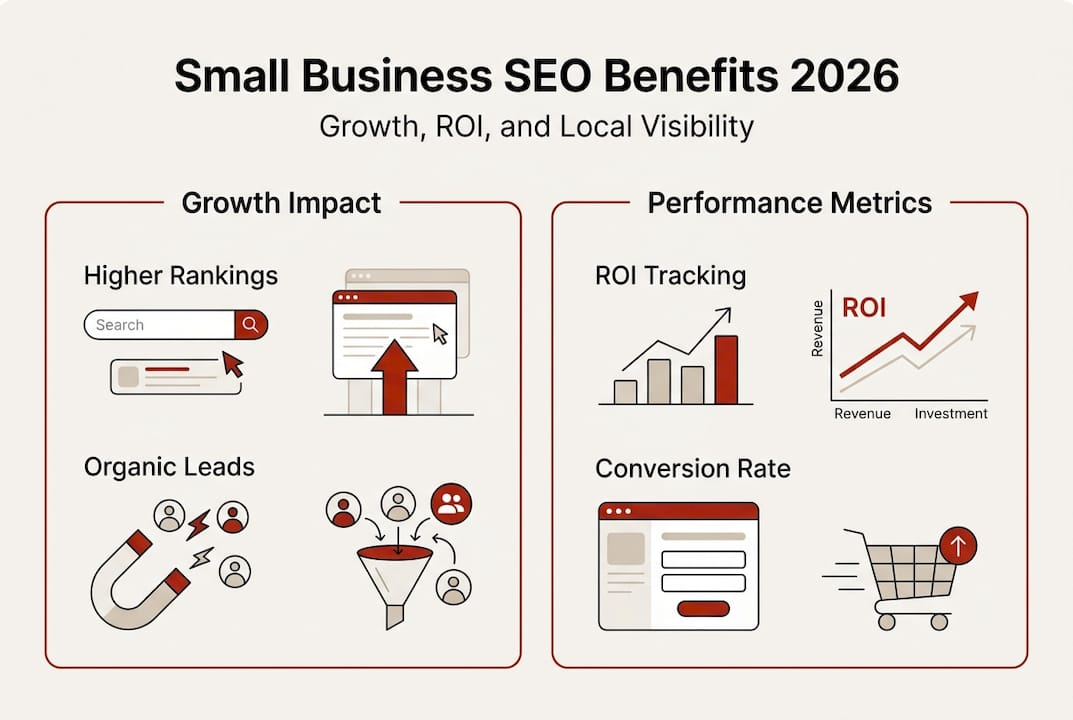
Revenue attribution models track conversions back to organic search touchpoints, revealing SEO’s true impact. First-click attribution credits the initial organic visit, whilst last-click attributes conversions to the final touchpoint before purchase. Multi-touch models distribute credit across the customer journey, offering more nuanced insights into how SEO contributes alongside other channels.
| Metric type | Traffic-focused | Revenue-focused |
| — | — |
| Primary measure | Page views, sessions | Conversions, revenue |
| Success indicator | Increasing visitor numbers | Growing qualified leads and sales |
| Business alignment | Indirect correlation | Direct impact measurement |
| Actionability | Limited strategic insight | Clear ROI calculation |
| Long-term value | Vanity metric risk | Sustainable growth tracking |
Best practises for tracking SEO success:
- Implement goal tracking in Google Analytics for key conversion actions
- Use UTM parameters to distinguish organic from other traffic sources
- Set up e-commerce tracking to measure revenue by channel
- Monitor assisted conversions showing SEO’s role in multi-touch journeys
- Track keyword rankings for commercially valuable terms
- Measure organic click-through rates and adjust title tags accordingly
- Calculate customer lifetime value by acquisition channel
- Review bounce rates and engagement metrics by landing page
Pro tip: Integrate Google Analytics, Search Console, and your CRM platform for holistic attribution insights. Tools like Google’s free Data Studio connect these data sources, revealing patterns invisible when examining platforms separately.
Patience remains essential. Meta-analysis confirms significant traffic and ranking increases from SEO investments, but results compound gradually. Small businesses typically see initial improvements within 3 to 4 months, with substantial momentum building after 6 months of consistent optimisation.
Benchmarks for realistic expectations:
- Months 1 to 3: Technical improvements, content foundation, minimal traffic changes
- Months 4 to 6: Ranking improvements for long-tail keywords, modest traffic increases
- Months 7 to 12: Competitive keyword rankings, substantial organic growth
- Year 2+: Compounding authority, sustained traffic growth, strong ROI
Conducting regular SEO audits for mission-driven organisations identifies optimisation opportunities and tracks progress against benchmarks. Quarterly reviews keep strategies aligned with evolving algorithms and business priorities.
Understanding ethical SEO strategies specific to 2026 ensures your measurement approach reflects current best practises. The businesses achieving 700%+ returns track what matters, adjust based on data, and maintain consistent effort through the compounding phase.
Unlock your small business potential with expert SEO services
Ready to transform your online visibility? Marzipan combines ethical AI, sustainable web design, and performance-driven SEO to help Sydney’s mission-led brands grow without compromising their values. We understand the unique challenges facing small businesses and community organisations, creating strategies that scale impact rather than noise.
Our AI-powered SEO services leverage cutting-edge technology whilst maintaining transparent, ethical practises. We don’t chase algorithmic shortcuts but build sustainable authority that compounds over time. From local optimisation to comprehensive content strategies, we tailor approaches to your specific goals and budget.
Explore our flexible pricing options designed for organisations at different growth stages. Whether you’re just starting your SEO journey or scaling existing efforts, we offer solutions that deliver measurable results without breaking the bank. Our commitment to sustainability extends beyond strategy. Discover how our green hosting solutions reduce your digital carbon footprint whilst maintaining exceptional performance. Let’s build your online presence the right way.
Frequently asked questions
What are the biggest benefits of SEO for small businesses?
SEO delivers exceptional ROI averaging 748% whilst building sustainable visibility that doesn’t disappear when advertising budgets run out. It targets audiences actively searching for your solutions, creating qualified leads rather than interrupting potential customers. The authority and trust you build through quality content strengthens your brand positioning across all channels. Understanding local SEO optimisation helps Sydney businesses maximise these advantages.
How soon can small businesses expect to see results from SEO?
Results typically begin compounding after 6 months of consistent optimisation effort. Initial improvements in long-tail keyword rankings often appear within 3 to 4 months, but substantial traffic growth requires patience. The businesses seeing 700%+ returns maintain steady effort through this building phase rather than expecting overnight transformation. SEO rewards persistence with momentum that accelerates over time.
Is ethical SEO more expensive or difficult for small businesses?
Ethical SEO requires more thoughtful strategy upfront but reduces long-term risks and costs associated with penalties or reputation damage. Quality content creation and natural link building take time, yet these investments compound rather than requiring constant spending like paid advertising. The difficulty lies in patience and consistency rather than technical complexity. Most small businesses find ethical approaches more sustainable and aligned with their values once they understand the framework.
How does local SEO help community organisations in Sydney?
Local SEO connects Sydney organisations with geographically-relevant audiences actively seeking community resources and services. It improves visibility in map results and local search packs when residents search for nearby solutions. This targeting increases engagement quality, attracting supporters genuinely interested in your mission rather than casual browsers. Optimising for local search in Sydney builds stronger community connections and measurable impact.
What are key metrics to track SEO success besides website traffic?
Focus on revenue attribution, conversion rates, and customer engagement metrics that connect organic search to business outcomes. Track assisted conversions showing SEO’s role across multi-touch customer journeys. Monitor bounce rates and time on page by landing page to assess content quality. Calculate customer lifetime value by acquisition channel to understand long-term SEO impact. Integrated analytics platforms reveal patterns invisible when examining traffic numbers alone.