Mission-driven organisations often pour resources into meaningful work but struggle to reach their audiences online. Poor visibility doesn’t reflect your impact, it reflects technical barriers and missed SEO opportunities. A thorough SEO audit reveals these hidden issues and provides a roadmap to boost your online presence whilst maintaining your ethical values and accountability to your community.
Table of Contents
- Introduction To SEO Audits
- Prerequisites Before Starting An SEO Audit
- Step-By-Step SEO Audit Process
- Common SEO Audit Mistakes And Troubleshooting
- Expected Outcomes And Success Metrics From A Well-Executed SEO Audit
- Enhance Your Mission-Driven Impact With Expert SEO Support
- Frequently Asked Questions
Key takeaways
| Point | Details |
|---|---|
| Comprehensive coverage | SEO audits examine technical health, on-page elements, content quality, and off-page signals to identify improvement opportunities. |
| Essential preparation | Access to Google Search Console, Screaming Frog, and PageSpeed Insights ensures thorough analysis aligned with your mission. |
| Systematic approach | Following structured steps from technical checks through ethical alignment prevents oversights and maximises impact. |
| Common pitfalls | Neglecting mobile optimisation and site speed accounts for most audit failures and ranking drops. |
| Measurable results | Well-executed audits typically reduce bounce rates by 25% and increase organic traffic by 30% within months. |
Introduction to SEO audits
An SEO audit systematically evaluates your website’s performance across four core areas: technical infrastructure, on-page optimisation, content quality, and off-page signals. For mission-driven organisations, this process goes beyond rankings to ensure your digital presence authentically represents your values whilst reaching people who need your services.
Regular SEO audits help organisations maintain visibility and adapt to evolving search engine criteria. Google updates its algorithm hundreds of times yearly, making periodic reviews essential rather than optional.
The four audit areas work together:
- Technical SEO ensures search engines can crawl, index, and understand your site structure efficiently
- On-page optimisation aligns individual pages with user intent through strategic keywords, meta data, and content structure
- Content quality evaluates whether your material genuinely serves audience needs whilst reflecting organisational expertise
- Off-page factors assess external signals like backlinks, brand mentions, and digital reputation
Mission-driven groups face unique considerations. Your audit must balance visibility goals with ethical standards, avoiding manipulative tactics that compromise trust. Accessibility becomes non-negotiable when your mission centres equity and inclusion. Understanding these nuances transforms a standard audit into a strategic tool for ethical growth with SEO that scales impact authentically.
Prerequisites before starting an SEO audit
Successful audits require specific tools, permissions, and contextual knowledge. Without proper preparation, you’ll miss critical issues or waste time on surface-level problems.
Start with these essential tools:
- Google Search Console provides direct data on how Google sees your site, including indexing issues, search queries, and mobile usability problems
- Screaming Frog SEO Spider crawls your entire site to identify broken links, duplicate content, and technical errors
- PageSpeed Insights measures loading performance and highlights specific improvements
- Analytics platform (Google Analytics or privacy-focused alternatives) tracks user behaviour and conversion patterns
Access to these tools and basic SEO knowledge significantly improves audit effectiveness. You’ll need administrator access to your website, hosting environment, and analytics accounts. Without these permissions, you can only perform surface-level analysis.
| Tool | Primary Function | Cost |
|---|---|---|
| Google Search Console | Indexing and search performance data | Free |
| Screaming Frog | Site crawling and technical analysis | Free (limited) / £149 yearly |
| PageSpeed Insights | Performance measurement | Free |
| Ahrefs/SEMrush | Backlink analysis and keyword research | From $99 monthly |
Before starting, verify your sitemap is current and accessible at yoursite.com/sitemap.xml. Check your robots.txt file isn’t accidentally blocking important pages. These foundational elements guide crawlers and directly impact what appears in search results.
Understand your organisation’s mission deeply. Ethical SEO choices during the audit depend on knowing what tactics align with your values. If transparency matters to your community, you’ll approach link building differently than organisations comfortable with grey-area strategies. This context shapes every ethical SEO prerequisite and recommendation.
Step-by-step SEO audit process
1. Prepare your audit environment
Set up a spreadsheet to track findings across audit areas. Create sections for technical issues, on-page problems, content gaps, and off-page opportunities. This organisation prevents lost insights during implementation.
Verify all tools connect properly to your site. Run a quick crawl in Screaming Frog to confirm access. Check Search Console shows recent data.
2. Technical SEO examination
Begin with crawlability. Search engines must access and understand your site structure before ranking becomes possible. Run a complete site crawl and identify:
- Pages returning 404 errors or redirect chains longer than two hops
- Orphaned pages with no internal links pointing to them
- XML sitemap errors or pages excluded from the sitemap
- Robots.txt rules inadvertently blocking important content
Next, examine indexing. Use the site:yoursite.com search operator in Google to see indexed pages. Compare this number to your actual page count. Significant discrepancies indicate indexing problems requiring immediate attention.
Evaluate site speed. Mobile page loads exceeding three seconds lose 53% of visitors. Run PageSpeed Insights on key pages and prioritise Core Web Vitals improvements: Largest Contentful Paint, First Input Delay, and Cumulative Layout Shift.

Check mobile usability through Search Console’s Mobile Usability report. Touch targets must be adequately sized, content must fit screens without horizontal scrolling, and text must remain readable without zooming.
3. On-page optimisation review
Systematic audits covering on-page SEO identify key barriers and opportunities. Examine these elements page by page:
- Title tags should be unique, 50-60 characters, and include target keywords naturally
- Meta descriptions must compellingly summarise page content in 150-160 characters
- Heading structure requires proper hierarchy (single H1, logical H2-H6 progression)
- URL structure works best when short, descriptive, and keyword-rich
- Image optimisation demands descriptive alt text and compressed file sizes
Analyse keyword usage. Are you targeting terms your audience actually searches? Do pages match search intent, or do they answer different questions than users ask? Tools like Google Search Console show which queries already drive traffic, revealing optimisation opportunities.
4. Content quality assessment
Evaluate whether content genuinely serves user needs. Thin pages with under 300 words rarely rank well unless they serve specific navigational purposes. Duplicate content confuses search engines about which version to rank.
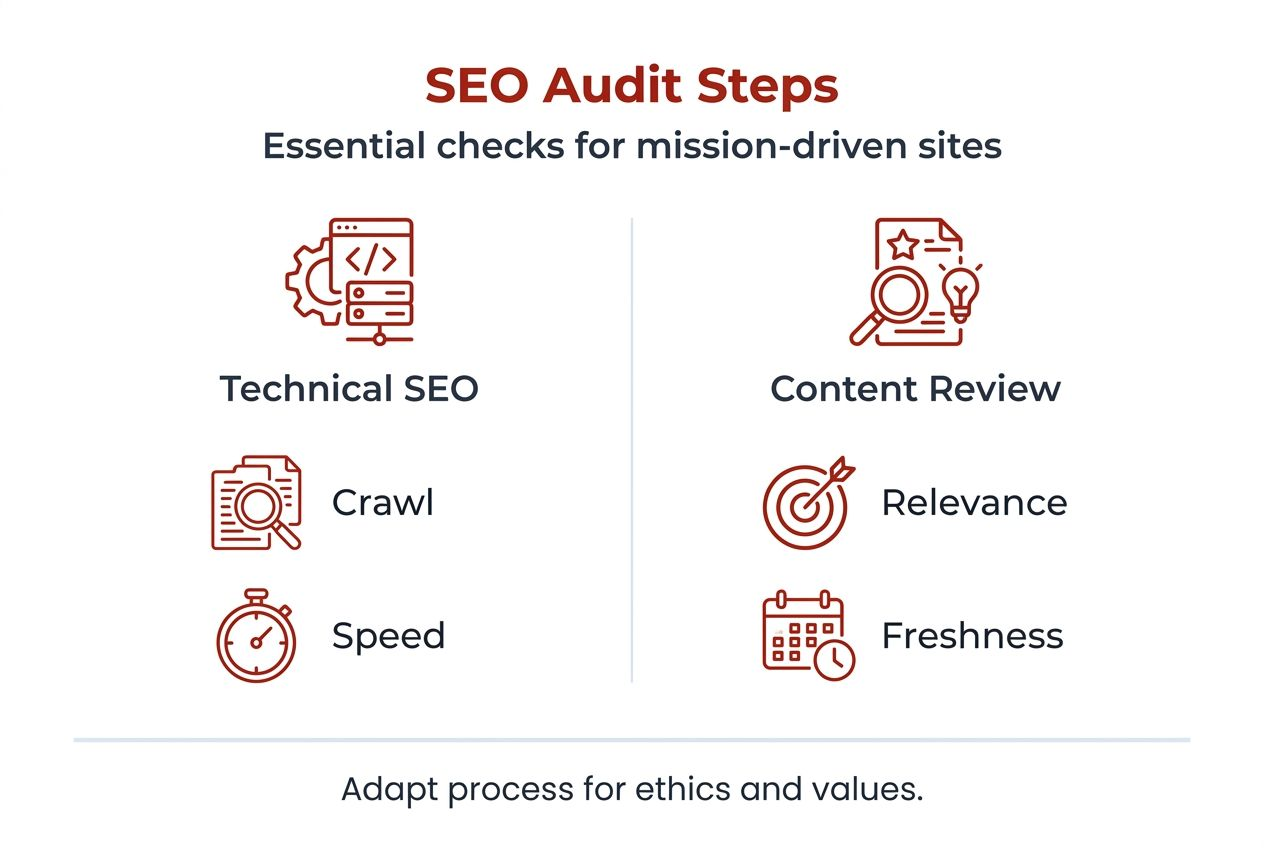
Check content freshness. Outdated information damages credibility and rankings. Pages discussing 2024 regulations when we’re in 2026 signal neglect.
Pro Tip: Create an SEO friendly website by ensuring every page answers a specific question your audience asks, using language they actually use rather than internal jargon.
5. Off-page and backlink analysis
Your backlink profile significantly influences domain authority and rankings. Use Ahrefs or SEMrush to:
- Identify total referring domains and their quality
- Spot toxic links from spammy or irrelevant sites
- Find broken backlinks pointing to deleted pages
- Discover competitor backlink sources you might also earn
For local SEO optimisation, verify your Google Business Profile is complete and consistent with website information. Check citations across directories for NAP (name, address, phone) consistency.
6. Ethical SEO alignment check
| Audit Area | Ethical Consideration | Action Required |
|---|---|---|
| Accessibility | WCAG 2.1 AA compliance | Test with screen readers, verify colour contrast |
| Content transparency | Clear authorship and sources | Add author bios, cite claims properly |
| User privacy | Cookie consent and data handling | Review privacy policy, implement ethical tracking |
| Link practices | Natural, earned backlinks only | Audit for paid links, remove manipulative schemes |
This step distinguishes mission-driven organisations from purely commercial sites. Your audit must verify technical excellence supports rather than compromises your values.
Common SEO audit mistakes and troubleshooting
Even experienced auditors make predictable errors that undermine results. Recognising these patterns helps you avoid wasted effort.
Mobile optimisation neglect represents the most damaging oversight. Over 60% of SEO audits miss mobile issues leading to ranking drops. Google’s mobile-first indexing means your mobile site version determines rankings, not desktop. Test extensively on actual devices, not just browser tools.
Site speed blindness occurs when auditors note performance problems but fail to quantify their impact. A page loading in 5 seconds versus 2 seconds doesn’t sound dramatic, but the slower version loses 40% more visitors. Prioritise speed fixes by traffic volume and conversion value.
Duplicate content confusion stems from not understanding the difference between identical pages and similar content. Product variations might share descriptions legitimately, whilst copied blog posts definitely harm rankings. Use canonical tags to indicate preferred versions when appropriate.
Sitemap and robots.txt misconfiguration blocks search engines from important content. A common error involves leaving test environment rules in production, accidentally blocking entire sections. Always verify these files match current site structure.
Implementation paralysis happens when audits generate massive issue lists without prioritisation. You can’t fix everything simultaneously. Rank problems by potential impact and implementation difficulty.
Pro Tip: Use a website audit template specifically designed for mission-driven organisations to ensure you cover ethical considerations alongside technical factors.
Troubleshooting requires methodical testing. Change one variable at a time, measure results, then proceed. Batch changes make identifying successful interventions impossible.
Expected outcomes and success metrics from a well-executed SEO audit
Realistic expectations prevent disappointment and help you measure genuine progress. Effective SEO audits can reduce bounce rates by 25% and improve organic traffic up to 30% within months, but results depend on implementation quality and competitive landscape.
Bounce rate improvements typically appear within 4-8 weeks of fixing technical issues and improving content relevance. Watch for decreases of 15-25% on pages you’ve optimised. Sustained high bounce rates after fixes suggest deeper content or user experience problems.
Organic traffic growth follows a curve rather than a straight line. Expect minimal movement in the first month as search engines recrawl and reassess your site. Months two and three show acceleration as improved pages gain traction. By month six, well-executed audits typically deliver 20-35% traffic increases.
Keyword ranking improvements vary by competition intensity. Low-competition terms might jump 20+ positions within weeks. Competitive keywords require months of consistent effort beyond the initial audit.
| Metric | Timeline | Expected Improvement |
|---|---|---|
| Page Load Speed | Immediate | 30-50% faster |
| Mobile Usability Score | 2-4 weeks | Pass all Core Web Vitals |
| Indexed Pages | 4-6 weeks | 95%+ of total pages |
| Organic Traffic | 3-6 months | 20-35% increase |
| Bounce Rate | 4-8 weeks | 15-25% reduction |
| Keyword Rankings | 2-4 months | 10-30 position improvements |
Enhanced user experience manifests through metrics beyond SEO. Time on page increases as content better matches intent. Conversion rates improve when technical barriers disappear. Mobile usability scores directly correlate with user satisfaction.
“The most valuable outcome isn’t higher rankings, it’s the systematic understanding of what prevents your mission from reaching people who need it. Every technical fix and content improvement removes friction between your impact and your audience.”
Track these metrics through your analytics platform and Search Console. Document baseline measurements before implementing audit recommendations, then compare monthly. This data proves ROI and guides ongoing optimisation.
For mission-driven organisations, success includes qualitative factors. Are you reaching underserved communities? Does improved visibility translate to program participation? SEO success metrics should align with organisational goals, not just vanity numbers.
Enhance your mission-driven impact with expert SEO support
Conducting thorough SEO audits demands significant time and technical expertise. If your team’s energy belongs in direct service delivery rather than technical optimisation, professional support ensures nothing falls through the cracks.
Marzipan specialises in AI-powered SEO services tailored for mission-driven organisations. We combine technical excellence with ethical practices, ensuring your improved visibility never compromises your values. Our audits go deeper than standard checklists, examining how your digital presence authentically represents your impact.
Our digital marketing services extend beyond SEO to create integrated strategies that scale your reach sustainably. We understand mission-driven groups operate differently, balancing growth with accountability to communities you serve.
Values alignment extends to infrastructure. Our green hosting guide helps organisations reduce digital carbon footprints whilst maintaining performance. Technical excellence and environmental responsibility aren’t opposing forces when approached thoughtfully.
Frequently asked questions
How often should mission-driven organisations conduct SEO audits?
Quarterly audits strike the right balance between staying current and avoiding analysis paralysis. Search algorithms evolve constantly, but major site changes rarely warrant monthly reviews. Conduct additional audits after website redesigns, significant content additions, or algorithm updates affecting your rankings. This rhythm keeps your ethical SEO strategy responsive without consuming excessive resources.
What tools are essential for conducting an SEO audit?
Google Search Console and Screaming Frog form the foundation, providing indexing data and technical crawl analysis. Add PageSpeed Insights for performance measurement. Budget permitting, Ahrefs or SEMrush dramatically improve backlink analysis and keyword research. Free alternatives like Google Analytics and Answer the Public supplement paid tools effectively for organisations with limited budgets.
How can mission-driven organisations ensure their SEO audits respect their ethical values?
Incorporate accessibility testing using screen readers and contrast checkers. Avoid manipulative tactics like keyword stuffing or buying backlinks. Ensure transparency by clearly marking sponsored content and citing sources properly. Align technical recommendations with your mission by asking whether each change genuinely serves your audience or just chases rankings. Prioritise ethical local SEO optimisation that builds authentic community connections rather than gaming systems.
What are common SEO audit errors to avoid?
Neglecting mobile optimisation remains the most damaging mistake, affecting over 60% of site traffic. Ignoring site speed costs conversions and rankings. Overlooking duplicate content confuses search engines about which pages to rank. Failing to prioritise fixes leads to implementation paralysis where nothing improves despite identifying problems. Test one change at a time to isolate what actually works.