TL;DR:
- Website audits assess technical, security, accessibility, and ethical standards vital for mission-driven organizations.
- Regular audits improve online impact, reinforce organizational values, and protect community trust and funding.
- Ethical audits emphasize authenticity, inclusion, and sustainability, aligning digital practices with core mission principles.
Website audits are widely associated with improving search rankings, but for mission-driven organisations in Australia, they deliver far more than that. An audit examines whether your site is technically sound, accessible to all users, secure against data breaches, and genuinely representative of your values. Many organisations overlook this process entirely, or treat it as a one-off technical task. As SEO audits reveal, they provide a roadmap to boost online presence while maintaining ethical values. This guide explains what a thorough audit actually covers and why it matters for organisations that put purpose before profit.
Table of Contents
- What is a website audit and why does it matter?
- Key benefits: How audits improve impact and ethics
- What makes an audit ‘ethical’ for mission-driven websites?
- Practical steps: How to audit your site for mission and performance
- The uncomfortable truth: Why most mission-driven sites miss out
- Next steps: Get expert help to strengthen your impact
- Frequently asked questions
Key Takeaways
| Point | Details |
|---|---|
| Align audits with mission | Website audits should support organisational values and community trust, not just SEO results. |
| Quarterly checks boost resilience | Conducting regular audits anticipates changes in SEO, security, and compliance landscapes. |
| Ethical focus prevents risks | Auditing accessibility, privacy, and content integrity safeguards against ethical and reputational threats. |
| Data-driven improvements create results | Evidence shows audits can boost traffic and reduce bounce rates, delivering measurable impact. |
What is a website audit and why does it matter?
A website audit is a structured review of your site’s performance across several key areas. It is not a single check but a layered process covering technical health, content quality, search visibility, security, and accessibility. For mission-driven organisations, each of these layers carries added weight because your website is often the primary point of contact for donors, volunteers, and the communities you serve.
The main areas a thorough audit covers include:
- Technical performance: Page speed, mobile responsiveness, broken links, and crawl errors
- Content and SEO: Keyword relevance, content accuracy, metadata, and internal linking
- Backlink profile: The quality and authenticity of sites linking to yours
- Accessibility: Compliance with WCAG standards to ensure all users can access your content
- Cybersecurity: Data protection measures, secure connections, and vulnerability assessments
For Australian not-for-profits (NFPs), audits also carry governance responsibilities. The Australian Charities and Not-for-profits Commission (ACNC) expects organisations to maintain sound operational practices, and your digital infrastructure is part of that. Essential Eight compliance audits are a governance responsibility for Australian NFPs to protect donor data, meet ACNC standards, and avoid funding and insurance risks.
A data breach or an inaccessible website does not just cause operational problems. It damages community trust and can jeopardise funding relationships. Supporters and grant bodies expect organisations to handle their data responsibly.
A website audit is not simply about ranking higher on Google. For mission-driven organisations, it is about ensuring your digital presence honestly reflects your values and protects the people who rely on you.
Following mission-driven SEO audit steps helps organisations move beyond surface-level fixes and address the full picture of their online presence.
Key benefits: How audits improve impact and ethics
The evidence for regular website audits is clear. Well-executed SEO audits typically reduce bounce rates by 25% and increase organic traffic by 30%. For an NFP, that means more people finding your services, more donors reaching your giving page, and more volunteers discovering how to get involved.
The table below shows typical before-and-after outcomes following a structured audit:
| Metric | Before audit | After audit |
|---|---|---|
| Organic traffic | Baseline | Up to 30% increase |
| Bounce rate | High | Reduced by up to 25% |
| Page load speed | Slow or inconsistent | Optimised for mobile and desktop |
| Accessibility score | Partial compliance | Full WCAG alignment |
| Security vulnerabilities | Undetected gaps | Identified and resolved |
Beyond the numbers, audits support ethical alignment. When your content accurately reflects your mission, uses inclusive language, and meets accessibility standards, it signals to your community that your values are genuine. This matters for retaining supporters and maintaining credibility with funding bodies.

The SEO benefits for community organisations extend well beyond visibility. Improved site structure makes it easier for users with disabilities to navigate your content. Faster load times reduce barriers for people in regional areas with slower internet connections. These are not just technical wins. They are ethical ones.
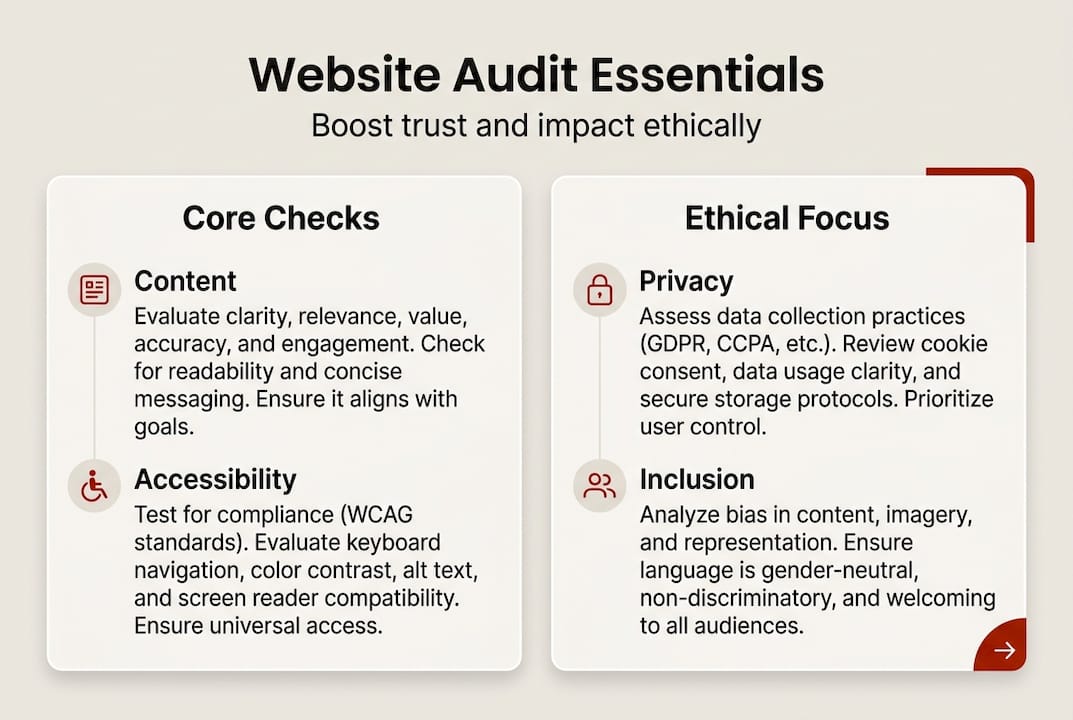
Pro Tip: When reviewing audit findings, assess each recommended change against your organisation’s values. If a tactic improves traffic but compromises inclusivity or authenticity, it is not the right fix. A website audit template for NFPs can help structure this values-led review process.
Regular audits also protect funding relationships. Grant bodies and major donors increasingly scrutinise how organisations manage data and digital operations. A well-maintained, secure, and accessible website demonstrates accountability.
What makes an audit ‘ethical’ for mission-driven websites?
Not all audits are created equal. A standard commercial audit focuses primarily on traffic, conversions, and revenue. An ethical audit for a mission-driven organisation goes further, examining whether the site’s practices align with its stated values.
Ethical SEO distinguishes mission-driven organisations through a focus on natural backlinks, WCAG compliance, and sustainable hosting. These practices align performance with values such as equity and environmental responsibility.
The comparison below illustrates the difference:
| Priority | Standard audit | Ethical audit |
|---|---|---|
| Primary goal | Rankings and traffic | Mission alignment and visibility |
| Backlinks | Volume-focused | Natural, authentic sources only |
| Accessibility | Optional | Core requirement (WCAG) |
| Hosting | Performance only | Sustainable and low-carbon |
| Content review | Keyword optimisation | Accuracy, inclusion, and authenticity |
| Privacy | Basic compliance | Values-led data minimisation |
Practical elements of an ethical audit include:
- Accessibility review: Testing against WCAG 2.1 AA standards to ensure content is usable by people with disabilities
- Natural backlink assessment: Checking that inbound links come from credible, relevant sources rather than paid or manipulative schemes
- Green hosting verification: Confirming your hosting provider uses renewable energy or carbon offsets
- Privacy audit: Reviewing data collection practices to ensure they are transparent and minimal
- Content integrity check: Verifying that all published content accurately represents your programmes and impact
For guidance on making SEO-friendly ethical sites, the principles of honest content and genuine user value apply directly. NFP compliance requirements, as outlined in the NFP compliance guide, reinforce why these standards matter beyond digital performance. Exploring ethical SEO for growth offers further context on how these practices translate into long-term organisational credibility.
Practical steps: How to audit your site for mission and performance
Conducting a website audit does not require a large technical team. Small to medium Australian NFPs can follow a structured process that involves both digital staff and governance leads.
- Define your audit scope: Decide whether you are conducting a full audit or focusing on a specific area such as security or accessibility. A full audit covers all five areas: technical, content, backlinks, accessibility, and security.
- Gather your tools: Free tools such as Google Search Console, PageSpeed Insights, and WAVE (for accessibility) provide a strong starting point. Paid platforms offer deeper analysis.
- Review technical performance: Check for broken links, slow-loading pages, mobile usability issues, and crawl errors. These affect both user experience and search visibility.
- Assess content and SEO: Review whether your pages accurately reflect your current programmes, use relevant search terms, and meet basic metadata standards.
- Check accessibility: Run your site through WCAG testing tools and manually review key pages for keyboard navigation, colour contrast, and alt text on images.
- Conduct a security review: Assess your site against the Essential Eight framework. Involve your board or a governance representative, as this is a compliance matter, not just an IT task.
- Document findings and prioritise actions: Separate quick wins (fixing broken links, updating metadata) from deeper improvements (migrating to green hosting, redesigning navigation).
- Assign ownership and set timelines: Each action item should have a named owner and a realistic deadline.
Quarterly audits are recommended to adapt to Google algorithm changes, of which there are hundreds each year, and to maintain visibility without compromising mission integrity.
Pro Tip: Involve diverse internal stakeholders in your audit review, including programme staff, not just digital teams. They can identify content gaps or inaccuracies that technical tools will not catch. A clear SEO workflow for NFPs supports this collaborative approach.
The uncomfortable truth: Why most mission-driven sites miss out
Most mission-driven organisations in Australia either skip website audits altogether or conduct them only when something goes visibly wrong. This reactive approach leaves significant gaps in both performance and ethical accountability.
The deeper problem is that many organisations treat audits as a compliance checkbox rather than a strategic tool. They fix broken links and move on. They do not examine whether their homepage messaging still reflects their current mission, whether their data practices respect community privacy, or whether their hosting choices align with their environmental commitments.
Audits ensure websites authentically represent organisational values, turning technical fixes into tools for ethical growth and community accountability. That shift in perspective changes everything. An audit is not a one-time report. It is a regular discipline that keeps your digital presence honest.
Organisations that commit to this approach build stronger relationships with their communities, attract more aligned funding, and reduce the risk of reputational damage. Those that treat audits as optional tend to discover their shortcomings at the worst possible moment. Exploring ethical SEO that lasts provides a useful framework for making this shift a permanent part of your digital strategy.
Next steps: Get expert help to strengthen your impact
Understanding what a thorough, ethical website audit involves is the first step. Acting on that understanding is where real change happens for mission-driven organisations.
At Marzipan, we specialise in supporting purpose-driven organisations across Australia with AI-informed SEO services and sustainable web design that align with your values. Whether you need a full audit, targeted improvements, or a clearer picture of your site’s environmental footprint, our website carbon checker is a practical starting point. We work with NFPs and community organisations to build digital presences that are technically strong, ethically grounded, and built to last. Get in touch to discuss how we can support your next audit.
Frequently asked questions
What is the main purpose of a website audit for NFPs?
For NFPs, audits verify technical health and ethical alignment, protecting community trust and meeting governance standards. Essential Eight compliance audits are a governance responsibility that protects donor data and helps meet ACNC requirements.
How often should we audit our website?
Quarterly audits are recommended to keep pace with Google algorithm updates, security threats, and compliance changes without compromising mission integrity.
What is a key difference between a standard and ethical website audit?
Ethical audits prioritise authenticity, inclusion, privacy, and values-alignment, going well beyond search rankings. Standard audits focus on rankings and traffic, while mission-driven audits emphasise ethical alignment and authentic representation.
How do audits help us avoid funding or insurance risks?
Audits identify security gaps and compliance shortfalls before they become serious problems. Essential Eight cybersecurity audits are specifically designed to protect donor data and reduce the risk of breaches that could affect funding or insurance coverage.
Recommended
- How to conduct an SEO audit for mission-driven sites – Marzipan
- Free website audit template for community organisations – Marzipan
- SEO & Websites for High-Trust Organisations | Marzipan Sydney
- SEO & Websites for High-Trust Organisations | Marzipan Sydney
- SEO Audit for Attorneys: Boost Online Visibility Fast