Creating effective SEO content for Australian community organisations often feels like navigating a maze of conflicting priorities. You need to balance search visibility with mission alignment, regulatory requirements with resource constraints, and technical optimisation with authentic community engagement. Many content strategists assume SEO workflows are either too complex for smaller teams or too generic to reflect their organisation’s unique values. This guide breaks down an efficient, ethical SEO content creation workflow specifically designed for Australian community-based organisations, showing you how to build sustainable processes that amplify your impact without compromising your mission or exhausting your team.
Table of Contents
- Key takeaways
- Understanding the SEO landscape for Australian community organisations
- Steps in an efficient SEO content creation workflow tailored for CBOs
- Avoiding common risks and pitfalls in community organisation SEO workflows
- Measuring and refining your SEO content workflow for lasting impact
- Explore tailored SEO and digital marketing solutions
- Frequently asked questions
Key Takeaways
| Point | Details |
|---|---|
| Hybrid workflow | Combines internal teams with external partners and free tools to deliver efficient ethical SEO for community organisations. |
| Ethical signals | ACNC badges, localised keywords and seasonal calendars help align search optimisation with regulatory and community priorities. |
| Mobile local focus | Prioritising mobile optimisation and localised search prevents missed opportunities and strengthens community relevance. |
| Structured workflow | A clear sequential process reduces errors and boosts the impact of SEO content for community organisations. |
Understanding the SEO landscape for Australian community organisations
SEO for community-based organisations differs fundamentally from corporate approaches. Your audience searches with different intent, your credibility markers are unique, and your success metrics extend beyond simple traffic numbers to encompass community impact and mission alignment.
Australian community organisations face specific considerations that shape their SEO strategy. Integrating ACNC badges, ethical local keywords, and seasonal calendars helps align search optimisation with regulatory and mission context. These elements signal trustworthiness to both search engines and community members who evaluate organisations based on transparency and local relevance.
Critical factors for community organisation SEO include:
- Regulatory trust signals like ACNC registration badges that differentiate legitimate organisations from questionable entities
- Localised keyword strategies reflecting community language rather than corporate jargon
- Seasonal content calendars aligned with appeal periods, community events, and awareness campaigns
- Mobile optimisation for on-the-go searches by community members seeking immediate support
- Accessibility standards ensuring content reaches people with diverse needs and abilities
Ignoring these nuances creates serious problems. Generic SEO approaches miss the specific search behaviours of people seeking community support, who often use location-specific terms and trust signals in their queries. When your content lacks these elements, you risk reduced visibility among the exact audiences you serve, whilst simultaneously appearing disconnected from the community values that define your mission. Understanding this landscape forms the foundation for building an ethical SEO guide community organisations can actually implement.
Steps in an efficient SEO content creation workflow tailored for CBOs
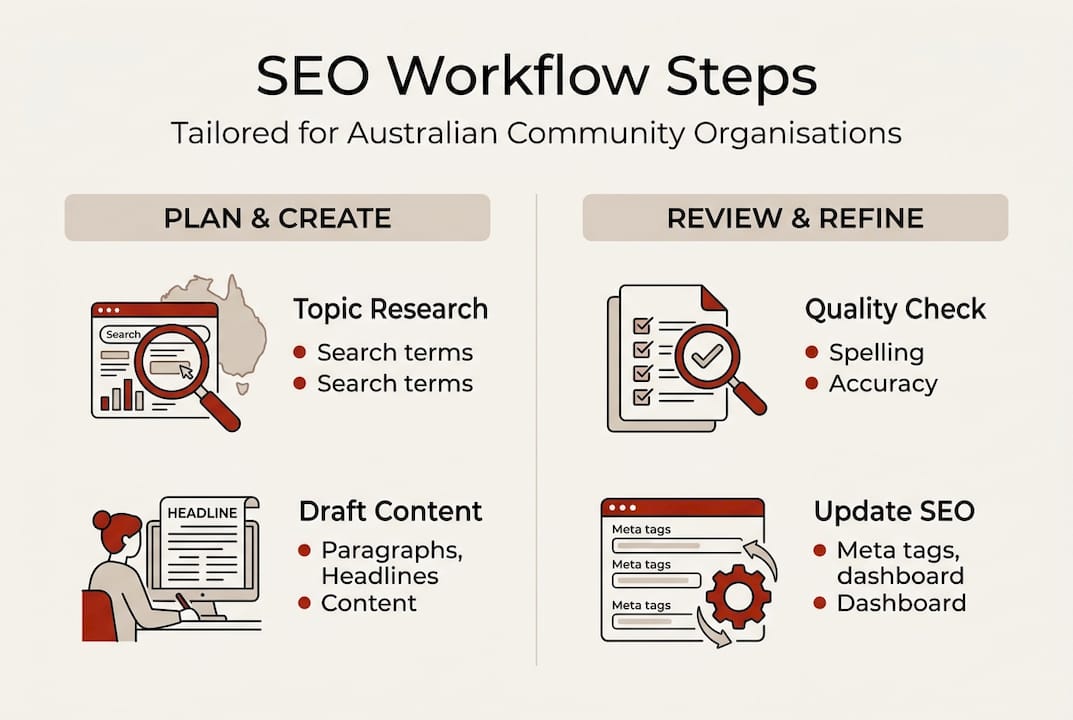
Building an effective SEO content workflow requires sequential steps that balance efficiency with quality, ensuring each piece serves both search algorithms and community needs.
Workflow efficiency improves by using free tools like Google Search Console and Keyword Planner, whilst hybrid agency and internal teams deliver the best results by combining technical expertise with mission knowledge.
-
Define content goals aligned with mission and audience needs. Start by identifying what community members actually search for when they need your services. Map these searches to your organisational priorities, ensuring content serves both SEO objectives and mission outcomes. Document clear success criteria that include visibility metrics and community impact measures.
-
Conduct keyword research focusing on ethical, local, and seasonal terms. Use tools like Google Keyword Planner to identify search terms your community uses, prioritising phrases that reflect local geography, seasonal needs, and mission-aligned language. Avoid competitive corporate keywords in favour of specific community-focused terms where you can genuinely rank and provide value.
-
Plan content briefs with clear SEO and mission alignment criteria. Create detailed briefs that specify target keywords, required trust signals, community relevance markers, and mission alignment checkpoints. Include guidelines for tone, accessibility requirements, and regulatory compliance to ensure consistency across all content.
-
Produce content using hybrid agency and internal resources. Assign technical SEO tasks and strategy development to agency partners whilst keeping mission-critical content creation and community voice in-house. This division leverages specialist expertise without losing authentic community connection.
-
Implement quality checks measuring first-pass QA success and cluster visibility. Review content against your brief criteria before publication, tracking how often pieces pass quality assurance on first review. Monitor how well content clusters rank for related search terms rather than obsessing over individual keyword positions.
-
Publish and monitor using Search Console and feedback loops. Track performance through Google Search Console, noting which content attracts community engagement and which falls flat. Establish regular review cycles to adjust strategy based on real performance data rather than assumptions.
Pro Tip: Start with small content batches of three to five pieces rather than planning massive campaigns. This prevents content debt whilst letting you refine your workflow based on actual results before scaling up. Quality always trumps quantity for community organisations where trust and authenticity determine success. Understanding making SEO friendly website principles helps ensure each piece contributes to overall site authority.
Avoiding common risks and pitfalls in community organisation SEO workflows
Even well-intentioned SEO workflows encounter predictable obstacles that undermine efficiency and effectiveness. Recognising these risks early helps you build preventive measures into your processes.
Risks for SEO workflows include content debt from unstructured volume, AI visibility gaps, and ignoring mobile and local search for community queries. These challenges particularly affect resource-constrained community organisations that lack dedicated SEO specialists.
Content debt accumulates when organisations commit to publishing schedules they cannot sustain with quality. You end up with half-finished drafts, outdated information, and content that fails to serve either search engines or community members. This creates a vicious cycle where poor-performing content demands resources for updates whilst new priorities remain unaddressed.

AI-generated content presents unique visibility challenges. Whilst AI tools can accelerate drafting, content that lacks human expertise, local knowledge, and authentic community voice often fails to rank or engage readers. Search engines increasingly prioritise content demonstrating genuine expertise and original insights, making purely AI-generated pieces risky for organisations building long-term authority.
Mobile and local optimisation gaps severely limit reach. Ignoring mobile and local SEO significantly limits search presence for community-focused organisations, as most community members search for immediate support on mobile devices using location-specific terms.
Key risks to actively prevent:
- Overcommitting to content volume without adequate quality control processes
- Relying on AI generation without human expertise review and community voice integration
- Neglecting mobile page speed and local search optimisation for community queries
- Failing to schedule regular content audits that catch outdated information and declining rankings
- Ignoring accessibility standards that exclude community members with disabilities
“The biggest mistake community organisations make is treating SEO as a one-time project rather than an ongoing process requiring regular attention and refinement.”
Pro Tip: Schedule quarterly SEO audits that review content performance, identify decay, and prioritise updates. This prevents small issues from becoming major visibility problems whilst keeping your workflow aligned with evolving community needs and search algorithm changes. Regular audits also help you identify which content types and topics deliver the strongest results, informing smarter resource allocation. Implementing local SEO optimisation strategies helps maintain visibility for community searches.
Measuring and refining your SEO content workflow for lasting impact
Effective measurement transforms your SEO workflow from guesswork into a data-informed process that continuously improves efficiency and impact.
Measuring success by first-pass quality assurance rates and cluster visibility rather than raw traffic alone provides more meaningful insights for community organisations focused on mission outcomes alongside search performance.
Define KPIs that reflect both efficiency and effectiveness. Track how often content passes quality review on first submission, indicating your briefs and processes are working well. Monitor cluster visibility to see how groups of related content perform together, building topical authority rather than chasing individual keyword rankings. Include mission alignment metrics that assess whether content genuinely serves community needs or simply attracts traffic.
Google Search Console provides free, powerful monitoring capabilities. Track impressions and clicks for priority keywords, identify pages losing visibility that need updates, and discover unexpected search terms revealing community needs you hadn’t considered. Set up regular reporting that highlights trends rather than obsessing over daily fluctuations.
Audience feedback completes the measurement picture. Community engagement signals like time on page, scroll depth, and return visits indicate whether content genuinely helps people. Direct feedback through surveys, comments, and support enquiries reveals gaps in your content strategy that pure SEO metrics miss.
| Metric | Target | Measurement Tool |
|---|---|---|
| First-pass QA rate | 80% or higher | Internal workflow tracking |
| Cluster visibility | Top 10 for priority clusters | Google Search Console |
| Mobile page speed | Under 3 seconds | PageSpeed Insights |
| Local search presence | Appearing in local pack | Google Business Profile insights |
| Community engagement | 60%+ scroll depth | Google Analytics |
Regularly refine your workflow based on these insights:
- Adjust brief templates when first-pass QA rates drop below targets
- Reallocate resources to content types and topics showing strongest cluster visibility
- Update keyword targets based on actual community search behaviour rather than assumptions
- Modify publishing frequency to maintain quality when content debt accumulates
- Revise mission alignment criteria as organisational priorities evolve
This iterative approach ensures your SEO workflow remains efficient and effective rather than becoming a rigid process disconnected from actual results. Conducting regular SEO audit for mission-driven sites helps maintain workflow health and identify improvement opportunities.
Explore tailored SEO and digital marketing solutions
Building an efficient SEO content workflow takes time, expertise, and ongoing refinement. Many community organisations benefit from partnering with specialists who understand both technical optimisation and mission-driven values.
Marzipan offers digital marketing for high-trust organisations specifically designed for community-based groups navigating the unique challenges of ethical SEO and sustainable growth. Our services combine technical expertise with genuine understanding of mission-driven priorities, helping you build workflows that amplify community impact without compromising values.
We specialise in sustainable approaches that align with environmental and social responsibility. Our green web hosting Australia solutions reduce your digital carbon footprint whilst maintaining the performance community members expect. We integrate AI SEO services Sydney capabilities that accelerate content creation without losing the authentic community voice that builds trust and engagement. Whether you need strategic guidance to establish your workflow or hands-on support to implement and refine processes, we offer flexible solutions that respect your budget constraints and organisational capacity.
Frequently asked questions
How can Australian community organisations balance SEO efficiency with ethical values?
Integrate ethical local keywords and regulatory badges during your planning phase rather than treating them as afterthoughts. Use transparent metrics focused on mission alignment alongside traditional SEO measures, tracking whether content genuinely serves community needs rather than simply attracting traffic. This approach ensures efficiency gains don’t compromise the values that define your organisation. Resources like this ethical SEO guide community organisations provide frameworks for maintaining this balance.
What tools help optimise SEO content creation for community-based organisations?
Google Search Console provides free monitoring of search performance, showing which content attracts community searches and where visibility gaps exist. Keyword Planner helps identify terms your community actually uses rather than corporate jargon. Using free tools like these improves workflow efficiency without requiring expensive enterprise software. PageSpeed Insights and mobile testing tools ensure your content remains accessible to community members searching on various devices.
How often should SEO content workflows be audited and refined?
Quarterly audits work well for most community organisations, preventing content decay and visibility loss without creating excessive overhead. Use audit findings to refine both content and processes, identifying which brief templates, content types, and topics deliver strongest results. This regular review cycle keeps your workflow aligned with evolving community needs and search algorithm changes. Implementing systematic SEO audit for mission-driven sites practices ensures consistent workflow health.
What makes hybrid agency and internal teams most effective for community SEO?
Agencies bring technical SEO expertise and strategic perspective that small internal teams often lack, whilst internal staff provide irreplaceable community knowledge and mission alignment. This combination lets you leverage specialist skills for complex technical tasks whilst keeping authentic community voice and mission-critical decisions in-house. The key is clearly defining which responsibilities belong where, ensuring neither side duplicates effort or creates gaps in your workflow.
How can community organisations avoid content debt whilst maintaining SEO visibility?
Start with small, sustainable content batches that your team can genuinely produce with quality. Focus on creating comprehensive, authoritative content on priority topics rather than publishing frequent shallow pieces. Establish clear quality gates that prevent substandard content from publication, even if it means missing arbitrary publishing schedules. Regular audits help identify and update existing content rather than constantly creating new pieces, maximising value from work already completed.