TL;DR:
- Small Australian businesses can save costs by adopting sustainability practices that reduce waste and energy use.
- Assessing current operations, prioritising high-impact low-cost actions, and engaging stakeholders are key steps.
- Digital and IT sustainability, including green hosting and responsible e-waste disposal, provide significant environmental benefits.
Australian small businesses face growing pressure from customers, partners, and regulators to operate more sustainably. The good news is that eco-friendly practices are not simply a cost centre. Many businesses find that reducing waste, cutting energy use, and rethinking procurement also reduce operating expenses. Sustainable business practices in Australia show that up to 70% of SMEs implementing sustainability initiatives reported cost savings. This article offers practical, evidence-based guidance for Australian SMEs looking to reduce their environmental impact without overextending their budgets or resources.
Table of Contents
- How to choose the right eco-friendly practices for your business
- Top eco-friendly business actions for Australian SMEs
- Greening your digital footprint: digital and IT sustainability
- Measuring, reporting, and unlocking support for sustainability
- A smarter way to embed sustainability in small business
- Advance your sustainable business journey with expert help
- Frequently asked questions
Key Takeaways
| Point | Details |
|---|---|
| Start with assessment | Measuring your footprint helps prioritise actions for faster sustainability gains. |
| Go digital, go green | Digital strategies such as green hosting and e-waste management are rapidly growing in importance. |
| Savings with sustainability | Most SMEs in Australia report that eco-friendly changes also reduce their business costs. |
| Measure, improve, repeat | Track key metrics and seek available grants to keep progressing on your sustainability journey. |
How to choose the right eco-friendly practices for your business
Selecting the right sustainability actions starts with understanding where your business currently stands. Without a baseline, it is difficult to prioritise or measure progress. A structured approach helps avoid wasted effort and ensures resources go to the areas with the greatest impact.
The first step is to measure your carbon footprint. Free tools such as Climate Active provide a starting point for Australian businesses. The quick sustainability checklist for Australian businesses covers 8 key areas, including energy, waste, water, procurement, and transport. Working through this checklist gives a clear picture of where your business sits across each category.
Once you have a baseline, prioritise actions by two criteria: environmental impact and upfront cost. Some changes, such as switching off equipment overnight or reducing paper use, cost nothing and deliver immediate results. Others, such as solar panel installation, require capital but may qualify for government grants. Exploring funding options relevant to your state and sector is worthwhile before ruling out larger investments.
Stakeholder alignment is often overlooked at this stage. Consulting staff, suppliers, and key customers early ensures that sustainability changes are practical and well-supported. Staff who understand the reasons behind new practices are far more likely to follow through consistently.
Here is a simple framework for getting started:
- Assess your current energy, waste, water, and procurement practices using a free tool or checklist
- Prioritise changes with the highest impact and lowest cost first
- Consult staff and partners to identify barriers and opportunities
- Research grants available through your state government or industry body
- Set small, measurable goals with clear timelines
- Review progress quarterly and adjust as needed
Aligning sustainability with ethical business strategies also strengthens your brand positioning, particularly if your customers care about values-led operations.
Pro Tip: Communicate planned changes to staff before they happen. Early involvement builds buy-in and surfaces practical concerns that management may not anticipate.
Top eco-friendly business actions for Australian SMEs
With a selection process in place, the next step is identifying which actions deliver the most value. The following list covers high-impact areas relevant to most Australian SMEs, regardless of industry.
- Switch to LED lighting and GreenPower electricity. LED lighting uses up to 75% less energy than traditional incandescent bulbs. Signing up to a GreenPower-accredited electricity plan means your energy comes from certified renewable sources, with no infrastructure changes required.
- Install water-efficient fixtures. Low-flow taps, dual-flush toilets, and water-efficient dishwashers reduce consumption and lower utility bills. Many local councils offer rebates for water-saving upgrades.
- Reduce, reuse, recycle. Audit your waste streams and introduce composting for organic waste. Circular economy practices, such as repairing equipment rather than replacing it, extend product life and reduce landfill contributions.
- Optimise procurement. Buying locally reduces transport emissions and supports the local economy. Choosing suppliers with verified sustainability credentials adds another layer of impact.
- Transition fleet and travel. Where possible, replace petrol vehicles with electric alternatives or encourage remote work to reduce commuting. Even partial adoption reduces fuel costs and emissions.
- Reduce single-use materials. Switching to reusable packaging, digital invoicing, and electronic record-keeping cuts both waste and supply costs.
Nearly 70% of SMEs implementing sustainability initiatives reported cost savings, making eco-friendly practices a sound financial decision as well as an environmental one.
For businesses interested in how sustainability in Australian digital agencies is being approached, there are useful parallels in how service-based businesses reduce their footprint without major capital outlay.
Pro Tip: The Australian Government’s Instant Asset Write-Off scheme allows eligible businesses to immediately deduct the cost of new equipment. This can apply to energy-efficient appliances, making upgrades more financially accessible.
Greening your digital footprint: digital and IT sustainability
Physical operations are only part of the picture. The digital side of a business, including servers, devices, cloud storage, and software, carries a significant and growing environmental cost. This area is often overlooked by SMEs, yet it offers some of the fastest and most cost-effective sustainability gains.
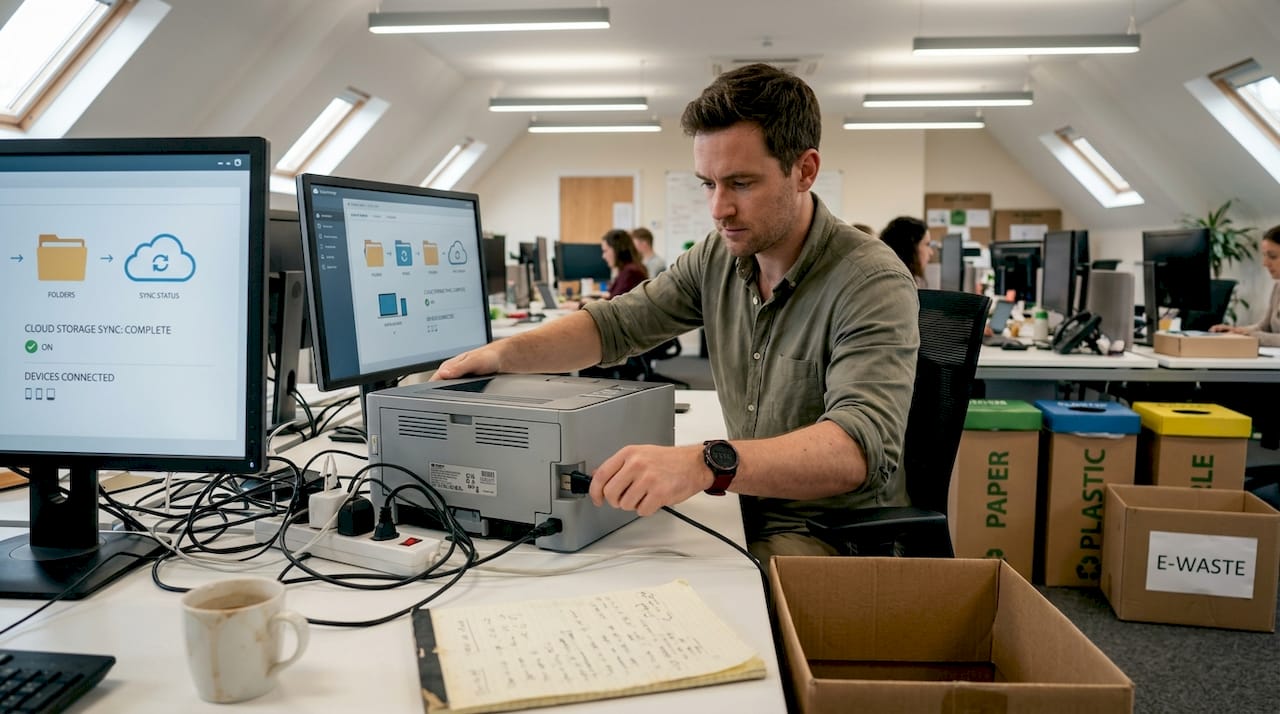
Australia’s e-waste is expected to reach 23.4kg per person by 2030, with less than 20% currently recycled. For businesses running multiple devices, this adds up quickly. Responsible e-waste disposal through certified recyclers is a straightforward first step.
Beyond hardware disposal, consider the following actions:
- Choose energy-efficient hardware. Look for ENERGY STAR rated devices when replacing computers, monitors, and printers. These use significantly less power during operation and standby.
- Migrate to green cloud hosting. Many major cloud providers now offer data centres powered by renewable energy. Choosing a green hosting option reduces the carbon cost of your website and digital operations.
- Virtualise and right-size. Running physical servers at low capacity wastes energy. Virtualisation consolidates workloads onto fewer machines, reducing both energy use and hardware costs.
- Support remote work. Fewer commutes and less office space in use means lower energy consumption across the board.
- Audit cloud usage. Overprovisioned cloud storage and unused software licences are common in SMEs. Regular audits reduce waste and cut costs.
The table below compares traditional and green IT approaches across key dimensions:
| Dimension | Traditional IT | Green IT |
|---|---|---|
| Energy use | High, often inefficient | Lower, optimised usage |
| Hardware lifecycle | Shorter, frequent replacement | Longer, repair-first approach |
| Carbon impact | Higher per workload | Reduced through renewables |
| Maintenance cost | Higher over time | Lower with virtualisation |
| E-waste output | Higher | Reduced with responsible disposal |
For a broader view of how digital impact for good is being pursued by purpose-driven organisations, the principles translate directly to SME operations.
Measuring, reporting, and unlocking support for sustainability
Taking action is important, but tracking progress is what turns individual efforts into a coherent sustainability strategy. Measurement also positions your business well if reporting requirements expand in future.
Key performance indicators (KPIs) worth tracking include:
- Total energy consumption (kWh) per month
- Percentage of energy from renewable sources
- Waste volume sent to landfill versus recycled
- Water consumption (kilolitres) per quarter
- Business travel kilometres and associated emissions
Even if your business is not currently required to report on sustainability, collecting this data now is valuable. Large companies in Australia are increasingly required to report on their supply chain emissions, which means SME suppliers may receive requests for sustainability data from 2025 onwards. Starting data collection early avoids scrambling later.
Government support is available to help fund and guide this process. Grants available to Australian businesses include the NSW Net Zero Planning Grant (up to $30,000) and the Energy Performance Services Grant (up to $50,000). Other states offer comparable programmes, and local councils often provide additional resources or subsidised assessments.
| Grant | State | Purpose | Value |
|---|---|---|---|
| Net Zero Planning Grant | NSW | Sustainability planning | Up to $30,000 |
| Energy Performance Services Grant | NSW | Energy efficiency upgrades | Up to $50,000 |
| Business Energy Advice Program | VIC | Energy audits and advice | Subsidised |
| Small Business Sustainability Fund | QLD | Waste and energy projects | Varies |
For businesses looking to build a structured sustainability reporting workflow, starting with a simple spreadsheet and monthly data entry is sufficient in the early stages.
Key insight: Nearly 70% of businesses observed cost savings after adopting sustainability measures, reinforcing that measurement and accountability drive better outcomes, not just compliance.
A smarter way to embed sustainability in small business
Much of the public conversation around business sustainability focuses on visible actions: solar panels, reusable packaging, electric vehicles. These are worthwhile, but they can distract from the less visible operational changes that often deliver faster and more consistent results.
For most SMEs, the next era of sustainable business is about integration rather than isolated projects. Sustainability works best when it is embedded into procurement decisions, IT management, and supplier selection as a matter of routine, not as a separate initiative.
Digital measures, in particular, are frequently underestimated. Switching to ethical digital agency growth models and green hosting, right-sizing cloud infrastructure, and managing e-waste responsibly can reduce both costs and emissions without significant capital investment.
The businesses that sustain progress over time treat sustainability as a continuous improvement process. They set small targets, measure results, adjust, and repeat. This approach is more durable than one-off compliance exercises and more credible to customers, partners, and staff alike.
Advance your sustainable business journey with expert help
For small businesses ready to move beyond the basics, professional support can accelerate progress and ensure your digital presence reflects your sustainability values.
At Marzipan, we work with purpose-driven businesses across Australia to build digital experiences that are both effective and environmentally considered. Whether you need sustainable website design that minimises digital carbon output, want to check your site’s impact with our carbon footprint checker, or are looking for digital marketing for impact that reaches the right audience without waste, we can help. Our team in Sydney specialises in aligning online strategy with the values that matter to your business and your customers.
Frequently asked questions
What is the first step for making my business more eco-friendly?
Start by assessing your current environmental impact using tools like Climate Active. A structured sustainability checklist covering 8 key areas helps identify quick wins in energy efficiency and waste reduction.
Are there Australian government grants to help fund eco-friendly changes?
Yes, grants up to $30,000 and $50,000 are available through programmes such as the NSW Net Zero Planning Grant and the Energy Performance Services Grant, with additional support available in other states.
Does going green really save money for small businesses?
Yes. Nearly 70% of SMEs reported cost savings after adopting sustainable practices, particularly in energy and waste management.
Will my business need to report on sustainability?
Direct reporting requirements currently apply to large entities, but SMEs face indirect pressure as large supply chain partners begin requesting sustainability data from 2025 onwards.
How can I reduce my business’s digital carbon footprint?
Switch to green web hosting, use energy-efficient IT hardware, manage e-waste through certified recyclers, and support remote work where operationally feasible.
Recommended
- How to Make SEO Friendly Website for Mission-Driven Brands – Marzipan
- Benefits of website SEO for community organisations – Marzipan
- SEO services for small businesses: ethical strategies for 2026 – Marzipan
- How to Design a Website for a Small Business Ethically – Marzipan
- Why choose eco-friendly accessories? 20-30% less waste – Didis Beauty Center