TL;DR:
- Mobile devices account for 89% of searches and 72% of organic traffic in Australia.
- Optimising for mobile improves visibility, accessibility, trust, and community service reach.
- Strong mobile SEO involves responsive design, fast speed, clear content, and aligning with ethical web principles.
Mobile devices now account for the majority of website visits across Australia, and community organisations are no exception to this shift. 89% of searches in Australia are conducted on mobile devices, meaning your supporters, volunteers, and beneficiaries are almost certainly finding you through a smartphone. Mobile SEO, which refers to the practice of optimising your website so it performs well in mobile search results, is no longer optional for organisations with a social mission. This article covers what mobile SEO is, why it matters specifically for community groups, and what practical steps you can take to improve your organisation’s visibility and reach.
Table of Contents
- Mobile search: The gateway to your community impact
- How mobile SEO elevates user experience and engagement
- Key strategies for mobile SEO: What every organisation needs to know
- Mobile SEO and the unique needs of Australian community groups
- The overlooked truth: Mobile SEO as your community’s digital infrastructure
- Level up your organisation’s mobile SEO with expert support
- Frequently asked questions
Key Takeaways
| Point | Details |
|---|---|
| Mobile dominates search | Most Australians use mobile devices for searching, so your organisation must be discoverable there. |
| Mobile SEO boosts engagement | Fast, responsive, and accessible sites keep visitors involved and can increase your community impact. |
| Nonprofits need tailored strategies | Combining mobile SEO with local marketing and values-driven approaches sustains your mission. |
| Treat SEO as infrastructure | Viewing mobile SEO as digital infrastructure leads to durable, trusted, and future-ready visibility. |
Mobile search: The gateway to your community impact
Mobile search has become the primary way Australians discover organisations, services, and causes. Whether someone is looking for a local food bank, a mental health support group, or a volunteer opportunity, they are most likely reaching for their phone first. For community organisations, this means your mobile presence is often the first impression you make.
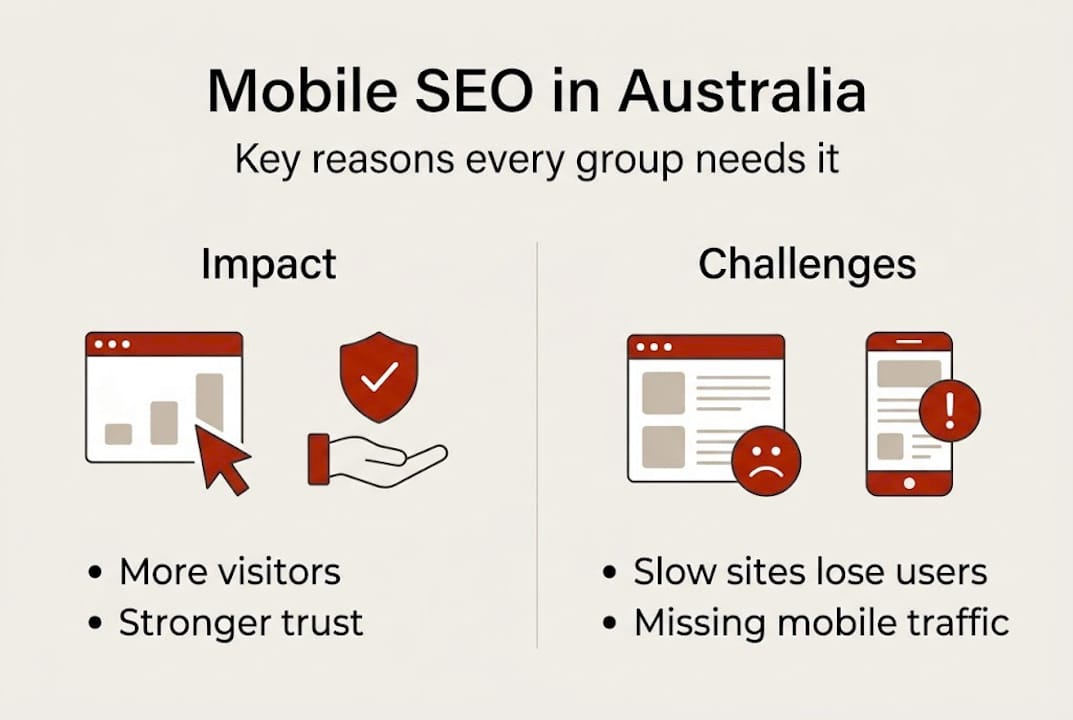
The numbers are clear. 72% of organic search traffic in Australia now comes from mobile devices. If your website is not optimised for mobile, you are effectively invisible to the majority of people searching for services like yours.
| Search behaviour | Statistic |
|---|---|
| Mobile share of all Australian searches | 89% |
| Organic traffic from mobile devices | 72% |
| Users who abandon slow mobile pages | 53% |
A strong mobile presence does more than improve your search ranking. It builds trust. When a potential supporter or service user visits your site on their phone and finds it easy to navigate, loads quickly, and presents information clearly, they are more likely to engage, donate, or make contact. A poorly performing mobile site, on the other hand, signals a lack of professionalism, even if your organisation does exceptional work.
“Your website is often the first point of contact between your organisation and the people you serve. On mobile, first impressions are formed in seconds.”
The SEO benefits for community groups extend well beyond search rankings. Improved visibility means more people can access your services, more volunteers can find opportunities to contribute, and more donors can connect with your cause. For organisations working with limited budgets, mobile SEO offers a cost-effective way to extend reach without paid advertising.
Key reasons mobile SEO matters for community organisations:
- It increases the likelihood that people in need will find your services quickly
- It improves accessibility for users across a range of devices and connection speeds
- It supports local SEO optimisation, helping you appear in searches for services in your area
- It builds credibility with both users and search engines
Ignoring mobile optimisation means missing the people your organisation exists to serve.
How mobile SEO elevates user experience and engagement
Recognising the dominance of mobile search is the first step. The next is understanding what keeps visitors active and engaged once they arrive on your site. Mobile usability covers several technical and design factors, including site speed, readability, and ease of navigation.
Site speed is particularly critical. 53% of users abandon a mobile page if it takes more than three seconds to load. For a community organisation, every abandoned visit is a missed opportunity to connect with someone who may need your services or want to support your mission.
Steps to improve mobile user experience:
- Compress images and reduce file sizes to improve load speed
- Use a mobile-responsive design that adapts to different screen sizes
- Ensure buttons and links are large enough to tap easily on a touchscreen
- Simplify your navigation menu so users can find key information in two taps or fewer
- Use legible font sizes, typically 16px or larger, to improve readability on small screens
“Good mobile experience is not about aesthetics. It is about ensuring every person, regardless of their device or connection speed, can access what they need.”
Accessibility is a core consideration here. Many of the people community organisations serve may be using older devices or slower internet connections. Sustainable web design for impact takes this into account, building sites that perform well even under constrained conditions. This is not just a technical nicety. It is an ethical responsibility for organisations that exist to serve their communities.

Pro Tip: Use Google’s free PageSpeed Insights tool to test your site’s mobile performance. It provides specific, actionable recommendations to improve load times and usability without requiring technical expertise.
Beyond speed, ethical web design principles support mobile SEO by prioritising clarity and user needs over visual complexity. Simpler layouts, clear calls to action, and well-structured content all contribute to a better mobile experience and stronger search performance.
Key strategies for mobile SEO: What every organisation needs to know
With a clear focus on user experience, it is important to apply specific strategies that are proven to improve mobile SEO. Core methodologies include responsive design, fast page speeds, content parity between mobile and desktop, avoiding intrusive popups, and Core Web Vitals optimisation.
Responsive design means your website automatically adjusts its layout to fit the screen size of any device. This is now the standard approach and is strongly preferred by Google for mobile indexing. If your site requires users to pinch and zoom to read content, it is not responsive.
| Strategy | Why it matters | Priority |
|---|---|---|
| Responsive design | Adapts to all screen sizes | High |
| Page speed under 3 seconds | Reduces abandonment | High |
| Content parity | Same info on mobile and desktop | Medium |
| No intrusive popups | Avoids Google penalties | Medium |
| Core Web Vitals | Measures real user experience | High |
Core Web Vitals are a set of metrics Google uses to assess the real-world experience of visiting a page. They measure loading speed, visual stability, and interactivity. Organisations that score well on these metrics are more likely to rank higher in mobile search results.
Key mobile SEO actions for community organisations:
- Conduct a mobile SEO audit to identify current gaps and priorities
- Ensure your site uses HTTPS, which is a basic trust and security signal
- Avoid using large blocks of text. Break content into short paragraphs with clear headings
- Remove or replace any Flash-based content, which does not function on most mobile devices
- Test your site on multiple devices and browsers to catch display issues
Building an SEO-friendly nonprofit website does not require a large budget. Many of the most impactful improvements are technical adjustments that a developer or digital partner can implement efficiently. The key is knowing where to start, which is why an audit is often the most valuable first step.
Mobile SEO and the unique needs of Australian community groups
While general mobile SEO strategies apply to all organisations, community groups have specific opportunities and considerations that make their approach distinct. For non-profits and community organisations, mobile SEO works best when integrated with broader digital tools and a values-driven approach.
One of the most powerful combinations available to eligible non-profits is pairing mobile SEO with Google Ad Grants. For non-profits, combining Google Ad Grants with Google Business Profile optimisation and strong mobile SEO creates a layered digital presence that is difficult to ignore in local search results.
Pro Tip: Check your Google Ad Grant eligibility early. Eligible organisations can access up to $10,000 USD per month in free Google Ads spend, which combined with strong mobile SEO, can dramatically increase your reach.
Steps to integrate mobile SEO into your broader digital strategy:
- Claim and optimise your Google Business Profile with accurate contact details, opening hours, and photos
- Ensure your website’s mobile experience matches the quality of your Google Ads landing pages
- Use local keywords that reflect the communities and locations you serve
- Build content that answers the specific questions your audience searches for on mobile
For local SEO for community groups, visibility in suburb-level and city-level searches is often more valuable than broad national rankings. People searching for support services typically search with location intent, such as “food relief Sydney” or “mental health support Melbourne.”
Additional considerations for community organisations:
- Prioritise accessibility standards such as WCAG 2.1 to ensure your site works for users with disabilities
- Work with ethical SEO service providers who understand the non-profit context
- Treat SEO investment as infrastructure, not a one-off project, to build sustainable long-term visibility
The overlooked truth: Mobile SEO as your community’s digital infrastructure
Most organisations approach SEO as a marketing activity. They think about it when launching a new campaign or when traffic drops. For community groups, this framing misses something important.
Mobile SEO is not just about being found. It is about ensuring equitable access to your services, building long-term trust with your audience, and creating a digital foundation that supports every other initiative you run. When your mobile presence is strong, your Google Ad Grants perform better, your social media links convert more reliably, and your email campaigns land on pages that work properly.
Viewing mobile SEO as ethical SEO essentials infrastructure changes how you invest in it. Instead of sporadic fixes, you build a consistent practice of improvement. Instead of chasing rankings, you focus on serving users well, which is exactly what search engines reward. For organisations whose mission is to serve their communities, this alignment between values and strategy is not just convenient. It is the right approach.
Level up your organisation’s mobile SEO with expert support
Putting mobile SEO strategies into practice takes time, technical knowledge, and a clear understanding of your organisation’s goals. Marzipan Media works specifically with community-based organisations to build digital foundations that align with their values and deliver measurable results.
From AI-informed SEO services to digital marketing for high-trust organisations, the team at Marzipan brings ethical, performance-focused expertise to every project. Whether you need a full sustainable web design build or a targeted mobile SEO audit, the focus is always on long-term impact over short-term noise. If your organisation is ready to improve its mobile presence and reach more of the people it exists to serve, Marzipan is ready to help.
Frequently asked questions
What are the most important elements of mobile SEO for community groups?
Focus on responsive design, fast loading times, clear navigation, and keeping mobile content consistent with your desktop site. These four areas have the greatest combined effect on both search rankings and user experience.
How does mobile SEO affect website traffic for Australian organisations?
89% of searches in Australia happen on mobile devices and 72% of organic traffic comes from these devices, so strong mobile SEO directly determines how many people can find and access your organisation online.
Why do slow mobile sites lose potential supporters?
53% of users abandon a mobile page that takes more than three seconds to load, which means slow sites consistently lose the visitors most likely to engage, donate, or seek services.
Can mobile SEO support Google Ad Grants for nonprofits?
Yes. Combining Ad Grants with mobile SEO ensures that users who click on your grant-funded ads arrive at a fast, well-structured mobile page, which improves campaign performance and helps you meet Google’s quality requirements.