TL;DR:
- Ethical web design prioritises user needs, accessibility, privacy, and transparency, resulting in higher engagement and credibility.
- Implementing these principles avoids manipulative dark patterns, reduces regulatory risks, and enhances long-term trust and performance.
- If you’re looking for web design services for your charity or nonprofit org head here and discover how we can help you shine online.
Ethical web design is often treated as a compliance exercise, something to tick off alongside privacy policies and cookie banners. For mission-driven organisations in Australia, that framing misses the point entirely. W3C design principles define ethical web design as prioritising user needs, accessibility, privacy, transparency, sustainability, and the avoidance of manipulative practices. When organisations actively build these values into their websites, they see measurable gains in engagement, credibility, and long-term impact. This article covers what ethical web design actually means, why it matters, and how to put it into practice.
Table of Contents
- Defining ethical web design: Principles and practices
- Why ethical web design matters: Impact, credibility, and trust
- Ethical web design in action: Case studies and performance benchmarks
- Applying ethical design: Steps for mission-driven Australian organisations
- Why ethical web design wins: Lessons most agencies overlook
- Ethical web solutions for mission-driven organisations
- Frequently asked questions
Key Takeaways
| Point | Details |
|---|---|
| Ethical design builds trust | Prioritising user needs and transparency enhances credibility and impact for mission-driven websites. |
| Avoid manipulative practices | Dark patterns erode trust, risk regulatory attention, and should be eliminated from nonprofit websites. |
| Sustainable web practices matter | Reducing digital carbon and improving accessibility leads to better SEO and performance outcomes. |
| Practical steps drive impact | Applying a step-by-step ethical framework aligns your website with organisational values and legal requirements. |
Defining ethical web design: Principles and practices
Ethical web design is a set of deliberate choices about how a website functions, who it serves, and what it asks of users. For mission-driven organisations, these choices carry extra weight because the website is often the primary point of contact between the organisation and the communities it supports.
At its core, ethical web design rests on several interdependent principles. Accessibility ensures that people with disabilities can navigate and use the site without barriers. Privacy means collecting only the data that is genuinely needed and being transparent about how it is used. Sustainability refers to reducing the environmental footprint of the website, from server energy use to unnecessary data transfers. Transparency means communicating clearly and honestly, without hidden costs, misleading copy, or confusing structures.
Understanding these principles is easier with a working knowledge of ethical web design terminology, particularly for teams new to this space.
The contrast between ethical and unethical practices becomes clear when you look at what are known as dark patterns. These are design tactics deliberately created to confuse or manipulate users into doing things they did not intend to do. Common examples include pre-ticked subscription boxes, hidden unsubscribe links, countdown timers that pressure purchases, and consent dialogues that make “reject all” far harder to find than “accept all.” These tactics are the opposite of ethical design.
Here is a summary of core ethical design principles alongside typical unethical equivalents:
| Ethical practice | Unethical equivalent |
|---|---|
| Clear, easy-to-find privacy settings | Hidden or obfuscated opt-out options |
| Accessible navigation for screen readers | No alt text, poor colour contrast |
| Transparent pricing and costs | Hidden fees revealed at checkout |
| Simple, honest consent dialogues | Dark pattern consent interfaces |
| Lightweight, sustainable page design | Bloated pages with unnecessary scripts |
| Plain language content | Jargon used to confuse or impress |
Key areas to address when reviewing your website for ethical compliance include:
- Accessibility: Does the site meet web accessibility guidelines such as WCAG 2.1 AA?
- Privacy: Is data collection minimal, clearly explained, and compliant with the Australian Privacy Act?
- Transparency: Are costs, processes, and data use explained plainly and upfront?
- Sustainability: Is the site hosted on green servers, and is the page weight kept low?
- Dark patterns: Has the site been audited for manipulative features?
Pro Tip: Review your website against the ethical SEO for nonprofits framework to identify issues that affect both ethics and search performance at the same time.
Why ethical web design matters: Impact, credibility, and trust
With principles established, it is crucial to understand how ethical choices shape organisational outcomes online. For nonprofits and community groups, trust is not just a nice-to-have. It is fundamental to whether people donate, volunteer, seek services, or engage with campaigns.
Dark patterns have a directly measurable negative effect on user trust. Research cited in the Made to Manipulate report found that 56% of users lose trust in an organisation when they encounter manipulative design. For a nonprofit that depends on community confidence, that figure is significant. A single poorly designed consent form or a confusing donation flow can permanently damage the relationship between the organisation and its supporters.
“Dark patterns, including hidden reject buttons, pre-ticked boxes, and subscription traps, create real ACCC enforcement risks under Australian Consumer Law and the Unfair Trading Practices Bill, while directly eroding the credibility that mission-driven organisations depend on.”
The regulatory dimension adds further urgency. The Australian Competition and Consumer Commission actively investigates dark patterns ethics issues under the Australian Consumer Law. The proposed Unfair Trading Practices Bill would extend these protections further. Organisations found to be using manipulative design tactics risk formal enforcement action, reputational damage, and legal costs. For resource-constrained nonprofits, that is a serious risk to manage proactively.
The positive case for ethical design is equally strong. When users encounter a website that is easy to navigate, honest in its communication, and respectful of their time and data, they are more likely to stay longer, return more often, and take the actions the organisation wants them to take. This applies directly to social impact web design, where the connection between design quality and mission outcomes is direct.
Demonstrating trustworthiness online can take several practical forms:
- Display clear privacy policies that are written in plain language, not legal jargon
- Provide genuine, easy opt-out options at every data collection point
- Use inclusive web content practices that address diverse audiences
- Make contact information and complaint processes easy to find
- Be transparent about funding, governance, and how donations are used
These are not just ethical choices. They are strategic ones that strengthen reputation and reduce regulatory risk at the same time. When an organisation considers updating for ethical impact, these elements form the foundation of the review process.
Ethical web design in action: Case studies and performance benchmarks
To ground the ethical framework, it is worth reviewing real outcomes from organisations already leading the way. The evidence shows that ethical design choices produce significant, measurable improvements across performance, accessibility, and sustainability metrics.
The Human Rights Law Centre (HRLC) in Australia provides one of the clearest documented examples. Following a website redesign focused on ethical and sustainable principles, performance gains were substantial: mobile performance increased by 45%, desktop speed improved by 86%, accessibility scores rose by 14%, and the site achieved a perfect SEO score. These are not marginal improvements. They represent a fundamentally better digital experience for every person who visits the site.

The Mightybytes agency documented comparable results on its own ethical redesign. Page size was reduced by 50%, dropping from 644kb to 305kb. The site achieved an “A” digital carbon rating, placing it among the lowest-emitting websites in its category. You can assess your own site’s environmental footprint using a website carbon footprint tool.
The table below compares typical outcomes across ethical and conventional web design approaches:
| Metric | Ethical web design | Conventional web design |
|---|---|---|
| Page load speed | Faster, optimised | Often slower, unoptimised |
| Carbon rating | A or B (low emissions) | C to F (high emissions) |
| Accessibility score | High (WCAG compliant) | Often partial or non-compliant |
| SEO performance | Strong, consistent | Variable |
| User trust | Higher, long-term | Lower, erosion over time |
| Regulatory risk | Low | Higher with dark patterns |
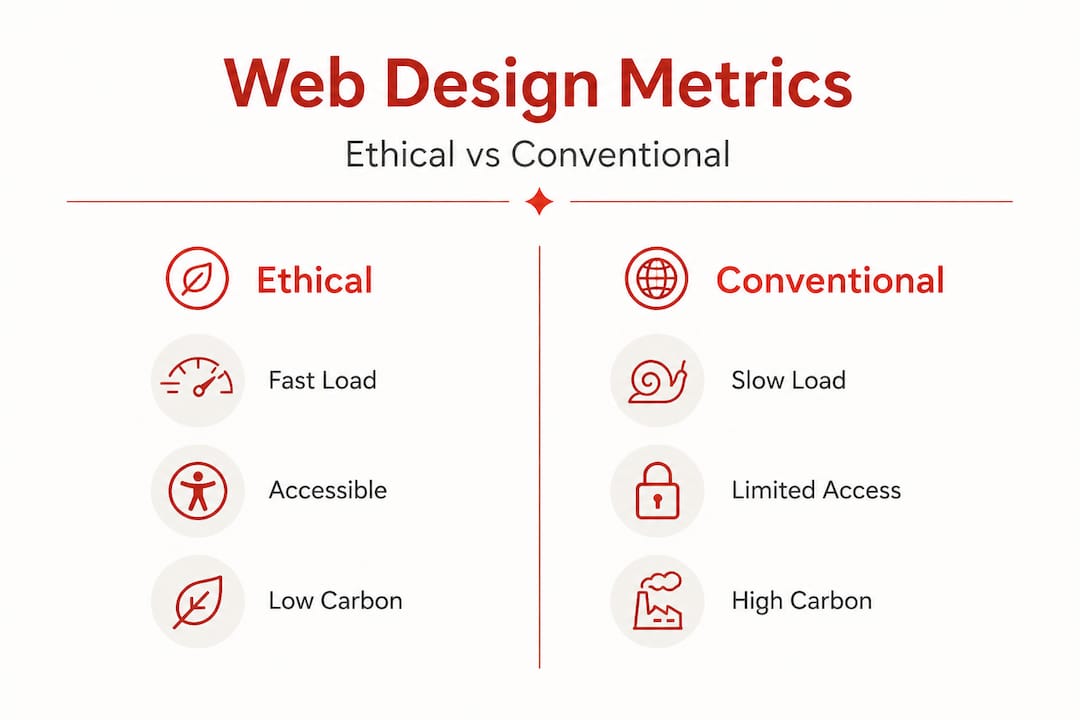
These benchmarks matter because they connect directly to digital sustainability outcomes that funders, boards, and communities increasingly expect from mission-led organisations.
Pro Tip: Use a combination of Google Lighthouse for performance and accessibility scores, and a website carbon calculator, to establish your baseline before beginning any ethical redesign process. This gives you concrete data to report against.
Reviewing the Sydney social impact design landscape shows that these improvements are achievable across different organisation sizes and budgets. The HRLC example demonstrates that even organisations with complex content needs and diverse user groups can achieve outstanding technical results through ethical design. The key is making ethics the starting point, not an afterthought in the refresh for ethical impact process.
Applying ethical design: Steps for mission-driven Australian organisations
Having seen what is possible, here is how your organisation can apply ethical web design in practice. Ethical web design enhances engagement by building trust through alignment with values like inclusivity and sustainability, consistently outperforming manipulative tactics over the long term.
The following roadmap provides a practical sequence for organisations at any stage of digital maturity:
- Conduct an accessibility audit. Use the WCAG 2.1 AA standard as your baseline. Check colour contrast, keyboard navigation, screen reader compatibility, and alt text on images. This is the non-negotiable starting point.
- Review privacy and data practices. Map every data collection point on your website. Ensure each one has a clear purpose, plain language explanation, and genuine opt-out mechanism. Check compliance with the Australian Privacy Act.
- Audit for dark patterns. Walk through every user journey on your website as if you were a first-time visitor. Look for pre-ticked boxes, difficult cancellation flows, misleading button labels, and confusing consent interfaces.
- Assess sustainability. Test your site’s carbon rating and page weight. Consider switching to a green hosting provider and removing unnecessary third-party scripts that add both weight and tracking risk.
- Run an SEO and performance review. Follow structured SEO audit steps to identify technical issues that affect both user experience and search visibility. Ethical design and strong SEO are closely aligned.
- Adopt eco-friendly web design practices. Compress images, use system fonts where possible, and minimise the number of external resources loaded on each page.
- Implement transparent content practices. Ensure all pricing, donation use, governance, and contact information is easy to find and written in plain language.
- Measure and report. Define impact metrics before launch and track them consistently. Engagement rates, accessibility scores, page speed, and carbon ratings all provide evidence of ethical performance.
Additional actions that support long-term ethical performance include:
- Training your content team on plain language principles and inclusive writing
- Reviewing accessibility improvement tips on an annual basis as standards evolve
- Applying SEO for mission-driven brands practices that prioritise relevance over manipulation
- Building ethical design criteria into any future procurement or agency brief
The roadmap above is not a one-time project. Ethical web design requires ongoing review and iteration as technology, regulation, and community needs change.
Why ethical web design wins: Lessons most agencies overlook
Most web agencies approach design through the lens of persuasion. The goal is to move users towards a desired action as efficiently as possible. Click-through rates, conversion funnels, and A/B tests on button colours are the standard currency. This approach has its place in commercial contexts, but it creates real problems when applied to mission-driven organisations without adjustment.
The core issue is that persuasion-focused design often borrows from dark pattern thinking, even unintentionally. Urgency cues, friction reduction in checkout flows, and aggressive email capture mechanisms all carry the same underlying logic: override user hesitation. For a nonprofit or community organisation, this approach is counterproductive. The audience is not a consumer to be converted. They are a community member whose long-term trust is far more valuable than a single transaction.
Ethical design, in contrast, is built on respect for the user’s autonomy and time. This is not a softer or less effective approach. It is a more accurate model of how trust-dependent organisations actually grow. When a user feels respected by a website, they are more likely to return, to recommend the organisation to others, and to deepen their involvement over time. That pattern of behaviour is what bespoke ethical impact design is built to support.
There is also a compounding effect that agencies rarely discuss. Ethical design choices, particularly accessibility and performance improvements, directly strengthen SEO results. Faster pages rank better. Accessible content is indexed more effectively. Transparent, well-structured content earns more genuine backlinks. The HRLC case study is a clear illustration: ethical redesign produced a perfect SEO score, not in spite of ethical choices, but because of them.
The agencies that miss this connection tend to treat ethics and performance as competing priorities. The evidence consistently shows they are the same priority, viewed from different angles.
Ethical web solutions for mission-driven organisations
Mission-driven organisations in Australia deserve websites that reflect their values as clearly as their programmes do. Ethical design is not a constraint on performance. It is the foundation of it.
At Marzipan, we work with purpose-driven organisations to build websites that are accessible, sustainable, and free from manipulative practices. Our SEO services are built on ethical foundations, and our digital marketing approach prioritises genuine engagement over short-term tactics. We also specialise in tailored solutions for organisations like community legal centres, where trust, accessibility, and clear communication are essential. If your organisation is ready to align its website with its values, we are ready to help you build something that lasts.
Frequently asked questions
What are dark patterns and why should we avoid them?
Dark patterns are manipulative design tactics that deceive users into unintended actions, eroding trust and creating real ACCC enforcement risks under Australian Consumer Law and the proposed Unfair Trading Practices Bill.
How does ethical web design enhance online engagement?
Ethical web design builds user trust through inclusivity, transparency, and sustainability, and trust-centred design consistently outperforms manipulative tactics for long-term engagement, particularly for mission-driven organisations.
What practical steps can our organisation take towards ethical web design?
Start by implementing WCAG accessibility standards, removing manipulative features, adopting sustainable hosting, and reviewing your privacy and data collection practices against the Australian Privacy Act.
Does ethical web design affect SEO or digital performance?
Yes. Ethical practices such as faster load times and improved accessibility directly contribute to better SEO and performance scores, as demonstrated by the HRLC redesign achieving a perfect SEO score and an 86% desktop speed improvement.
Recommended
- Web design for social impact: Sydney orgs build sustainably – Marzipan
- Why audit your website: boost impact and trust ethically – Marzipan
- How to update web design for meaningful impact – Marzipan
- Web design terminology: guide for ethical, sustainable sites – Marzipan
- Verhoog klanttevredenheid met sterke user experience