TL;DR:
- Intent-based SEO focuses on matching content to user goals rather than specific keywords.
- Properly identifying and mapping search intent improves engagement and local visibility for community organizations.
- Regular audits and understanding nuanced intent shifts are crucial for sustained SEO success.
Most digital marketers focus on keywords. They build lists, track rankings, and optimise pages around specific terms. Yet this approach often misses what actually drives search behaviour: the underlying goal a person has when they type a query. Intent-based SEO prioritises aligning content with the purpose behind a search, not just the words used. For Australian community organisations working with limited budgets and tight teams, this distinction is significant. Matching content to user intent improves engagement, reduces wasted effort, and builds lasting visibility without requiring expensive tools or large content teams.
Table of Contents
- What is intent-based SEO and why does it matter?
- Identifying search intent: tools, methods, and practical audit steps
- Working with nuanced and hybrid search intents
- Aligning content strategy with search intent for community engagement
- What most marketers get wrong about intent-based SEO
- Next steps: connect your SEO intent to real community impact
- Frequently asked questions
Key Takeaways
| Point | Details |
|---|---|
| Intent outperforms keywords | Understanding user motivations and structuring content around search intent leads to higher engagement than keyword-first approaches. |
| SERP analysis is essential | Analysing search results and clustering keywords by intent reveals user needs and guides effective content updates. |
| Nuances drive better results | Recognising mixed, local, and drifting intents prevents wasted effort and increases visibility for community-minded organisations. |
| Ethical, semantic SEO boosts trust | Using ethical practices and semantic mapping aligns content with intent, reducing bounce rates and supporting sustainable engagement. |
What is intent-based SEO and why does it matter?
Intent-based SEO is a method of planning and creating content based on what a user is trying to accomplish, rather than which specific words they use. A person searching for “volunteer opportunities near me” is not simply looking for a keyword match. They want a list of local options, preferably with contact details and application steps. If your page only mentions volunteering in passing, it will not satisfy that need, regardless of how many times the phrase appears.
Intent-based SEO categorises queries into four main types. Understanding these categories is the foundation of any intent-driven content strategy:
- Informational intent: The user wants to learn something. Example: “how does community land trust work?”
- Navigational intent: The user wants to find a specific website or page. Example: “Red Cross Australia donate page.”
- Commercial investigation intent: The user is comparing options before making a decision. Example: “best community grant platforms Australia.”
- Transactional intent: The user is ready to act. Example: “register for community garden programme Sydney.”
The contrast between keyword-oriented and intent-oriented content planning is significant. Keyword strategies ask: “What terms should we include?” Intent strategies ask: “What does this person need to accomplish, and does our page deliver that?”
| Approach | Focus | Outcome |
|---|---|---|
| Keyword-oriented | Term frequency and density | Pages rank for terms but may not convert |
| Intent-oriented | User goal and content match | Higher engagement and lower bounce rates |
Aligning content with user intent reduces bounce rates and improves time-on-page, two signals that influence organic rankings over time.
For community organisations, applying semantic SEO strategies means thinking about the questions your audience is genuinely asking, not the terms you assume they use. Reviewing SEO service provider guidance specific to nonprofits can also clarify which intent-matching approaches are most appropriate for your sector. Accurate query intent identification is the starting point for all of this work.
With the basics outlined, let’s look at how you can practically identify and map search intent across your content.
Identifying search intent: tools, methods, and practical audit steps
Knowing the four intent types is useful. Knowing how to detect intent across your existing content and incoming queries is where the practical value lies. The core methodology involves SERP analysis using the 3C method: examining content type, content format, and content angle for any given query.
Content type refers to whether the top results are blog posts, product pages, videos, or tools. Content format refers to how information is presented: listicles, step-by-step guides, comparison tables, or long-form articles. Content angle refers to the unique positioning of top results, such as “beginner-friendly,” “free resource,” or “local to Australia.”
Here is a step-by-step process for conducting an intent audit on your community organisation’s website:
- Export your top queries from Google Search Console, filtering for those with at least ten impressions.
- Group queries into intent categories: informational, navigational, commercial investigation, and transactional.
- For each query cluster, examine the top five Google results using the 3C method.
- Compare your current page format and angle to what is ranking. Note any mismatches.
- Prioritise pages where your content type does not match the dominant intent signal in the SERP.
The following table illustrates how common community organisation queries map to intent types:
| Query example | Intent type | Ideal content format |
|---|---|---|
| “what is a tenants union?” | Informational | Explainer article |
| “Sydney community legal centre” | Navigational | Homepage or about page |
| “best grant writing tools” | Commercial investigation | Comparison guide |
| “donate to food bank now” | Transactional | Donation landing page |
Pro Tip: Google Search Console is free and sufficient for most intent audits. You do not need paid tools to begin mapping your queries to intent categories.
Intent drift is also worth tracking. A query that once attracted informational searches may shift toward transactional behaviour as a topic matures. Reviewing your SEO audit steps guide for nonprofits can help structure this ongoing monitoring. For a deeper walkthrough, conducting an SEO audit for mission-driven organisations covers the full process. Additional free intent audit tools can complement what Search Console already provides.

Now that you know how to uncover intent, let’s address situations where intent is not always clear-cut.
Working with nuanced and hybrid search intents
Search intent is not always straightforward. Many real-world queries sit between categories or shift depending on context. Recognising these edge cases is important for community organisations where search behaviour often reflects complex, layered needs.
Edge cases in intent analysis include the following common scenarios:
- Mixed or fractured intent: A single query attracts users with different goals. For example, “community garden Sydney” may bring people wanting to find a garden, learn about starting one, or volunteer. A single page rarely satisfies all three equally well.
- Intent drift: A query’s dominant intent changes over time. “Online community grants” once attracted informational searchers but increasingly attracts transactional ones as more programmes move online.
- Local and hybrid intent: Queries with geographic modifiers often combine informational and transactional signals. “Family support services Parramatta” may indicate someone wanting both information and an immediate referral.
- Post-purchase intent: Users who have already taken action (donated, registered, attended) may return with follow-up queries. These deserve dedicated content such as FAQs or next-step guides.
- AI-driven intent: As generative search tools become more common, query phrasing is shifting toward conversational, multi-part questions. Content needs to address these longer, context-rich queries directly.
Pro Tip: For mixed intent queries, consider creating a hub page that links to dedicated pages for each intent segment. This gives each user a clear path without forcing one page to do everything.
For Australian community organisations, local and hybrid intent is particularly common. Residents searching for local services often combine a geographic term with an action phrase. Aligning your content with local SEO solutions for Sydney community groups is one direct way to address this. Structuring your SEO content workflow around these intent variations ensures your team creates the right type of content at each stage.
Managing these nuances leads directly to the practical steps for aligning your content strategy.
Aligning content strategy with search intent for community engagement
Once intent types are mapped, the next step is making sure your content structure, schema, and messaging match what users expect to find. This is where intent-based SEO produces the most visible results for community organisations.
Several practical methods help close the gap between user intent and page delivery:
- Semantic entity mapping: Instead of targeting keywords, identify the topics, people, places, and concepts your audience associates with each query. Build pages around these entities, not individual terms.
- Schema markup aligned to intent: Use FAQ schema for informational pages, event schema for transactional registrations, and organisation schema for navigational queries. Schema helps search engines confirm your page matches the expected intent.
- Intent-Friction Matrix: Avoiding intent mismatch reduces pogo-sticking (when users return immediately to search results) and high bounce rates. Map your pages against user expectations to identify where friction exists.
- Multi-intent cluster mapping: Group related queries into clusters, then create a network of pages that collectively serve the full range of intent signals around a topic.
- Ethical content practices: Avoid tactics that artificially force content into intent categories. Prioritise genuine usefulness over manipulation.
Intent alignment boosts visibility for non-profits without requiring large budgets. For organisations with limited resources, this is a meaningful advantage. A well-mapped intent strategy produces more from less.
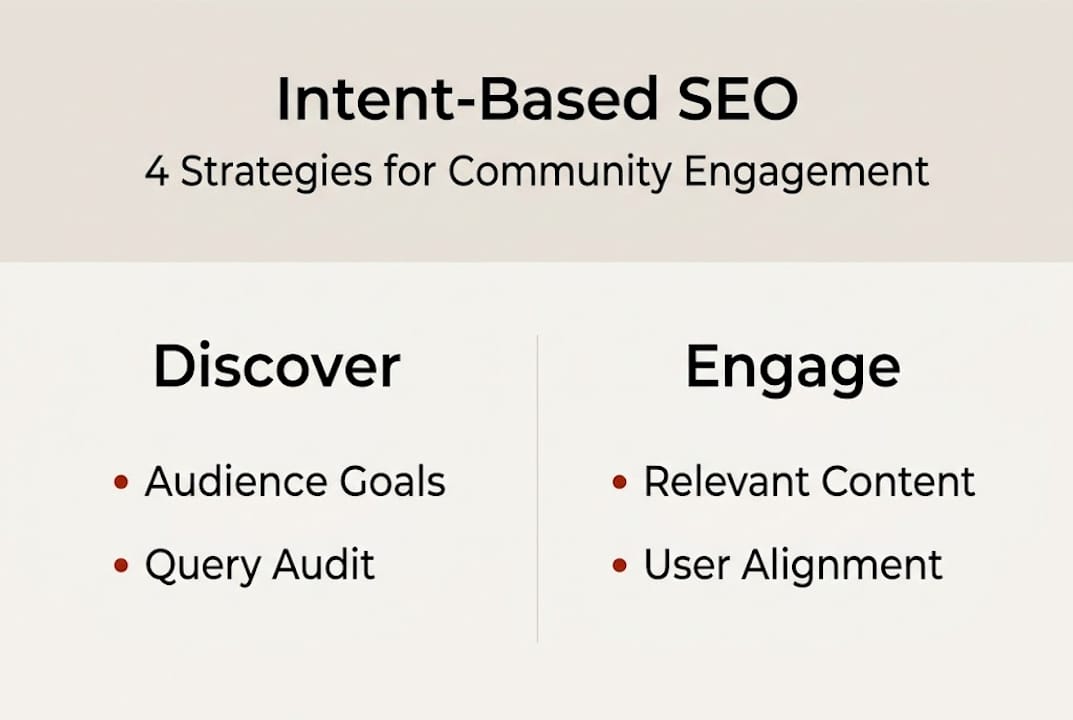
Exploring the broader SEO benefits for community organisations provides additional context for prioritising these efforts. Pairing intent alignment with sustainable SEO strategies ensures the approach remains effective over time. Building an intent-led content workflow gives your team a repeatable system for producing content that consistently matches user goals.
With practical alignment covered, let’s look at what most guides never tell you about intent-based SEO.
What most marketers get wrong about intent-based SEO
Many marketers treat intent categories as rigid boxes. They identify a query as “informational” and produce a generic explainer, then wonder why engagement remains low. The error is working backwards from a taxonomy instead of forwards from community need.
Intent-based SEO works best when the starting point is genuine understanding of what your audience is trying to accomplish, not a framework imposed on top of existing content. For community organisations, this means talking to your members, reviewing your most common enquiries, and letting real questions shape your content plan.
The other common mistake is treating intent as static. Organisations that audit their content once and assume it remains aligned are consistently surprised by traffic drops. Intent shifts with events, policy changes, and seasonal cycles. Regular review is not optional.
Applying ethical SEO guidance reinforces this point. Ethical SEO is not just about avoiding penalties. It is about building content that genuinely serves users, which is precisely what intent-based SEO demands. Organisations that approach it this way consistently outperform those chasing short-term visibility.
Next steps: connect your SEO intent to real community impact
Intent-based SEO produces better results when it is supported by a website built to match how users engage with community content.
Marzipan works with Australian community organisations to build sustainable web design solutions that reflect your values and serve your audience’s real needs. From site structure through to content alignment, every decision is informed by intent. Our AI SEO services help your organisation identify the right queries, map them to intent clusters, and produce content that earns sustained visibility. If your current site is not converting visitors into engaged community members, the issue is often intent mismatch, and it is fixable.
Frequently asked questions
How does intent-based SEO differ from traditional keyword SEO?
Intent-based SEO prioritises user goals, mapping content to the purpose behind a search rather than matching exact keyword strings. Traditional keyword SEO focuses primarily on term frequency and placement.
What are the four main types of search intent?
Informational, navigational, commercial investigation, and transactional intents cover learning, finding, comparing, and completing an action respectively.
Why is intent-based SEO especially important for Australian community organisations?
Intent alignment improves non-profit visibility without requiring large budgets, making it a practical approach for organisations with constrained resources who need to reach local audiences efficiently.
How can you identify search intent using free tools?
Google Search Console allows you to analyse query types and performance, giving you enough data to conduct a basic intent audit without any paid subscriptions.
Recommended
- Local SEO Optimisation: Impact for Community Brands – Marzipan
- How ethical strategies shape the future of SEO for 2025 – Marzipan
- Semantic SEO explained: ethical strategies for mission-driven organisations – Marzipan
- SEO Marketing Company Near Me: Ethical Growth – Marzipan
- Content Strategist Recruiters — SEO, Editorial & Brand | Careerscape
- Sales interaction automation explained: boost engagement & efficiency | SuperSocial Blog