

TL;DR:
- Modern search engines prioritize meaning, relationships, and user intent over isolated keywords.
- Semantic SEO builds trust through genuine, community-focused content spanning topics and entities.
- Ethical, sustainable SEO emphasizes authority, accessibility, and local relevance aligned with organizational values.
Outdated keyword tactics are still common across many Australian community organisations, yet Google has moved well beyond counting keyword repetitions. Modern search engines assess meaning, relationships, and user intent. Organisations that continue to chase isolated keywords risk invisibility, while those that adopt semantic SEO gain sustainable, ethical visibility aligned with their mission. Semantic SEO optimises for meaning, context, entities, relationships, and user intent rather than isolated keywords. For community-focused groups, this shift is not just a technical upgrade. It is a more honest, values-driven way to be found online.
Table of Contents
- What is semantic SEO and why does it matter?
- Core components of semantic SEO
- How semantic SEO aligns with ethical and sustainable strategies
- Implementing semantic SEO: Practical steps for community organisations
- Why most semantic SEO guides miss the mark for mission-driven organisations
- Next steps: Bring ethical, sustainable SEO to your organisation
- Frequently asked questions
Key Takeaways
| Point | Details |
|---|---|
| Meaning matters most | Semantic SEO prioritises context, intent, and relationships over keywords for better long-term results. |
| Ethical strategies win | Approaching SEO with ethics and sustainability ensures trust, visibility, and mission alignment. |
| Topic clusters boost authority | Organising content into topic clusters enhances expertise, trust, and search rankings. |
| Local focus drives impact | Tailoring semantic SEO to local entities and community issues maximises visibility and relevance. |
What is semantic SEO and why does it matter?
Semantic SEO is the practice of structuring content so that search engines understand the full meaning behind it, not just the words on the page. Where traditional SEO focused on repeating specific phrases, semantic SEO builds relationships between topics, entities, and user needs. It treats content as a network of connected ideas rather than a collection of keyword-optimised pages.
For community organisations, this distinction matters. Traditional approaches often encouraged tactics that felt manipulative: stuffing pages with phrases, building low-quality backlinks, or creating thin content purely to rank. Semantic SEO, by contrast, rewards genuine depth, clear organisation, and content that genuinely serves the reader.
| Factor | Traditional SEO | Semantic SEO |
|---|---|---|
| Focus | Isolated keywords | Meaning and context |
| Content strategy | Keyword density | Topic depth and relationships |
| Link building | Volume-based | Authority and relevance |
| User intent | Often ignored | Central to strategy |
| Ethical alignment | Variable | Inherently user-first |
This table illustrates why semantic SEO is a stronger fit for organisations practising ethical SEO for communities. The approach naturally discourages manipulation because search engines now penalise shallow, disconnected content.
Semantic SEO rewards organisations that communicate clearly, cover topics thoroughly, and prioritise the needs of their audience. For mission-driven groups, this is not a compromise. It is a direct extension of their values.
The SEO benefits for community organisations extend beyond rankings. Semantic SEO builds lasting authority in a topic area, which means your organisation becomes a trusted reference point rather than just another search result. This is the kind of visibility that supports real community impact.
Core components of semantic SEO
With a clear definition in place, it is time to unpack the main components that set semantic SEO apart from older approaches.
Entities are the people, places, organisations, and concepts that search engines recognise as distinct things in the world. When your content clearly identifies your organisation, its location, its programmes, and the communities it serves, search engines can place your content within a broader knowledge framework.

Topic clusters are groups of related content organised around a central theme. A main page covers a broad topic, while supporting pages address specific subtopics. This structure signals topical authority and helps both users and search engines navigate your content logically.
Schema markup is structured data added to your website’s code. It tells search engines precisely what your content represents. For community organisations, this might include your organisation’s name, address, and events.
Semantic internal linking connects related pages on your site using descriptive anchor text. This reinforces topic relationships and helps users find relevant information. Building SEO-friendly websites depends heavily on this kind of intentional structure.
Methodologies such as topic clusters, Schema.org markup, natural language, semantic internal linking, and entity optimisation form the practical backbone of any semantic SEO strategy.
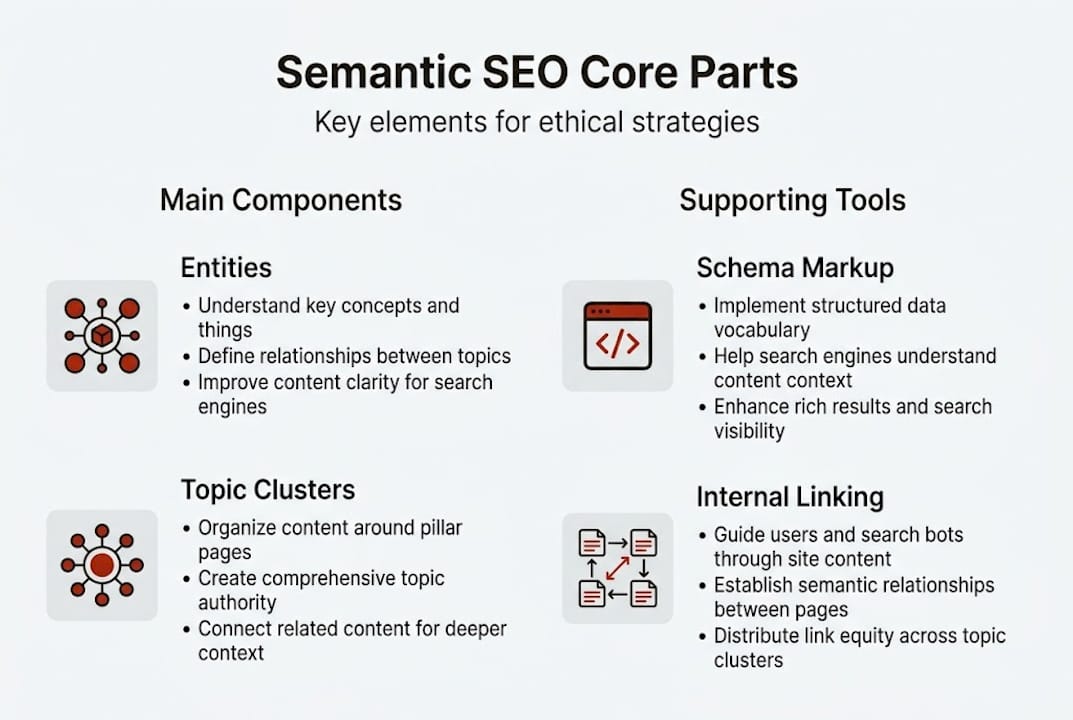
| Component | Primary impact | Ethical alignment |
|---|---|---|
| Entities | Search engine recognition | High: based on real-world facts |
| Topic clusters | Topical authority | High: rewards genuine depth |
| Schema markup | Rich results, visibility | High: transparent and accurate |
| Internal linking | User navigation, trust | High: improves accessibility |
Pro Tip: Use Organisation and Event Schema markup on your site to help Google understand who you are and what you do locally. These two Schema types are particularly effective for Australian nonprofits and community groups seeking local search visibility.
Avoid these common mistakes:
- Creating shallow topic clusters with only one or two supporting pages
- Using keyword stuffing instead of natural, topic-relevant language
- Adding Schema markup that does not accurately reflect your actual content
- Building internal links without descriptive, meaningful anchor text
- Ignoring entity consistency across your site and external profiles
How semantic SEO aligns with ethical and sustainable strategies
Now that the parts of semantic SEO are clear, it is worth examining how they directly support both ethical standards and mission-driven outcomes.
Semantic SEO naturally deters manipulative tactics because the approach only works when content is genuinely useful and well-organised. There is no shortcut to topical authority. You either cover a subject thoroughly and honestly, or you do not rank for it. This makes the strategy a strong fit for organisations that already prioritise transparency and community trust.
Measuring topical breadth and depth, entity salience, and avoiding thin clusters supports sustainable design via accessible rendering methods, which reinforces both SEO performance and site usability for all visitors.
Here is a practical sequence for integrating semantic SEO into ethical, sustainable digital practice:
- Audit your existing content to identify topic gaps and thin pages
- Define two or three core themes that reflect your organisation’s mission
- Build topic clusters around each theme, starting with a strong pillar page
- Add Organisation and Event Schema to relevant pages
- Review your internal linking structure to ensure it reflects topic relationships
- Publish content in plain, accessible language that serves your community audience
Organisations that build content around genuine community themes, rather than search volume alone, develop trust that sustains visibility over time. Rankings follow authority. Authority follows genuine depth.
Consider a practical example. A nonprofit focused on housing support in regional New South Wales might begin with a single blog post about rental assistance. Using semantic SEO, they would expand this into a cluster covering tenancy rights, local support services, emergency housing, and community advocacy. Each page reinforces the others, and the organisation becomes the authoritative local source on the topic.
Pro Tip: Accessible semantic structures, such as clear heading hierarchies and descriptive link text, improve both your SEO performance and your site’s usability for people using screen readers or assistive technology. This dual benefit is especially relevant for community organisations with diverse audiences.
The future of ethical SEO points firmly towards approaches that serve users first, and semantic SEO is central to that direction. Organisations that adopt it now are building on solid ground, while those that rely on ethical ways to improve Google ranking will find semantic principles already embedded in best practice.
Implementing semantic SEO: Practical steps for community organisations
With the ethical case established, here is exactly how to put semantic SEO into practice within your own organisation.
- Identify your core topics. List the three to five subjects most central to your mission. These become the pillars of your topic clusters.
- Research local entities. Include specific places, programmes, partner organisations, and community terms relevant to your Australian context. Local entities strengthen your relevance in regional and city-specific searches.
- Build your cluster structure. Create or update a pillar page for each core topic, then plan supporting pages that address specific questions or subtopics.
- Implement Schema markup. Add Organisation Schema to your homepage and Event Schema to any programme or event pages. Use Google’s Rich Results Test to verify your markup.
- Audit and improve internal links. Ensure every supporting page links back to its pillar page using clear, descriptive anchor text.
- Prioritise accessible design. Use proper heading structures, descriptive alt text for images, and plain language throughout.
For auditing mission-driven sites, a structured review of these six areas provides a clear starting point.
Recommended measurement tools and indicators:
- Topical breadth: Track how many subtopics your cluster covers compared to competitors
- Entity salience: Use tools such as Google’s Natural Language API to check how prominently your key entities appear
- Citation rates: Monitor whether your content is referenced in AI-generated answers and featured snippets
- Organic visibility: Track impressions and clicks in Google Search Console by topic group
For mission-driven community organisations, semantic SEO aligns ethically by focusing on comprehensive, user-first content with local entities and topic clusters on social impact themes. This approach produces results that are both measurable and meaningful, rather than chasing metrics that do not reflect real community impact.
Tailoring your approach to the Australian context means using local language, referencing Australian community frameworks, and incorporating structured data that reflects your specific programmes and service areas.
Why most semantic SEO guides miss the mark for mission-driven organisations
Most semantic SEO guides are written for commercial websites with large content teams, substantial budgets, and a primary goal of driving revenue. The advice is often sound in technical terms, but it does not translate directly to the needs of a community organisation in Parramatta or Geelong.
The instruction to “follow the data” assumes that search volume is the right measure of priority. For a community group, the most important topics may have low search volume but high local relevance. Optimising for scale over mission can lead organisations away from the content their communities actually need.
Accessibility is another gap. Many guides treat it as an afterthought, yet for community organisations serving diverse populations, accessible content is a core obligation, not a bonus feature. Semantic structures, when implemented correctly, support accessibility by default.
The mindset shift required is from traffic to value. A community organisation that becomes the trusted local authority on housing support, disability services, or environmental advocacy does not need millions of visitors. It needs the right people to find it, trust it, and act on what they find.
Ethical SEO growth in Australia looks different from commercial SEO growth, and the strategies should reflect that difference. Embedding organisational values, local context, and genuine accessibility into every content decision produces results that are both durable and authentic.
Next steps: Bring ethical, sustainable SEO to your organisation
Implementing semantic SEO takes time, but the right support makes the process more straightforward and more effective. At Marzipan, we work with mission-driven organisations across Australia to build digital presences that reflect their values and serve their communities.
Our approach combines sustainable web design with performance-driven ethical SEO services to create sites that are accessible, visible, and aligned with your mission. We also offer digital marketing for community groups that prioritises genuine impact over vanity metrics. If your organisation is ready to build lasting online authority without compromising its values, we would be glad to help you take the next step.
Frequently asked questions
What is the main difference between semantic SEO and traditional SEO?
Semantic SEO is the practice of optimising for meaning and intent, not just keywords. Traditional SEO targets isolated keyword phrases, while semantic SEO builds content around topics, entities, and the genuine needs of users.
How can semantic SEO benefit community organisations in Australia?
Semantic SEO is especially effective for mission-driven community organisations, providing sustained local visibility and supporting content that aligns with community values rather than commercial search trends.
What are topic clusters and why are they important?
Topic clusters organise your content around central themes, with a main pillar page supported by related subtopic pages. Building topic clusters is a key strategy for establishing topical authority with search engines.
What Schema markup should nonprofits use for SEO?
Organisation and Event Schema are the most beneficial types for community groups. Schema.org markup for Organisation and Events helps search engines accurately identify your identity, location, and activities.
How do you measure the results of semantic SEO?
Rankings alone are not sufficient. Measure by topical breadth, entity salience, and AI citation rates to get a fuller picture of how well your semantic SEO strategy is performing over time.
Recommended
- How to Make SEO Friendly Website for Mission-Driven Brands – Marzipan
- What is ethical SEO: a guide for community organisations – Marzipan
- How ethical strategies shape the future of SEO for 2025 – Marzipan
- What is an SEO service provider? ethical guidance for nonprofits – Marzipan
- 10 Unmissable Search Engine Marketing Strategies for 2026