TL;DR:
- Routine SEO audits are essential for nonprofits to improve search visibility and community impact.
- Focus on technical health, relevant content, and local SEO strategies tailored for Australian communities.
- Ethical, community-centered SEO practices build trust and long-term online presence for purpose-driven organizations.
Australian nonprofit organisations produce meaningful work every day, yet their websites often fail to reach the people who need them most. The problem is rarely the mission. It is the absence of a structured SEO audit that leaves critical pages invisible in search results. For community managers and digital marketers, a methodical audit is not a luxury. It is a practical step toward greater impact. This guide walks through the exact process, from gathering the right tools to executing technical checks, refining on-page content, and applying local SEO tactics that suit the Australian nonprofit context.
Table of Contents
- Preparing for your SEO audit: tools and essentials
- Step-by-step technical SEO audit for nonprofits
- Content and on-page SEO: optimising for search intent and community impact
- Local and ethical SEO: community-first strategies for Australian nonprofits
- What most SEO audit checklists miss for Australian nonprofits
- Take your next step: SEO support for progressive organisations
- Frequently asked questions
Key Takeaways
| Point | Details |
|---|---|
| Use the right audit tools | Start your SEO audit with reliable templates and free online tools tailored to nonprofits. |
| Focus on technical health first | Check site crawlability, speed, and secure protocols before optimising content. |
| Optimise for on-page clarity | Ensure each key page is relevant, original, and clearly maps to your organisation’s mission. |
| Prioritise local and ethical SEO | Promote your nonprofit locally and build trust with community-first, transparent strategies. |
Preparing for your SEO audit: tools and essentials
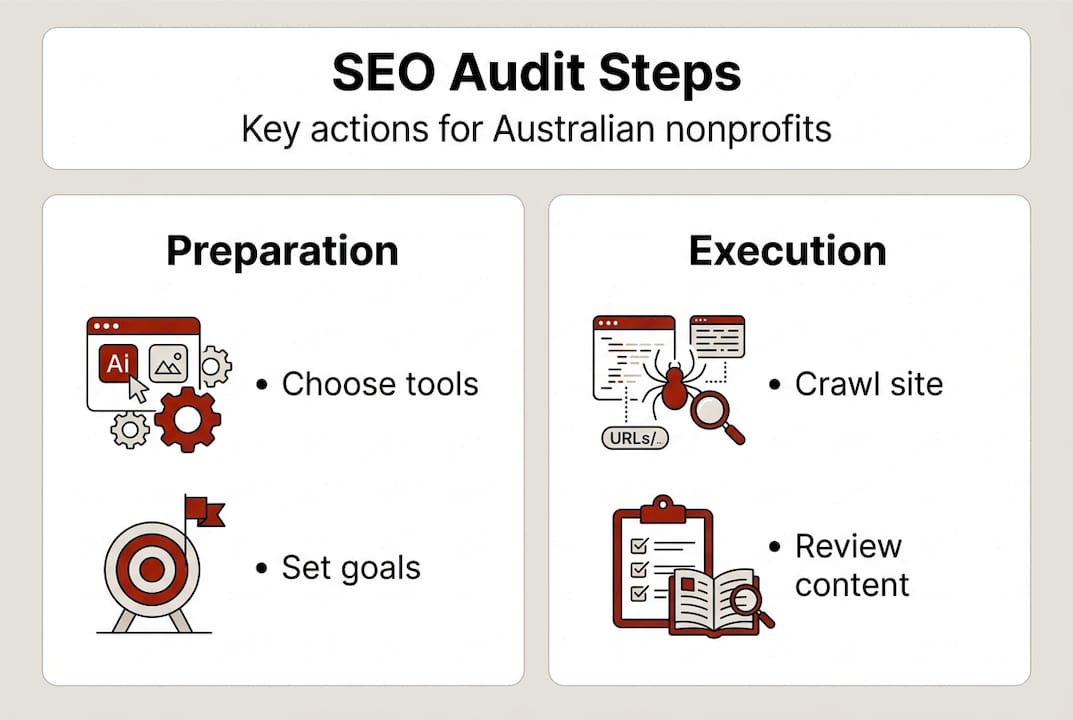
Before running a single crawl or reviewing a single page, it pays to gather the right resources. Approaching an SEO audit without preparation leads to incomplete findings and wasted effort. A clear setup process makes the entire audit more reliable and actionable.
Start by collecting access credentials and baseline data. You will need administrator access to Google Search Console, Google Analytics, and your content management system. Export your current keyword rankings, organic traffic reports, and any existing sitemap files. These form the factual baseline against which audit findings are measured.
The following tools are well suited to nonprofit budgets:
- Google Search Console (free): monitors indexing status, crawl errors, and search performance
- Screaming Frog SEO Spider (free up to 500 URLs): crawls your site for broken links, missing metadata, and redirect chains
- Moz Free Tools: provides domain authority checks and basic keyword data
- Google PageSpeed Insights (free): measures site speed and Core Web Vitals
- Ahrefs Webmaster Tools (free tier): identifies backlink profiles and site health issues
Once tools are in place, set realistic goals. An audit for a small nonprofit site with 50 pages will look different from one covering 500 pages. Define what success looks like before you start, whether that is fixing a set number of broken links, improving page load speed, or increasing indexed pages.
| Audit goal | Recommended tool | Cost |
|---|---|---|
| Crawl errors and broken links | Screaming Frog | Free (up to 500 URLs) |
| Indexing and search performance | Google Search Console | Free |
| Backlink profile | Ahrefs Webmaster Tools | Free tier |
| Page speed | Google PageSpeed Insights | Free |
| Keyword tracking | Moz Free Tools | Free |
Using a structured audit template can streamline the process and ensure nothing is overlooked. Pairing a template with the essential SEO tools listed above gives your team a repeatable, scalable process.
Pro Tip: Create a shared spreadsheet to log every finding as you audit. Assign a priority level (high, medium, low) to each issue so your team can tackle the most impactful fixes first.
Step-by-step technical SEO audit for nonprofits
With tools and data ready, the next phase is the technical audit itself. This is the structural layer of your website. Faults here can prevent search engines from reading your content at all, regardless of how well written it is.
- Check crawlability. Run Screaming Frog across your site and review the crawl report. Look for pages blocked by robots.txt, broken internal links (4xx errors), and redirect chains that slow down page loading.
- Review indexing. In Google Search Console, open the Coverage report. Identify pages marked as “excluded” or “not indexed.” Duplicate content is a common culprit. Use canonical tags to tell search engines which version of a page is the primary one.
- Assess site speed and mobile performance. Run key pages through Google PageSpeed Insights. For nonprofits, lightweight design is both an accessibility and an SEO priority. Compress images, remove unused scripts, and enable browser caching where possible.
- Confirm HTTPS is active. Every page should load securely. Mixed content warnings, where some resources load over HTTP, can undermine trust signals and search rankings.
- Check structured data. Use Google’s Rich Results Test to verify that schema markup is present and valid. Nonprofits benefit from Organisation and Event schema in particular.
“Technical SEO remains the core foundation for online visibility in 2026, especially for nonprofits competing with larger organisations.”
Ethical, transparent SEO practices are essential for the reputation of high-trust organisations. Avoid tactics such as keyword stuffing, hidden text, or manipulative redirects. These may produce short-term gains but carry long-term reputational risks for organisations that depend on public trust.
The Moz technical audit guide provides additional detail on crawl configurations and indexing checks that go beyond the basics.
Pro Tip: After fixing technical issues, resubmit your sitemap via Google Search Console to prompt a fresh crawl. This speeds up the time it takes for corrections to be reflected in search results.
Content and on-page SEO: optimising for search intent and community impact
Technical health is the foundation, but content is what connects your organisation to the people searching for it. On-page SEO covers the elements that appear directly on each page: titles, meta descriptions, headings, and body copy.
Start with your most important pages. For a nonprofit, these are typically the homepage, the about page, donation or volunteer pages, and any programme pages. Review each one against the following checklist:
- Title tag: Is it under 60 characters? Does it include a primary keyword and reflect the page purpose?
- Meta description: Is it under 160 characters? Does it summarise the page value clearly?
- H1 heading: Is there exactly one H1 per page? Does it match the search intent of the target keyword?
- H2 and H3 headings: Do they structure the content logically and include secondary keywords where natural?
- Body content: Is it original, accurate, and aligned with the organisation’s mission? Does it answer the question a visitor is likely to have?
On-page SEO that matches user intent helps mission-driven messages cut through online noise. The goal is not to stuff keywords into every paragraph. It is to ensure that each page clearly communicates what it offers and to whom.
| Weak nonprofit landing page | Strong nonprofit landing page |
|---|---|
| Generic title: “Welcome to our site” | Specific title: “Youth mental health support in Melbourne” |
| No meta description | Clear meta description with call to action |
| Single block of text, no headings | Structured with H1, H2, and bullet points |
| No internal links | Links to related programmes and donation page |
Balancing keywords with accessibility is also important. Use plain language, avoid acronyms without explanation, and ensure content is readable at a broad literacy level. Review on-page SEO steps from Ahrefs for a practical framework to apply across your pages.
Local and ethical SEO: community-first strategies for Australian nonprofits
For Australian nonprofits, local SEO is one of the highest-return activities available. People searching for community services, volunteering opportunities, or local charities are often ready to act. Being visible in those searches directly translates to more support.

Begin with your Google Business Profile. Ensure the name, address, and phone number are accurate and consistent across all platforms. Add photos, a clear description of your services, and your operating hours. Encourage supporters to leave genuine reviews.
Next, build local citations. A citation is any online mention of your organisation’s name, address, and phone number. Consistency across directories improves local search rankings.
Key citation sources for Australian nonprofits include:
- Infoxchange Service Seeker: the primary directory for Australian community services
- Connecting Up: a technology resource hub with nonprofit listings
- Your local council website: many councils list community organisations
- State government service directories: relevant for health, housing, and social services
- Volunteering Australia: for organisations seeking volunteers
Being visible for local intent searches significantly increases the support base for Australian nonprofit organisations. Link-building and citation efforts yield the best results when based on authentic community engagement rather than paid directories or link exchanges.
For Sydney-based organisations, a targeted Sydney local SEO boost can make a measurable difference in suburb-level search visibility. Broader guidance on local SEO for nonprofits outlines how community-focused tactics differ from commercial approaches.
Pro Tip: Ask partner organisations, local councils, or community media outlets to link to your site from their own pages. These earned links carry significant weight in local search rankings and cost nothing beyond the relationship.
What most SEO audit checklists miss for Australian nonprofits
Most generic SEO audit guides focus heavily on technical complexity and assume organisations have access to expensive tools or dedicated SEO staff. For Australian nonprofits, this framing misses the point entirely.
The most impactful audits we have seen from mission-driven organisations are not the most technically sophisticated. They are the ones where the team had a clear understanding of their community’s needs and used that knowledge to guide every decision. A page that answers a genuine community question in plain language will consistently outperform a technically perfect page with no clear purpose.
Another overlooked area is the alignment between SEO goals and organisational values. Nonprofits that chase generic traffic metrics often attract visitors with no connection to their mission. Focusing instead on SEO benefits for community organisations means prioritising the searches that matter: people looking for specific services, local support, or ways to contribute.
Finally, many checklists treat ethical SEO as a footnote. For high-trust organisations, it is central. Transparent practices, accurate content, and genuine community links are not just good ethics. They are the foundation of durable search visibility.
Take your next step: SEO support for progressive organisations
Running a thorough SEO audit takes time, but the results are measurable. Improved rankings, more relevant traffic, and stronger community connections are all within reach for Australian nonprofits that approach the process systematically.
At Marzipan, we work with purpose-driven organisations across Australia to build and maintain search visibility that aligns with their values. Whether you need AI SEO services to accelerate your audit findings, digital marketing support to turn insights into action, or sustainable website options that perform without compromise, we are here to help. Our approach is practical, ethical, and built around your mission. Reach out to explore how we can support your organisation’s next stage of growth.
Frequently asked questions
Why is SEO especially important for Australian nonprofits?
SEO increases online impact for community organisations by ensuring they appear in relevant search results, reaching more supporters, volunteers, and donors without relying solely on paid advertising.
How often should a nonprofit conduct an SEO audit?
Every six to twelve months is recommended. Regular audits help organisations adapt to evolving search engine requirements and maintain consistent visibility over time.
Which free tools can Australian nonprofits use for SEO audits?
Google Search Console, Screaming Frog (free version), and a structured audit template are reliable starting points that require no budget to use effectively.
How does local SEO help Australian charities?
Local SEO increases visibility in location-based searches. Being visible for local searches significantly increases the support base by attracting nearby supporters, volunteers, and community partners.
Recommended
- SEO content workflow for Australian community organisations – Marzipan
- How to conduct an SEO audit for mission-driven sites – Marzipan
- Local SEO solutions for Sydney community groups in 2026 – Marzipan
- What is ethical SEO: a guide for community organisations – Marzipan
- Boost local SEO with strategic UK phone number use in 2026|BM