TL;DR:
- Purpose-led organizations need ethical, community-focused SEO strategies rather than traffic-maximizing approaches.
- Building content clusters, demonstrating expertise, and aligning with community needs improve search visibility ethically.
- Regular workflow reviews and accurate, experience-based content sustain long-term SEO success aligned with organizational values.
Many mission-led organisations in Sydney produce genuinely valuable content, yet their websites remain invisible in search results. The problem is rarely the quality of their work. It is the absence of a structured, values-aligned SEO content strategy. Benefits of website SEO are well documented for commercial businesses, but purpose-driven groups face a different set of challenges. This guide explains what an effective, ethical SEO content strategy actually involves, and how to build one that serves your community without compromising your principles.
Table of Contents
- Why purpose-driven organisations need a distinct SEO approach
- Core elements of an ethical SEO content strategy
- From plan to practice: mapping your SEO content for impact
- Sustaining SEO success: aligning workflow with values
- Why the conventional wisdom on SEO content fails purpose-driven organisations
- Take your purpose-driven SEO to the next level
- Frequently asked questions
Key Takeaways
| Point | Details |
|---|---|
| Prioritise people-first content | Focusing on helpful, original material wins trust and rankings. |
| Build strong topic clusters | Groups of 8-10 themed articles establish authority and avoid overlap. |
| Demonstrate ethical expertise | Use credible experts and cite qualified sources for sensitive topics. |
| Sustain SEO with ongoing reviews | Regular updates and ethical workflows keep your content effective and values-aligned. |
Why purpose-driven organisations need a distinct SEO approach
Most mainstream SEO advice is built around one goal: maximising traffic volume. That approach works for commercial publishers and e-commerce sites where page views translate directly into revenue. For mission-led organisations, however, the logic breaks down quickly. Attracting large numbers of unqualified visitors does not advance a social mission. It consumes resources, distorts impact reporting, and can introduce audiences whose expectations do not match what the organisation offers.
Purpose-driven sites also carry stricter expectations around content quality. Supporters, funders, and community members expect accuracy, transparency, and accountability. A blog post that overpromises or presents unverified claims does not just rank poorly. It damages credibility in ways that are difficult to reverse. Understanding the SEO service provider guidance available for nonprofits helps organisations avoid agencies that chase metrics rather than mission alignment.
There is also a structural mismatch known as intent mismatch. This occurs when the keywords an organisation targets attract visitors who are searching for something different from what the site actually provides. A community legal centre, for example, might rank for a broad legal term but attract people seeking commercial legal services. Those visitors leave immediately, which signals to Google that the content is not useful.
Google’s position on content quality is now very clear. According to Google’s own guidance, people-first content must demonstrate original experience, expertise, authoritativeness, and trustworthiness, and must provide substantial value beyond what competitors offer. This framework, known as E-E-A-T, rewards organisations that genuinely know their subject matter and communicate it honestly.
The key principles for purpose-led SEO are:
- Prioritise accuracy and depth over keyword density
- Align content topics with the real needs of your community audience
- Demonstrate genuine expertise from credentialed or experienced contributors
- Ensure every page serves a clear, researched audience intent
- Maintain ethical standards in how data, case studies, and quotes are used
“Content should be created for people first, and search engines second. Pages written primarily to rank, rather than to inform or assist, consistently underperform in quality assessments.”
With the primary challenge outlined, the next step is to clarify what an effective, ethical SEO content strategy actually involves.
Core elements of an ethical SEO content strategy
Building an SEO content strategy from an ethical foundation requires attention to several interconnected elements. These are not optional extras. They are the structural components that determine whether a site gains lasting authority or remains buried in search results.
1. Theme clustering
A single article on a topic rarely establishes authority. Research shows that small content clusters of fewer than eight to ten pages are generally ineffective at building topical depth. Effective semantic SEO strategies involve grouping eight to ten substantive articles around each core theme. A mental health charity, for instance, might cluster content around anxiety, grief support, community resources, crisis intervention, and practitioner referrals. Each article reinforces the others, and collectively they signal to Google that the site has genuine depth on the subject.
2. Originality and experience-led content
E-E-A-T content is not just well-written. It demonstrates real experience. This means including case studies from the organisation’s actual work, quotes from staff or community members, specific data from local programmes, and practical examples drawn from genuine situations. Generic advice written by someone with no connection to the field scores poorly under Google’s quality standards. Organisations should feature named authors with verifiable credentials wherever possible.

3. Avoiding keyword cannibalisation
Keyword cannibalisation occurs when multiple pages on the same site target the same or very similar search terms. Google cannot determine which page to rank, so it often ranks neither. Assigning a unique keyword focus to each page, and mapping those assignments clearly in a content plan, prevents this problem. Sustainable SEO for organisations requires this kind of structured discipline from the outset, not as a retrofit after problems emerge.
4. Minimising filler and intrusive elements
Pages that are padded with repeated information, excessive advertising, or content that does not serve the reader’s actual question are rated lower by Google’s quality reviewers. For mission-driven organisations, this is particularly relevant. Filler dilutes a site’s credibility signal and reduces the reader’s trust. Every paragraph should earn its place by adding specific, useful information.
5. YMYL content standards
YMYL stands for “Your Money or Your Life.” Google applies heightened scrutiny to content that could affect a reader’s health, financial situation, legal standing, or personal safety. Many community organisations operate squarely in YMYL territory: legal aid, mental health support, financial counselling, disability services. For these topics, content must be written by credentialed experts or reviewed and endorsed by them. Anonymous content or content written by unqualified staff in these areas carries real ranking risk.
Pro Tip: Before publishing any YMYL content, document the credentials of your reviewer or author and display that information clearly near the article. This transparency supports both E-E-A-T assessment and community trust.
A well-structured SEO content workflow brings all of these elements together in a repeatable process that organisations can sustain without specialist knowledge at every step.
From plan to practice: mapping your SEO content for impact
Translating strategy into action requires a content map. This is a structured record of every page and planned article on the site, along with the intent each piece serves, the keyword focus it holds, and the topic cluster it belongs to. Without this map, organisations often publish content reactively, creating overlaps and gaps that undermine authority.
The process for building a content map involves several steps:
- Audit existing content for gaps, overlaps, and outdated information
- Assign a clear search intent category to each page: informational, navigational, or transactional
- Group pages into topic clusters with a defined pillar page at the centre
- Identify missing cluster articles and schedule their creation
- Flag any pages where intent mismatch causes ranking failure so they can be rewritten or consolidated
Writing SEO-friendly copy is not simply a matter of inserting keywords. It requires understanding what a user is actually trying to accomplish when they type a query, then structuring content so it satisfies that need directly and completely.
The table below compares people-first and traffic-first content approaches in practice:
| Element | People-first strategy | Traffic-first strategy |
|---|---|---|
| Primary goal | Serve audience need | Maximise page views |
| Keyword use | Contextual and natural | High density and forced |
| Author credentials | Displayed and verifiable | Often anonymous |
| Content depth | Thorough and specific | Broad and generic |
| Update frequency | When information changes | When rankings drop |
| YMYL handling | Expert reviewed | Often unvetted |
| Community trust | Builds over time | Frequently erodes |
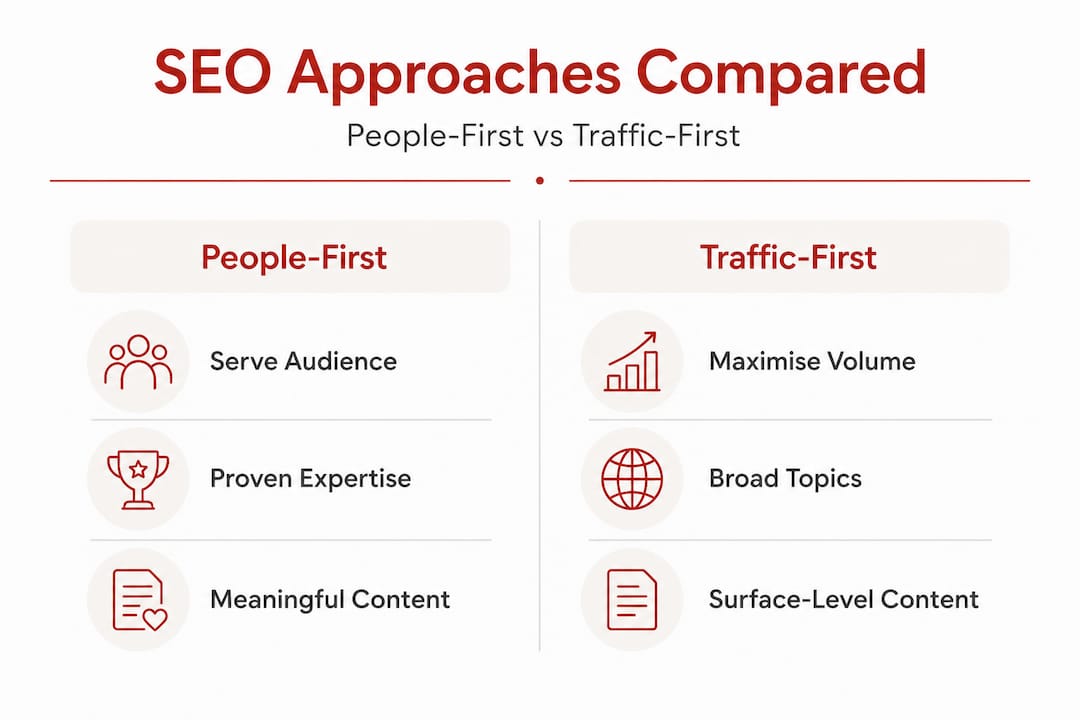
Understanding SEO traffic risks for Sydney CBOs is equally important. Community-based organisations in Sydney operate in a specific local context, and strategies designed for national or commercial audiences often produce poor results when applied without adaptation. Local intent, community language, and sector-specific terminology all need to be factored into the content map from the start.
With a plan mapped out, the critical next step is setting up a workflow that supports ongoing, ethical execution.
Sustaining SEO success: aligning workflow with values
A one-time content strategy is not enough. Search algorithms update regularly. Community needs shift. Information becomes outdated. Sustaining SEO success requires a structured workflow that organisations return to consistently.
The table below shows an example workflow for a Sydney-based nonprofit:
| Task | Frequency | Owner | Notes |
|---|---|---|---|
| Content performance review | Monthly | Digital coordinator | Track rankings, traffic, and conversions |
| Article accuracy check | Quarterly | Programme lead | Update statistics, links, and contact details |
| New cluster article publication | Fortnightly | Content writer | Follow content map and intent brief |
| YMYL content expert review | Per publication | Credentialed reviewer | Document reviewer credentials |
| Keyword cannibalisation audit | Every six months | SEO lead | Merge or redirect overlapping pages |
| E-E-A-T compliance check | Annually | Senior staff | Assess author bios and source quality |
Conducting regular SEO audit steps for nonprofits ensures that issues are caught early rather than accumulating into larger ranking problems.
Artificial intelligence tools are increasingly part of the content creation landscape. Google’s position is clear: AI-generated content is acceptable when it is carefully edited for quality and accuracy, but bulk production of low-quality AI content constitutes scaled abuse and attracts penalties. For mission-driven organisations, AI can be a legitimate efficiency tool for drafting outlines, generating initial research summaries, or producing first drafts that experienced staff then edit and verify. It should not be used to replace expertise or to publish without meaningful human review.
Tracking performance also requires metrics that reflect mission, not just rankings. Alongside standard measures such as organic traffic and keyword positions, purpose-driven organisations should track:
- Time on page for key community resources
- Conversion rate for volunteer sign-ups or service referrals
- Return visitor rate for community members
- Engagement with YMYL content by qualified audiences
Understanding how to make SEO-friendly websites is foundational to all of this. Technical factors such as page speed, mobile responsiveness, structured data, and internal linking structure all affect how well content performs, regardless of its quality.
Pro Tip: Set a recurring calendar reminder every three months to review your ten most-visited pages. Update any statistics, replace broken links, and verify that the content still reflects your organisation’s current programmes and values.
Why the conventional wisdom on SEO content fails purpose-driven organisations
Most SEO advice circulating online is written for businesses whose primary measure of success is revenue. Traffic volume equals income potential. Content quantity signals authority. Ranking positions determine commercial viability. These assumptions do not transfer to the purpose-driven sector, and applying them without adjustment produces predictable results: high bounce rates, audience mismatch, and a slow erosion of the credibility that mission-led organisations depend upon.
Volume-chasing approaches are particularly damaging for community organisations. Publishing large quantities of thin, generic content to capture keyword positions might generate short-term traffic, but it signals to both Google and to real readers that the site lacks genuine depth. Readers who arrive expecting detailed, trusted guidance and find generic articles leave immediately. That exit behaviour further suppresses rankings, creating a cycle that is difficult to reverse without significant remediation work.
There is also a compounding value in demonstrated expertise that most organisations underestimate. A well-researched, experience-led article published today continues to accumulate authority over months and years, as it earns backlinks, generates return visits, and attracts citations from other credible sources. A cluster of ten such articles on a single topic creates a body of work that is genuinely difficult for competitors to replicate quickly. Semantic SEO for ethical sectors builds this kind of defensible, long-term authority rather than chasing short-term positions that shift with every algorithm update.
The organisations that consistently perform well in search are those that treat their content as an extension of their mission, not as a separate marketing function. They write for their community first, structure for search engines second, and review for accuracy as a non-negotiable standard. That discipline, applied consistently over time, produces rankings that hold even through significant algorithm changes, because the content genuinely deserves to rank.
Take your purpose-driven SEO to the next level
Marzipan works with mission-led organisations in Sydney to build SEO content strategies that are ethical, evidence-based, and aligned with community impact goals. The approach combines structured content planning, E-E-A-T compliance, and sustainable workflows that organisations can manage without constant external support.
Whether your organisation needs a full digital marketing strategy, support with AI-informed SEO implementation, or a sustainable website design that performs in search from day one, Marzipan offers practical, values-aligned services built specifically for the community sector. Reach out to discuss an audit, a content strategy session, or full implementation support tailored to your organisation’s goals and capacity.
Frequently asked questions
What is E-E-A-T and why does it matter for purpose-driven organisations?
E-E-A-T stands for Experience, Expertise, Authoritativeness, and Trustworthiness. Google uses these criteria to assess whether content meets the people-first standard required for strong, lasting rankings.
Is AI-generated content acceptable for ethical SEO?
Yes, provided it is carefully edited for quality and accuracy by knowledgeable staff. Google’s guidance confirms that AI-generated content produced for scaled, low-quality output is penalised, while well-edited AI-assisted content is treated equally to human-written work.
How can small nonprofits avoid keyword cannibalisation?
Assign each page a unique keyword focus and group related topics into clearly defined clusters. Research confirms that keyword cannibalisation from overlap between pages directly causes ranking failures, particularly for sites with limited domain authority.
Why should YMYL content be written by experts?
Google applies heightened quality standards to content that could affect health, finances, or safety. YMYL topics require expert sources to meet the authoritativeness and trustworthiness thresholds that determine ranking eligibility in those categories.
What does people-first content mean in practice?
It means structuring every piece of content around what the audience genuinely needs to know, rather than what ranks well in isolation. People-first content prioritises real-world value, accurate information, and a satisfying reader experience over traffic volume or ad revenue.
Recommended
- Semantic SEO explained: ethical strategies for mission-driven organisations – Marzipan
- Why sustainable SEO matters for mission-driven organisations – Marzipan
- How ethical strategies shape the future of SEO for 2025 – Marzipan
- SEO services for small businesses: ethical strategies for 2026 – Marzipan
- SEO best practices: practical strategies for higher rankings
- How Content Marketing Supports Better SEO Results