TL;DR:
- Sustainable SEO focuses on long-term growth through quality content, technical health, and authority building.
- Black-hat tactics pose high risks of penalties, damaging trust and causing long-term disruptions for mission-driven organizations.
- Consistent, authentic efforts in content, technical SEO, and genuine link-building ensure resilient online visibility.
Many organisations believe that a few quick fixes will move them to the top of Google overnight. That assumption leads to wasted budgets, short-lived results, and sometimes serious penalties. For mission-driven organisations in Australia, where public trust and credibility are central to everything, the risks of chasing shortcuts are particularly high. This guide sets out what sustainable SEO actually involves, why it aligns with the values of purpose-led organisations, and how to apply it in practical steps. The goal is to give you a clear, evidence-based framework that supports long-term online visibility without compromising your mission.
Table of Contents
- What makes SEO sustainable?
- Principles and best practices for sustainable SEO
- The role of E-E-A-T and ethical consistency
- Practical application: Steps for mission-driven organisations
- Our take: Why sustainable SEO future-proofs your impact
- Take the next step with sustainable SEO
- Frequently asked questions
Key Takeaways
| Point | Details |
|---|---|
| Long-term focus wins | Sustainable SEO relies on consistent quality, technical health, and trust—not shortcuts. |
| Quality over quantity | Prioritising a few high-impact pages provides more stability than excessive, thin content. |
| Align with core values | Mission-driven organisations benefit most by linking ethical SEO to their purpose and transparency. |
| E-E-A-T matters | Demonstrating expertise and trust is crucial for search visibility under 2026 standards. |
| Practical steps count | Regular audits and targeted improvements create sustainable results for Australian organisations. |
What makes SEO sustainable?
Sustainable SEO refers to a set of practices that build online visibility steadily over time, rather than seeking rapid gains through methods that may violate search engine guidelines. As one industry source explains, sustainable SEO strategies prioritise consistent content updates, technical health, and authority building that withstand algorithm changes. The emphasis is on creating genuine value for users, not on manipulating rankings.
This stands in direct contrast to short-term or black-hat SEO tactics. Black-hat SEO (a term for practices that violate search engine guidelines) includes methods such as keyword stuffing, buying links, and cloaking content (showing different content to search engines than to users). These approaches may produce a brief rise in rankings, but they carry significant risk. Search engines including Google regularly update their algorithms, and sites relying on manipulative tactics are frequently penalised or removed from results altogether.
The core pillars of sustainable SEO can be summarised as follows:
- Content quality: Publishing accurate, relevant, and original material that genuinely addresses user needs.
- Technical health: Ensuring the website loads quickly, functions correctly on mobile devices, and meets accessibility standards.
- Authority building: Earning links and mentions from credible, relevant sources through legitimate means.
- Consistency: Maintaining a steady schedule of improvements rather than sporadic bursts of activity.
The contrast between sustainable and short-term approaches is stark:
| Factor | Sustainable SEO | Short-term/black-hat SEO |
|---|---|---|
| Timeline | 6 to 12 months for results | Days to weeks |
| Risk level | Low | High (penalties, deindexing) |
| Content approach | Original, high-quality, user-focused | Thin, duplicate, keyword-stuffed |
| Link building | Earned through genuine value | Purchased or manipulated |
| Algorithm resilience | Strong | Fragile |
| Trust signals | Builds over time | Erodes with penalties |
“Sustainable SEO success really involves consistent content updates, technical health, and authority building that withstand algorithm changes.” This principle applies regardless of organisation size or sector.
For mission-driven and nonprofit organisations, the relevance of sustainable SEO for mission-driven organisations is particularly pronounced. These organisations depend on community trust, and any association with deceptive practices can cause lasting reputational damage. Equally, because many operate with limited budgets, investing in practices that deliver durable returns is far more cost-effective than repeatedly recovering from penalties or restarting failed campaigns. Learning more about ethical SEO for community organisations can help teams understand the specific standards that apply to their context.
Principles and best practices for sustainable SEO
With the foundations defined, what daily and strategic actions deliver long-term, ethical SEO results? The answer lies in a set of well-established principles that, when applied consistently, produce compounding improvements over time.
Consistent, high-quality content publishing is the most impactful action most organisations can take. Search engines reward sites that regularly add new, well-structured content that answers real questions. This does not mean publishing for the sake of volume. Post-2026 algorithm updates have made it clear that scaled thin content is actively penalised, with unique data and genuine depth required on every page. A community health charity, for example, should publish detailed guides on local services, staff expertise, and real outcomes rather than short, generic posts.
Technical SEO health is often overlooked by smaller organisations, yet it has a direct impact on rankings and user experience. Key technical factors include:
- Page load speed: Pages that take longer than three seconds to load see significantly higher abandonment rates.
- Mobile usability: Google uses mobile-first indexing, meaning it primarily assesses the mobile version of a site.
- Structured data: Marking up content with schema (a form of structured data that helps search engines understand page content) improves how results appear in search.
- Accessible design: Meeting Web Content Accessibility Guidelines (WCAG) benefits both users and search engine crawlers.
Running a regular SEO audit for nonprofits helps organisations identify and prioritise technical issues before they affect rankings. Many technical problems accumulate gradually and are only noticed when traffic drops.

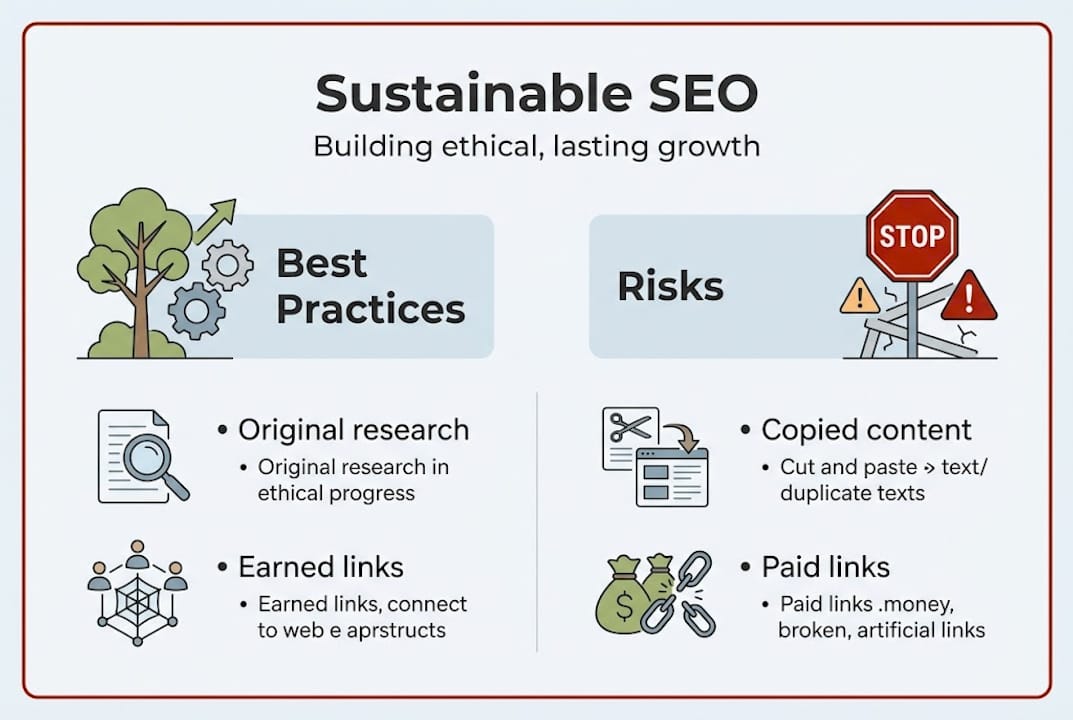
Authority and trust building requires earning links from credible external sources. This can be achieved through publishing original research, collaborating with partner organisations, contributing to industry publications, and earning media coverage. Each legitimate inbound link acts as a signal to search engines that the site is credible and relevant.
| Healthy practice | Outdated or risky tactic |
|---|---|
| Publishing original research and data | Copying or spinning competitor content |
| Earning links through genuine partnerships | Buying links from link farms |
| Optimising page speed and accessibility | Ignoring technical errors for months |
| Using structured data correctly | Keyword stuffing in meta tags |
| Updating outdated content regularly | Publishing and abandoning pages |
Pro Tip: Before publishing any new page, confirm that it adds something not already covered on your site. Duplicate or near-duplicate pages cannibalise each other’s rankings. Understanding how to create SEO-friendly websites from the outset reduces the need for costly rework later.
Avoiding penalties is as important as building positive signals. Black-hat shortcuts can lead to manual actions from Google, with recovery periods of three to six months or longer. For an organisation whose community relies on finding them online, that kind of interruption is not merely an inconvenience but a genuine operational risk.
The role of E-E-A-T and ethical consistency
Next, let’s explore the deeper ethical standards and signals powering search success in 2026. Google’s E-E-A-T framework (Experience, Expertise, Authoritativeness, and Trustworthiness) has become central to how search quality is evaluated, particularly for sites covering topics with real-world consequences.
E-E-A-T is not a direct ranking factor in the technical sense, but it shapes the quality rater guidelines that inform how Google’s systems are trained. Organisations that demonstrate genuine expertise and transparency perform better in search, particularly in sectors such as health, finance, legal services, and community support. The framework expanded from E-A-T to E-E-A-T in late 2022 to include “Experience”, recognising that first-hand knowledge adds credibility that book-learning alone cannot provide.
For mission-driven organisations, E-E-A-T plays out in specific ways:
- Experience: Sharing real case studies, client outcomes, and staff perspectives demonstrates that the organisation has hands-on knowledge.
- Expertise: Author credentials, qualifications, and clear attribution of content to named individuals strengthen authority signals.
- Authoritativeness: Coverage by reputable local or national media, citations from government sources, and partnerships with established bodies all reinforce this signal.
- Trustworthiness: Clear privacy policies, accessible contact information, transparent funding disclosures, and honest communication about limitations all contribute to trust.
Contextual E-E-A-T varies by query risk. A community arts organisation faces different standards than a health services provider, but both benefit from applying the same principles of transparency and authentic expertise.
Semantic SEO for ethical brands supports E-E-A-T by structuring content around topic clusters rather than isolated keywords. This means covering a subject thoroughly across interlinked pages, which signals depth of knowledge rather than surface-level coverage. An organisation focused on housing support, for instance, might publish interconnected pages covering eligibility, application processes, local resources, and frequently asked questions.
Aligning SEO with brand values is not simply an ethical choice. It is a practical one. Organisations that are transparent, consistent, and honest in their online presence build the kind of trust that translates to repeat visits, shares, and referrals. These behavioural signals contribute indirectly to search performance. Knowing how to select an ethical SEO service provider is itself a values-aligned decision that shapes long-term outcomes.
Pro Tip: Assign named authors with genuine credentials to all published content. A byline with a brief biography and relevant qualifications strengthens E-E-A-T signals significantly, particularly for health and community welfare topics.
The post-2026 algorithm environment makes clear that thin content penalties are real and enforceable. Scaled production of generic articles using AI tools without genuine editorial input or unique data now carries measurable risk. Organisations that have invested in authentic, well-attributed content are in a stronger position than those who relied on volume.
Practical application: Steps for mission-driven organisations
Now, bring these concepts together with a practical, actionable checklist for your organisation. The following steps apply specifically to Australian mission-driven organisations working with limited resources and high accountability.
-
Conduct a site audit. Start with a technical review using tools such as Google Search Console or a third-party audit platform. Identify broken links, slow-loading pages, missing meta descriptions, and mobile usability errors. Fixing these foundational issues creates a stable platform for further work.
-
Identify your highest-impact pages. Rather than trying to improve everything at once, focus on the pages most likely to attract relevant visitors. For most organisations, these are service pages, about pages, and key resource guides. Prioritising fewer high-intent pages over volume is consistently recommended in the 2026 algorithm environment.
-
Consolidate overlapping content. If your site has multiple pages covering similar topics, consider merging or redirecting them. Content cannibalisation (where multiple pages compete for the same search terms) dilutes authority. Consolidation concentrates ranking signals on a single, stronger page.
-
Establish a content calendar. Commit to a realistic publishing schedule, whether that is weekly, fortnightly, or monthly. Consistency matters more than frequency. Each new piece should address a specific audience question and link naturally to existing pages.
-
Monitor and adapt. Set up regular reporting on organic traffic, keyword positions, and page performance. Review this data monthly and adjust the strategy based on what is working. Avoid reacting to every algorithm update; instead, focus on maintaining the core pillars of quality and technical health. Understanding the benefits of website SEO for communities helps teams maintain focus on outcomes that matter.
-
Build external authority incrementally. Reach out to partner organisations, local councils, and industry bodies for legitimate linking opportunities. Contribute guest content to relevant publications. Encourage satisfied community members or partner organisations to mention and link to your resources.
Consider a hypothetical example: a community legal centre in regional New South Wales wants to improve its search visibility. They begin by auditing their site and finding several duplicate service pages and three broken links. They consolidate the duplicate pages into one comprehensive guide, fix the broken links, and then publish a monthly Q and A article written by their solicitors. Within six months, they see measurable growth in organic visitors to their key service pages. The approach is not complicated, but it is consistent and grounded in genuine value.
Pro Tip: When reviewing keyword performance, look for terms where your site ranks between positions 5 and 15. These are strong candidates for targeted improvement, since a modest gain in position can produce a substantial increase in click-through rates. Applying ethical ranking improvement practices keeps this process aligned with long-term goals.
Our take: Why sustainable SEO future-proofs your impact
There is a pattern worth noting among organisations that pursue quick SEO wins. Initially, results seem promising. Rankings move, traffic ticks up, and the approach seems justified. Then an algorithm update arrives, or a manual review flags a problem, and months of work are erased. Recovery is slow, costly, and demoralising.
For mission-driven organisations, the stakes are higher than for commercial businesses. Community members searching for legal aid, mental health support, housing assistance, or food relief need to find accurate, trustworthy information. If an organisation is deindexed or penalised, those people may turn to less reliable sources.
Sustainable, transparent SEO produces the opposite dynamic. Authority accumulates gradually. Each piece of quality content, each technical improvement, and each legitimate link adds to a foundation that becomes more resilient over time. Ethical SEO growth is slower at first, but the compounding effect means that organisations who start early and stay consistent build advantages that are genuinely difficult to replicate. The organisations most committed to impact are, by design, the best positioned to benefit from this approach. Their values and their SEO strategy point in the same direction.
Take the next step with sustainable SEO
Sustainable SEO is not a one-time project. It is an ongoing commitment to quality, transparency, and relevance, and it rewards organisations that treat it that way.
At Marzipan, we work with purpose-driven organisations across Australia to build and maintain SEO strategies that reflect their values and deliver measurable results. Whether you are starting from scratch or looking to improve an existing approach, our digital marketing services are designed for high-trust organisations that cannot afford to cut corners. We also offer sustainable web design that supports strong technical SEO from the ground up. For organisations wanting to apply the latest tools responsibly, our AI-informed SEO services combine innovation with ethical practice.
Frequently asked questions
What distinguishes sustainable SEO from traditional SEO?
Sustainable SEO centres on long-term value, prioritising consistent quality and technical reliability over rapid results. As research confirms, long-term SEO strategies focused on content quality and authority building are far more resilient to algorithm changes than short-lived tactics.
Why should mission-driven organisations avoid black-hat SEO shortcuts?
Black-hat tactics risk site penalties that result in months of lost visibility, a period of disruption that is particularly damaging for organisations that rely on community trust. According to current guidance, black-hat penalties typically require three to six or more months to recover from.
How has Google’s 2026 update changed sustainable SEO approaches?
The 2026 update places significantly greater weight on unique, high-quality content and contextual expertise. Scaled thin content and generic AI-produced material now face active demotion, making authentic, well-attributed content the clear standard.
What are the first steps for implementing sustainable SEO?
Begin with a site audit to identify technical issues, then prioritise high-intent pages for focused improvement. Establish a consistent content schedule and set up monitoring to track progress over time.