

TL;DR:
- Community organizations often remain invisible online due to unoptimized copy.
- Effective SEO copywriting enhances visibility, trust, and aligns with community values.
- Avoid common pitfalls by focusing on authentic, impact-driven content that matches audience intent.
Many community organisations in Australia produce thoughtful, mission-driven content that simply never gets found online. Their websites exist, their work is real, but generic or unoptimised copy leaves them invisible in search results at the exact moment a community member is looking for support. SEO-friendly copywriting, written with clarity and aligned to organisational values, changes that. This guide explains what SEO copy means for the community sector, what you need before you start, and how to write, check, and improve it step by step.
Table of Contents
- Understanding SEO copywriting for community organisations
- What you need to get started: SEO copy essentials and planning
- Step-by-step: How to write SEO-friendly copy for your organisation
- How to check your work: SEO copy verification and improvement
- What most organisations get wrong about SEO-friendly copy
- How Marzipan can help your organisation grow online
- Frequently asked questions
Key Takeaways
| Point | Details |
|---|---|
| Prioritise search intent | Always write to answer your audience’s questions clearly and up front. |
| Showcase organisational impact | Embed meaningful stories and trust factors to align SEO with your mission. |
| Avoid keyword stuffing | Focus on topics, related terms, and overall clarity—not awkward repetitions. |
| Always review for E-E-A-T | Check for expertise, experience, authority, and trust before publishing. |
Understanding SEO copywriting for community organisations
SEO-friendly copy is writing that helps search engines understand what a page is about while remaining clear and useful to the people reading it. For community organisations, this means writing that matches what your audience is actually searching for, uses plain language, and reflects your values rather than imitating commercial marketing.
The community sector has specific realities that shape how SEO copy should work. Budgets are limited, so every page needs to earn its place. Audiences are diverse, including service users, volunteers, donors, and government partners. Trust is essential. Copy that sounds sales-driven or hollow will push people away, and it will also underperform in search results, where search intent matching is now a core ranking factor.
Ethical, readable copy matters for nonprofits precisely because your credibility depends on it. People searching for community services are often in vulnerable situations. Clear, honest writing builds confidence that your organisation can actually help.
One practical method worth adopting early is the inverted pyramid. This means front-loading the most important answer or information at the top of a page, then providing supporting detail below. It matches how people read online and how search engines assess relevance.
The SEO benefits for community sector organisations go well beyond traffic. Good SEO copy increases the visibility of causes, services, and events that genuinely need to reach people.
Key qualities of SEO-friendly copy for community organisations include:
- Clarity: plain language that any community member can understand
- Intent-matching: copy that answers the actual question being searched
- Readability: short paragraphs, subheadings, and active voice
- Impact storytelling: real outcomes and community experiences over abstract mission statements
- Structured formatting: logical use of headings so search engines and readers both follow easily
‘SEO copywriting is not just for commercial gain; for community organisations, it’s about visibility for causes that matter most.’
Approaching SEO for mission-driven websites with this community-first lens is what separates effective nonprofit copy from generic content.
What you need to get started: SEO copy essentials and planning
With the purpose and value of SEO copy clear, here is everything a community group needs before drafting.
Before writing a single word, organisations need a clear picture of who they are writing for, what they stand for, and what resources they have available. Skipping this stage leads to copy that is generic, inconsistent, or misaligned with community needs.
Here are the typical prerequisites for getting started:
- A clearly documented organisational mission and values
- An agreed editorial voice and tone guide
- Staff or volunteer capacity to research, write, and review
- Access to a content management system (CMS) for publishing
- Basic keyword and topic research tools
- Existing content or a content gap audit
| Resource | Purpose | Example tools |
|---|---|---|
| CMS | Publish and update pages | WordPress, Squarespace |
| Keyword tool | Identify search topics | Google Search Console, Ubersuggest |
| Style guide | Keep tone consistent | Internal document or AP/sector guide |
| Analytics | Track what is working | Google Analytics 4 |
| Accessibility checker | Ensure content is inclusive | WAVE, Axe |
Once the basics are in place, keyword planning should take an entity-first approach. Rather than targeting isolated phrases, semantic SEO strategies build lists of related topics, people, places, and concepts that reflect your work. For example, an organisation supporting older adults might cluster topics around aged care, social connection, home support services, and volunteer programmes. Entity-first language and comprehensive topic coverage outperforms narrow keyword stuffing in modern search.
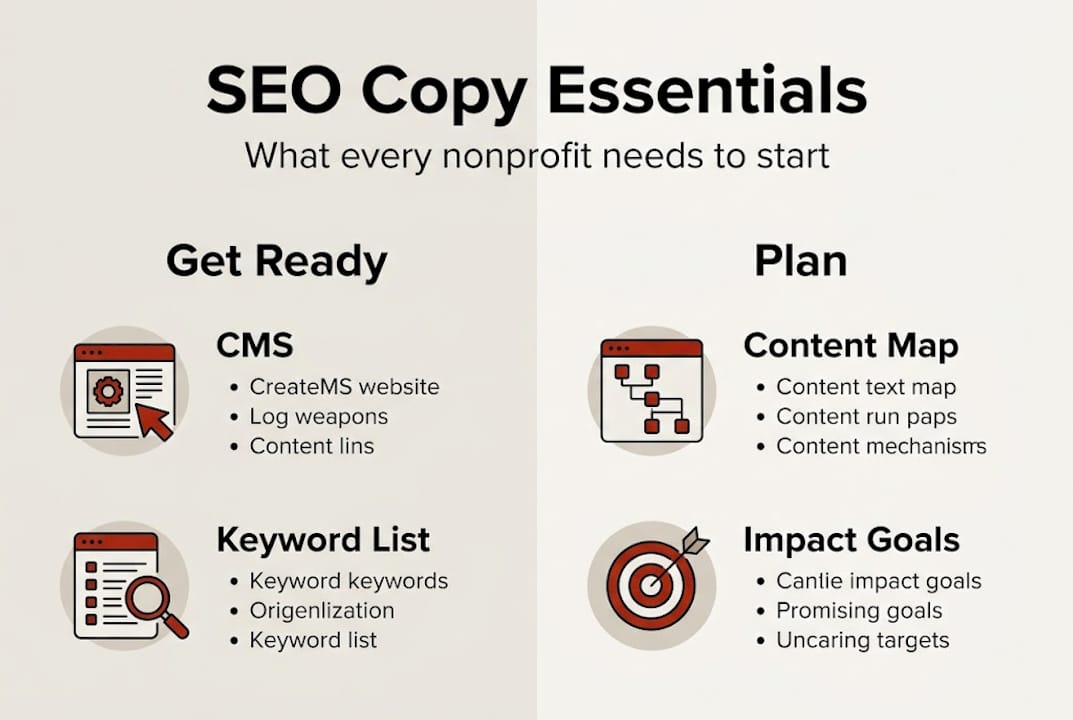
This approach also helps you build a content plan that mirrors your impact goals, not just what gets clicks.
Pro Tip: Always start with outcomes. Ask what questions community members in your area are searching for right now, and build your topic list from those real needs rather than internal jargon.
A well-planned SEO content workflow keeps writing consistent and reduces the time spent reworking copy later.
Step-by-step: How to write SEO-friendly copy for your organisation
Preparation in hand, it is time to put theory into practice with these steps.
- Research search intent: Identify what your audience is actually looking for. Are they seeking information, directions to a service, or a way to get involved?
- Outline using H2 and H3 headings: Map your page structure before writing. Headings tell search engines and readers what each section covers.
- Draft your introduction with the answer up front: Use the inverted pyramid. State the most important point in the first two sentences.
- Integrate keywords and entities naturally: Weave topic terms into the copy where they fit, without forcing them.
- Add impact stories: Include a real outcome, a beneficiary quote, or a local statistic to ground the content in lived experience.
- Format for easy reading: Use structured headings, short paragraphs, and bullet points to improve readability and scannability.
- Review for non-salesy tone: Read the draft aloud. If it sounds like an advertisement rather than a trusted community voice, revise it.
Here is a comparison of two approaches to the same content:
| Approach | Example |
|---|---|
| Keyword-stuffed | “Our aged care services provide aged care support for all aged care needs in Sydney aged care.” |
| Entity-first, impact-focused | “Our home support programme connects older Sydneysiders with trained volunteers for regular companionship and practical help.” |
The second example reads naturally, includes meaningful entities, and reflects the organisation’s actual impact. Nonprofits benefit from impact storytelling rather than salesy copy because it builds the trust that both readers and search engines now reward.

Pro Tip: Whenever possible, include a direct quote from someone your organisation has supported, alongside a local statistic. This adds credibility and differentiates your content from generic sector pages.
For further guidance on applying these steps, the SEO copy for mission impact resource covers practical examples. You can also review ethical SEO guidance for nonprofits before finalising your draft.
How to check your work: SEO copy verification and improvement
Having drafted your copy, verification is just as essential. Here is how to review and improve before publishing.
Publishing without a structured review process is one of the most common ways community organisations undermine their SEO efforts. Even a simple checklist applied by a staff member or volunteer can significantly improve quality and consistency.
When reviewing SEO copy, check for the following:
- Clarity: Can someone unfamiliar with your organisation understand the page in under a minute?
- E-E-A-T signals: Does the page demonstrate experience, expertise, authority, and trustworthiness? Author bios, cited sources, and firsthand experience all contribute to this.
- Tone: Is the writing community-focused and non-salesy throughout?
- Impact focus: Does the page centre real outcomes and community benefit rather than organisational self-promotion?
- Original value: Does the page offer something a reader cannot find on ten other sites?
Practical ways to embed trust signals include adding a short author bio to blog posts, linking to credible sector sources, and referencing firsthand programme outcomes. These steps support E-E-A-T, a framework Google uses to assess content quality.
‘SEO copy for nonprofits should demonstrate trust and impact, not just search ranking skills.’
Improvement is also an ongoing process. Set a reminder to update statistics and links every six to twelve months. Invite feedback from service users or community partners on whether your web content answered their questions. A regular SEO audit for nonprofits helps identify which pages need refreshing and which are already performing well.
An ethical SEO review also ensures your practices remain aligned with your values as the digital landscape changes.
What most organisations get wrong about SEO-friendly copy
Once you have mastered the mechanics, it is important to avoid common pitfalls and rethink some traditional advice.
The most persistent mistake is treating SEO copy as a technical exercise. Organisations focus on keyword counts, meta tags, and page speed while neglecting the one thing that actually builds long-term search visibility: writing that reflects genuine community knowledge and real outcomes.
AI writing tools are useful for drafts and research, but generic content produced without local context or lived experience will not differentiate a community organisation from thousands of similar pages. Search engines, particularly following recent updates, increasingly reward mission-driven SEO success built on authentic expertise.
Conventional advice still circulates telling organisations to focus on keyword density. That approach is obsolete. What matters now is demonstrating that your organisation has direct, credible experience with the issues your community faces. Write for people first. Search algorithms are secondary. An organisation that writes honestly about what it does, for whom, and with what result will outperform one that optimises copy for machines.
How Marzipan can help your organisation grow online
Equipped with the right strategy, you may want expert support to fast-track your SEO impact.
Marzipan works specifically with mission-led organisations that want to grow online without compromising their values. We understand nonprofit realities: limited budgets, diverse audiences, and the need for copy that builds genuine trust rather than chasing clicks.
Our sustainable web rebuilds and digital marketing for community groups are designed to deliver measurable impact. We combine ethical SEO, performance-driven content strategy, and a deep understanding of the Australian community sector to help your organisation reach the people who need you most. If your current website is not working as hard as your team is, we can help change that.
Frequently asked questions
What is the most important element of SEO-friendly copy for a community organisation?
Matching your audience’s intent and writing with clear structure matters most. Use short paragraphs, headings, and a community-focused voice to ensure your content performs well for both readers and search engines.
Should nonprofits target specific keywords or broader topics?
Focus on broader topics, including related keywords and entities, to demonstrate expertise and trust. Entity-first language and comprehensive topic coverage outperforms narrow keyword targeting in current search environments.
How can we make sure our copy aligns with our mission and values?
Highlight real outcomes, use community stories, and review for tone before publishing. Nonprofits benefit from impact storytelling because it keeps SEO efforts aligned with core community purpose.
What are common mistakes when writing SEO copy for nonprofits?
Overusing keywords, imitating commercial sites, and neglecting readability or storytelling are the most frequent errors. Keyword density is obsolete; focus on semantics, structure, and genuine community value instead.